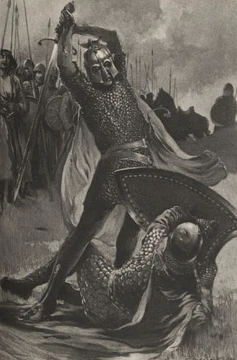
Väinämöinen
Demigod hero and central figure in Finnish folklore and the Kalevala.

Väinämöinen is a central figure in Finnish folklore, a demigod and hero who also serves as the protagonist of Elias Lönnrot’s national epic, the *Kalevala*. He is portrayed as an elderly, wise man whose singing voice carries potent magical power. Early literary sources, such as Mikael Agricola’s 1551 list of Tavastian gods, refer to him as the deity of chants, songs, and poetry.
The name itself is often linked to the Finnish words *väinä* (stream pool) or *väineä* (slow). Janne Saarikovi has suggested a possible connection to early Germanic forms of Odin’s name, where *wātenos* might have been borrowed into Proto-Karelian as *vätnä* or *väinä*, and the name Auðunn could be compared to Äinemöinen.
In mythology, Väinämöinen is a shaman-like hero, a *tietäjä* with secret knowledge and magical abilities, and the most skilled singer. He is also depicted as a warrior in some Ostrobothnian runic songs, wielding both sword and smithing skills. His birth is rarely described, but one Ostrobothnian song says he was born from the Maiden of the North, impregnated by a sea giant; another names his father as Kaleva, though the epic often leaves his parentage unspecified. He is sometimes called a son of the giant Kaleva, who according to Christfried Ganander had twelve sons, including Ilmarinen, Hiisi, Soini, Liekiöinen, and Kihovauhkonen. Joukahainen is occasionally named as his brother, though not in all versions.
Regional variations shape his stories. In Ostrobothnia, he tries to propose to the Air Maiden (Ilmatar), builds a boat as her task, and accidentally hurts his knee, causing a wound that bleeds. He also creates the kantele and plays it so beautifully that goddesses come to listen. His journey to the underworld Tuonela is common in Karelia but absent from Ostrobothnia, where he instead travels to Pohjola. In Savonia, his myths include creating the kantele, the knee injury, a singing battle with Joukahainen, stealing the sampo, and visiting the dead shaman Antero Vipunen. He is sometimes credited with forging a golden maiden, though Ilmarinen usually fills that role, and he is seen as the ruler of water. In Karelia, he is involved in world creation: shot into the sea, he lies with his knee above water; a bird lays an egg there, and when he moves, the egg breaks to form the earth and sky. His element is water, and he shapes the seafloor.
Quick Facts
- Symbol
- Water, sword and paddle
- Ethnic Group
- Finns, Karelians
Facts from the source article.
Lore & Background
Väinämöinen is first mentioned in literature in a 1551 list of Tavastian gods by Mikael Agricola, where he is said to have forged the chants. He is described as a shaman hero and mythical tietäjä with magical abilities and secret knowledge. In various regional traditions, he is involved in the birth of the world, such as in a Karelian myth where a bird lays an egg on his knee, and the broken egg forms the earth and sky. He is also known for creating and playing the kantele, and for a runic singing battle with Joukahainen, whom he sings into a bog.
Väinämöinen's adventures include attempting to propose to the Air Maiden (Ilmatar), building a boat, and accidentally hurting his knee, which bleeds. He travels to the underworld Tuonela in some versions, and in others to Pohjola. He communicates with the dead shaman Antero Vipunen to learn magic words. A medieval runic song tells of a child accusing Väinämöinen of killing his father, not incest.
Reader's Guide
Väinämöinen's significance lies in his role as the central figure of Finnish folklore and the Kalevala, embodying the archetype of the wise, magical hero. He represents the power of song and poetry, as his singing can create, transform, and defeat enemies. His myths span creation, shamanic journeys, and moral lessons, reflecting the values and worldview of pre-Christian Finnish culture. The variations in his stories across regions—Ostrobothnia, Savonia, Karelia, Kainuu—show the fluidity of oral tradition and the adaptation of myths to local contexts. His departure from Finland after the arrival of Christianity symbolizes the transition from pagan to Christian era. Väinämöinen's legacy endures as a national symbol of Finnish identity and artistic inspiration, influencing literature, music, and art. The unresolved disputes in the source—such as whether his departure meant death or continued existence—preserve the mystery and depth of his character.
Did You Know?
- Väinämöinen is described as having a potent, magical singing voice and is considered the god of chants, songs, and poetry.
- In a Karelian myth, a bird lays an egg on Väinämöinen's knee, and the broken egg forms the earth and sky.
- Väinämöinen is sometimes said to be blind and is often unlucky in fishing and courting.
- Some runic singers believed Väinämöinen sailed into a whirlpool and died, while others thought he still lives and will return.
Frequently Asked Questions
Who is Väinämöinen?
He is an elderly, wise demigod who anchors Finnish folklore and serves as the main hero of Elias Lönnrot's Kalevala. In older literary records, such as Mikael Agricola's 1551 inventory of Tavastian deities, he appears as the god of song, chant, and poetry.
What are Väinämöinen's magical abilities?
His voice is his greatest weapon: his singing can conjure the world into being, summon creatures, and shape matter through pure vocal power. He is also the mythic inventor of the kantele, the stringed instrument central to Finnish music.
What is Väinämöinen's role in the Kalevala?
He functions as both the epic's protagonist and its narrative engine, using his songcraft to drive the plot from cosmogony to the great forges. His wisdom and verses set the stage for nearly every major event in the poem.
Why is Väinämöinen significant in Finnish culture?
He personifies the Finnish oral tradition and the sacred power of music and poetry, linking modern national identity to pre-Christian myth. As the beating heart of the Kalevala, he remains a defining symbol of Finnish heritage and artistic spirit.
More in Mythological swordfighters 1-18
Spotted an error? Know more?
Reader corrections go straight into our review queue. Suggest an edit · How this site is sourced