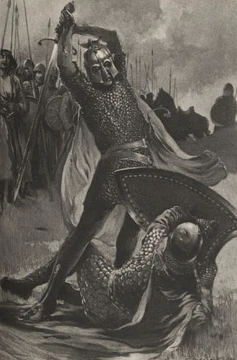
Susanoo-no-Mikoto
A wild, heroic kami of storms, sea, and agriculture.

Susanoo-no-Mikoto is a kami (deity) in Japanese mythology, known as the younger brother of Amaterasu, the sun goddess and mythical ancestress of the Japanese imperial line. He is a multifaceted figure with contradictory characteristics, portrayed variously as a wild, impetuous god associated with the sea and storms, a heroic serpent-slayer, or a local deity linked with harvest and agriculture. Alongside Amaterasu and the earthly kami Ōkuninushi, Susanoo is one of the central deities of the imperial Japanese mythological cycle recorded in the Kojiki (c. 712 CE) and the Nihon Shoki (720 CE).
Quick Facts
- God Of
- God of the sea, storms, and fields
- Script Name
- Japanese
- Cult Center
- Susa Shrine / Yaegaki Shrine / Suga Shrine / Kumano Taisha / Susanoo Shrine · ja · 素盞嗚神社 / Hikawa Shrine / Yasaka Shrine / Hiromine Shrine / Tsushima Shrine
- Consort
- Kushinadahime / Kamuōichihime / Samirahime
- Parents
- Izanagi (ja · Kojiki) / Izanagi and Izanami (ja · Nihon Shoki)
- Siblings
- Amaterasu / Tsukuyomi / (and others)
- Children
- Munakata goddesses / Ōtoshi / Ukanomitama / (and others)
- Texts
- ja · Kojiki / ja · Nihon Shoki / ja · Izumo Fudoki / ja · Sendai Kuji Hongi
Facts from the source article.
Lore & Background
Susanoo's birth is described in the Kojiki as occurring when Izanagi washed his nose after visiting Yomi; in the Nihon Shoki, he is born to Izanagi and Izanami after the creation of the Japanese archipelago. He was appointed ruler of the seas, but his incessant crying and wailing caused mountains to wither and rivers to dry up, leading his father to expel him. Before leaving, Susanoo ascended to Takamagahara to bid farewell to Amaterasu, but his arrival shook the land. To prove his sincerity, he proposed a trial by pledge (ukehi), in which both gods chewed and spat out objects carried by the other, producing three goddesses from Amaterasu's sword and five male deities from Susanoo's magatama beads.
Reader's Guide
Susanoo's significance lies in his central role in the imperial mythological cycle, particularly his interactions with Amaterasu, which explain the origin of key deities and the cycle of light and darkness. His destructive behavior—ruining Amaterasu's rice fields, defecating in her palace, and flaying a heavenly horse—led to her hiding in the Ama-no-Iwato, plunging the world into darkness, and his subsequent expulsion from heaven. This myth underscores themes of chaos and order, and Susanoo's multifaceted nature reflects the integration of local and regional cults into the imperial pantheon. The Fudoki of Izumo Province links him to western Japan, suggesting a regional connection. Syncretic beliefs of the Gion cult later conflated him with deities of pestilence and disease, showing his adaptability across religious traditions. His legacy endures as a complex deity embodying both destructive and heroic forces.
Did You Know?
- Susanoo's name may derive from the verb susabu meaning 'to be impetuous' or 'to go wild.'
- In the Kojiki, Susanoo was born when Izanagi washed his nose after visiting the underworld.
- He was punished by the eight-hundred myriad deities with a fine of a thousand tables of restitutive gifts and had his beard and nails cut off.
- The Fudoki of Izumo Province contains short legends about Susanoo or his children, suggesting a connection to that region.
Frequently Asked Questions
Who is Susanoo-no-Mikoto?
Susanoo-no-Mikoto is a major kami in Japanese mythology, depicted as the youngest child of the creator god Izanagi and the younger brother of the sun goddess Amaterasu. He appears as a central figure in both the Kojiki (c. 712 CE) and the Nihon Shoki (720 CE), the two oldest surviving records of Japanese myth.
What domains and powers is Susanoo-no-Mikoto associated with?
He is most commonly linked to the sea, storms, and untamed natural forces, though later traditions also connect him to harvest, agriculture, and even pestilence. His character is deliberately contradictory—he can be a destructive, impetuous force or a heroic protector depending on the passage.
Why is Susanoo-no-Mikoto important in Japanese mythology?
Together with Amaterasu and Ōkuninushi, he forms the triad of central deities in the imperial mythological cycle, and his conflict with his sister triggers the famous episode of Amaterasu hiding in a cave. His narrative also provides the origin story for the sacred sword Kusanagi, one of Japan's three imperial regalia.
What sword is Susanoo-no-Mikoto famous for?
He extracted the blade Ame-no-Murakumo-no-Tsurugi (commonly called Kusanagi) from the tail of the serpent Yamata no Orochi after slaying it. This sword later became one of the three sacred treasures symbolizing the Japanese imperial line.
More in Mythological swordfighters 1-18
Spotted an error? Know more?
Reader corrections go straight into our review queue. Suggest an edit · How this site is sourced