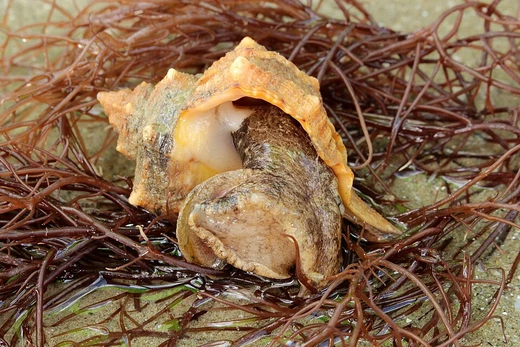
Vokesimurex
A genus of marine gastropod mollusks in the family Muricidae.

Vokesimurex is a genus of sea snails, specifically marine gastropod mollusks belonging to the family Muricidae—the group commonly known as murex snails or rock snails. The genus includes many living species as well as fossil forms, found in a range of marine habitats. Among its species are *Vokesimurex aliquantulus*, *V. anniae*, *V. bayeri*, *V. bazarutensis*, *V. blakeanus*, *V. bobyini*, *V. cabritii*, *V. chrysostoma*, the fossil †*V. coulsoni*, *V. danilai*, *V. dentifer*, *V. dolichourus*, *V. donmoorei*, *V. elenensis*, *V. gallinago*, *V. garciai*, *V. hamanni*, *V. hirasei*, *V. kiiensis*, *V. lividus*, *V. malabaricus*, *V. messorius*, *V. micropurdyae*, *V. mindanaoensis*, *V. multiplicatus*, the fossil †*V. nasongoensis*, *V. olssoni*, *V. parkrynieensis*, *V. purdyae*, *V. rectaspira*, *V. rectirostris*, *V. recurvirostris*, *V. rubidus*, *V. ruthae*, *V. sallasi*, *V. samui*, *V. sobrinus*, *V. tricoronis*, *V. tryoni*, the fossil †*V. wanneri*, *V. woodringi*, and *V. yuhsiuae*. Several names once considered separate species are now treated as synonyms: *V. bellegladeensis* is a junior subjective synonym of *V. sallasi*; *V. bellus* is a synonym of *V. chrysostoma*; *V. coriolis* is now regarded as a subspecies, *V. dentifer coriolis*; *V. lindajoycae* is a synonym of *V. anniae*; *V. morrisoni* is a synonym of *V. bellegladeensis*; and *V. tweedianus* has been moved to the genus *Haustellum* as *Haustellum tweedianum*.
Quick Facts
- Taxon
- Vokesimurex
- Type Species
- Murex messorius / Sowerby II, 1841
Facts from the source article.
Lore & Background
The genus Vokesimurex was established to accommodate a group of murex snails previously placed in other genera. Species within the genus exhibit a range of shell morphologies, often with elaborate spines and varices characteristic of the Muricidae. The genus includes both living species and fossil taxa, such as Vokesimurex coulsoni and Vokesimurex wanneri, indicating a long evolutionary history.
Many species were originally described under different genera and later reassigned to Vokesimurex. For example, Vokesimurex anniae was originally described as Murex anniae by M. Smith in 1940, and Vokesimurex chrysostoma was originally described by G.B. Sowerby II in 1834. The genus also contains several species named after collectors and malacologists, such as Vokesimurex purdyae and Vokesimurex ruthae.
Taxonomic revisions have resulted in some species being placed into synonymy. For instance, Vokesimurex bellegladeensis is considered a junior subjective synonym of Vokesimurex sallasi, and Vokesimurex bellus is a synonym of Vokesimurex chrysostoma. The species Vokesimurex tweedianus has been transferred to the genus Haustellum.
Reader's Guide
The genus Vokesimurex represents a significant component of the muricid fauna, with species distributed across tropical and subtropical seas. Its members are often collected for their ornate shells, which display a variety of colors and sculptural features. The genus includes both shallow-water and deeper-dwelling species, contributing to its ecological diversity.
Taxonomic work on Vokesimurex has been ongoing, with new species described as recently as 2021, such as Vokesimurex bazarutensis and Vokesimurex parkrynieensis. The genus also includes fossil species from the Miocene and Pliocene, providing insights into the evolutionary history of the group. The synonymy of several species reflects the challenges in distinguishing closely related forms.
The comprehensive treatment by Houart in 2014, 'Living Muricidae of the world. Muricinae. Murex, Promurex, Haustellum, Bolinus, Vokesimurex and Siratus,' serves as a key reference for the genus. Vokesimurex remains a subject of interest for malacologists and shell collectors alike, with ongoing discoveries and taxonomic refinements.
Did You Know?
- The genus Vokesimurex includes both living and fossil species, such as Vokesimurex coulsoni and Vokesimurex wanneri.
- Vokesimurex tweedianus was transferred to the genus Haustellum as Haustellum tweedianum.
- Several species within Vokesimurex were originally described under different genera, such as Vokesimurex anniae originally described as Murex anniae.
- New species of Vokesimurex were described as recently as 2021, including Vokesimurex bazarutensis and Vokesimurex parkrynieensis.
More in Murex Snails 1-24
Spotted an error? Know more?
Reader corrections go straight into our review queue. Suggest an edit · How this site is sourced