Dicathais
Monotypic genus of predatory sea snails found in Australia and New Zealand.

Dicathais is a genus of predatory sea snails, specifically marine gastropod molluscs belonging to the family Muricidae, commonly known as rock snails. This genus contains just one species: *Dicathais orbita*, often called the white rock shell or cart-rut shell, which lives along the coasts of Australia and New Zealand.
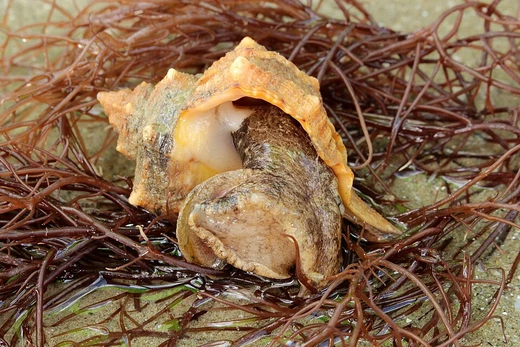
The white rock shell has a large, sturdy shell that typically measures about 6 centimeters in length, though it can occasionally reach twice that size. Its shell sculpture varies greatly depending on where it is found. In eastern Australia, each whorl has seven to nine deep, indented ribs separated by similarly wide grooves, with additional fine riblets on the surface. This creates a fluted edge on the lip, and the grooves are visible on the shell’s interior. The central column, or columella, is smooth, and the inside of the shell is white.
In western Australia, the shell features a row of distinct nodules instead of ridges, and the lip is not indented. In southern Australia, the ridges are much less pronounced, and the lip is nearly smooth. These different forms were once thought to be separate species, but it is now known that the variations in sculpture result from different living conditions. For example, specimens from New South Wales with deep ridges were kept in a still-water aquarium for three years; during that time, the new shell growth first became shallowly indented and later turned smooth.
The shell’s color is generally creamy white or grey, often with a thin yellowish line around the edge of the lip. Juveniles have thinner shells and are frequently brown.
This snail is abundant in the intertidal and sublittoral zones, living on rocks and among seaweed around the coasts of Australia (New South Wales, Queensland, South Australia, Tasmania, Victoria, and Western Australia), New Zealand, the Kermadec Islands, and Lord Howe Island.
The white rock shell is a predator, cannibal, and scavenger. It uses its radula to bore a hole into the shell of a barnacle or mollusc, then sucks out the contents. Its prey includes the sea snails *Lunella torquata*, *Cronia avellana*, and *Pyrene bidentata*, as well as the mussel *Septifer bilocularis*. As the tide rises, it makes foraging trips up the beach, traveling far from the sheltered crevices where it retreats at low tide.
Quick Facts
- Genus
- Dicathais
- Species
- orbita
Facts from the source article.
Lore & Background
The white rock shell shows great variation in its shell sculpture across its range. In eastern Australia there are seven to nine deeply indented ribs in each whorl with clefts of a similar width between them, sculptured with further fine riblets, giving a fluted edge to the lip. The central column or columella is smooth and the interior of the shell is white. The western Australian form has a row of well marked nodules rather than ridges and an unindented lip, while the southern Australian form has much less distinct ridges and a nearly smooth lip. At one time these different forms were thought to be distinct species, but it has now been established that the variations in sculpture are a function of different living conditions. Specimens gathered from New South Wales with deep ridges were kept in a still water aquarium for three years, during which time the new shell growth was at first shallowly indented and later was smooth. Juveniles have thinner shells and are often brown.
The white rock shell is a predator, cannibal and scavenger. It uses its radula to bore a hole in the shell of a barnacle or mollusc and then sucks out the contents. As the tide rises, it makes foraging expeditions up the beach, travelling far away from the sheltered niches to which it retreats at low tide. This is in contrast to the mulberry whelk Morula marginalba, which shares the same habitat but remains in an area where there are both crevices in which to hide and prey species on which to feed.
The sexes are separate. The eggs that develop in the female gonoduct are wrapped in a number of membranes to form an egg capsule. Several of these are joined together in an egg mass and attached to the substrate. Different precursors of the pigment Tyrian purple have been found in the male and female gonoducts and in the egg capsule. Early development of the larvae takes place inside the capsule, which contains yolk granules on which they feed. When they have developed to the veliger stage, the larvae emerge from the capsule and become planktonic. After drifting with the currents, they settle on the seabed, undergo metamorphosis and become juvenile snails.
Reader's Guide
The white rock shell is notable for its remarkable shell plasticity, which historically led to the misclassification of its regional forms as separate species. The demonstration that aquarium conditions could alter shell sculpture—from deeply indented to smooth—confirmed that environment, not genetics, drives these differences. This species also contributes to the study of Tyrian purple, as precursors of this historic dye have been found in its gonoducts and egg capsules. Ecologically, it is a significant intertidal predator and scavenger, preying on barnacles and molluscs including Lunella torquata, Cronia avellana, Pyrene bidentata, and the mussel Septifer bilocularis. Its foraging behavior, ranging far from low-tide refuges, contrasts with that of the sympatric mulberry whelk Morula marginalba. The species is plentiful across a wide geographic range encompassing Australia, New Zealand, the Kermadec Islands, and Lord Howe Island, making it a common subject for studies of marine gastropod biology and adaptation.
Did You Know?
- The white rock shell is also known as the cart-rut shell.
- Specimens kept in a still water aquarium for three years grew smooth shell instead of the typical deeply indented ridges.
- Juveniles have thinner shells and are often brown, unlike the creamy white or grey adults.
Frequently Asked Questions
Who is Dicathais?
Dicathais is a one-species genus of predatory sea snail in the rock-snail family Muricidae, represented by the single member Dicathais orbita, commonly nicknamed the white rock shell or cart-rut shell. It is a marine gastropod native to the coastal waters of Australia and New Zealand.
What does Dicathais look like?
The shell is a robust, rounded form that typically reaches around six centimetres in length, though specimens can occasionally double that. Its colour is usually a creamy white or pale grey, sometimes marked by a faint yellowish stripe along the lip margin, and the surface sculpture shifts noticeably between eastern Australian and other populations.
What are Dicathais's powers or role?
As a voracious predator, Dicathais bores clean holes through the shells of barnacles and other molluscs to reach their soft tissue. It is also a cannibal and an opportunistic scavenger, giving it a remarkably flexible feeding strategy for a rock-dwelling snail.
Where does Dicathais live?
You can find Dicathais clinging to rocks and weaving through seaweed in both the intertidal and sublittoral zones along the coasts of New South Wales, Queensland, South Australia, Tasmania, Victoria, and Western Australia. Its range also extends to New Zealand, the Kermadec Islands, and Lord Howe Island.
Why is Dicathais important?
As a top-level invertebrate predator on rocky shores, Dicathais helps regulate populations of barnacles, small molluscs, and other invertebrates in its habitat. Its presence also signals a healthy, structurally complex intertidal community, making it a useful indicator species for coastal ecologists.
More in Murex Snails 1-24
Spotted an error? Know more?
Reader corrections go straight into our review queue. Suggest an edit · How this site is sourced