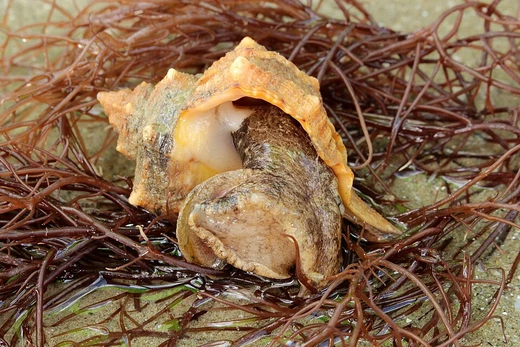
Thais (gastropod)
A genus of predatory sea snails in the family Muricidae.

Vengolis · CC BY-SA 4.0
Thais is a genus of medium to large predatory sea snails, marine gastropod molluscs in the family Muricidae. They are sometimes known by the common names dog winkles or rock shells, and possess an operculum.
Quick Facts
- Taxon
- Thais
Facts from the source article.
Lore & Background
The genus Thais includes a number of species, such as Thais ambustulata, Thais dayunensis, Thais nodosa, Thais pseudodiadema, and Thais tricolorata. A fossil species, † Thais demissa, is also recognized. Many taxa originally placed in Thais have since been reassigned to other genera, resulting in an extensive list of synonyms. For example, Thais aculeata is now Tylothais aculeata, Thais alouina is Mancinella alouina, and Thais aperta is Drupa aperta. Other former members have been moved to genera such as Reishia, Indothais, Menathais, Stramonita, Vasula, Nucella, Neorapana, Acanthais, Thaisella, Semiricinula, and Tylothais. This taxonomic revision reflects ongoing work in malacology to refine the classification within the Muricidae.
Reader's Guide
The genus Thais has served as a taxonomic hub for many muricid snails, with numerous species originally described under this name later transferred to other genera. This history of synonymy highlights the complexity of gastropod systematics and the importance of revisiting earlier classifications. The genus itself remains recognized for several extant species and at least one fossil form. Its common names, dog winkles and rock shells, are used in field guides and regional treatments. The extensive synonymy list documents the work of many malacologists over two centuries, from Linnaeus to modern researchers. While the genus is no longer as broad as once thought, it remains a valid taxon within the Muricidae, and its species continue to be studied for their ecological roles as predators in marine environments. The references by Vaught (1989) and Gofas et al. (2001) provide systematic context, while field guides such as Abbott & Morris (1995) and Macpherson & Gabriel (1962) offer accessible identification resources.
Did You Know?
- The genus includes the fossil species † Thais demissa from 1930.
- Many former Thais species are now placed in genera such as Reishia, Indothais, and Mancinella.
- Thais lapillus, the dog whelk, is now classified as Nucella lapillus.
Taxonomy & Identity
Murex trapa, commonly known as the rare-spined murex, belongs to the family Muricidae, a group of marine gastropod molluscs colloquially referred to as rock snails. As a sea snail, it occupies a well-defined place within the broader class of gastropods, sharing its lineage with thousands of other shelled marine invertebrates. The species epithet trapa distinguishes it from its numerous muricid relatives, while its common name highlights the relatively sparse arrangement of spines that characterizes its shell. Within the Muricidae, this species represents one of many fusiform, spined forms that have long attracted the attention of conchologists and shell collectors. Its classification as a demersal organism ties it to the seafloor community, where it interacts with a variety of invertebrate prey. The taxonomic placement underscores both its evolutionary heritage and its ecological niche among the rocky and sandy substrates of the tropical and subtropical Indo-Pacific.
Geographic Range
The rare-spined murex enjoys a remarkably broad distribution across the tropical and subtropical waters of the Indian Ocean and the western Pacific. Its range stretches from the islands of Madagascar and the Mascarene group eastward through the southeastern coast of India and the island of Sri Lanka. Further along, populations are documented in the Andaman Sea, the waters surrounding southern Indonesia, the Philippine archipelago, the coastal waters of Taiwan, and as far north as southern Japan. This extensive span indicates a species well adapted to a variety of local conditions within the warm, shallow marine environments of the Indo-Pacific. The presence of Murex trapa across such a wide arc of coastlines and island chains suggests strong dispersal capabilities, likely aided by larval stages carried by ocean currents. For shell collectors and marine biologists working in any of these regions, the species represents a recognizable and relatively common member of the local benthic fauna.
Shell Architecture
The shell of Murex trapa is a striking example of fusiform design, reaching lengths between fifty and one hundred twenty-four millimetres, with diameters ranging from eight to twenty-one millimetres. Its overall form is club-shaped, featuring a notably acute spire and prominent spiral ridges that wrap around the whorls. The surface coloration typically presents as light brown or blue-gray, with the spines often carrying a yellowish-brown tint. One of the most distinctive features is the body whorl, which bears three spiny varices—raised, toothed ridges that add to the shell's rugged texture. The aperture takes on a lenticular, or lens-like, shape, bordered by a white interior margin while the inner surface displays a deep red-brown hue. The outer lip of the aperture is crenulated, giving it a scalloped edge. Extending from the base is a straight, moderately long siphonal canal measuring roughly thirteen to forty-seven millimetres, along whose basal half three to four short spines are positioned. Together, these elements create a shell that is both architecturally complex and visually distinctive among its muricid kin.
Ecological Role
In its natural sandy, demersal habitat, the rare-spined murex functions as an active predator within the benthic food web. Rather than passively filtering or scavenging, it hunts and feeds primarily on other molluscs and barnacles, placing it in a predatory niche among the seafloor invertebrate community. This feeding strategy is consistent with the robust, muscular body typical of muricid snails, which use a radula and digestive enzymes to bore through the shells of their prey. The preference for barnacles and fellow molluscs suggests that Murex trapa occupies a mesopredatory role, helping to regulate populations of these sessile and slow-moving organisms in sandy environments. Its demersal lifestyle, combined with a relatively wide geographic range, means the species contributes to nutrient cycling and trophic structure across a broad swath of Indo-Pacific coastal ecosystems. Understanding its predatory habits also provides context for how shell morphology—particularly the strong, spined architecture—may serve both defensive and functional purposes in its ecological interactions.
Gallery

Frequently Asked Questions
What is Thais (gastropod)?
Thais is a genus of predatory sea snails that fall under the marine gastropod mollusc category. They are members of the family Muricidae, the same lineage that includes murex snails.
What do Thais (gastropod) snails eat?
Members of this genus are active hunters that prey on other marine organisms. Their carnivorous feeding strategy is a defining characteristic of the group.
What are the common names for Thais (gastropod)?
Shell collectors and coastal enthusiasts often call these snails dog winkles or rock shells. Both nicknames point to their preference for rocky shoreline habitats.
How large are Thais (gastropod) snails?
They span the medium-to-large size range among gastropods. Despite their considerable bulk, they remain effective predators in open marine settings.
Does Thais (gastropod) have an operculum?
Yes, these snails carry a hard operculum that seals the shell aperture when the animal withdraws. This plate serves as a protective barrier in their marine environment.
More in Murex Snails 1-24
Spotted an error? Know more?
Reader corrections go straight into our review queue. Suggest an edit · How this site is sourced