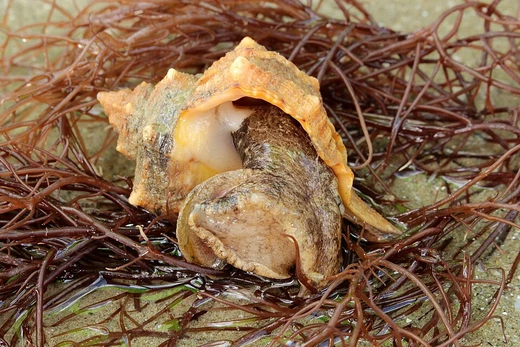
Pterynotus
A genus of murex snails with many reclassified former members.

Röding, 1798 · CC0
Pterynotus is a genus of sea snails, marine gastropod mollusks that belong to the subfamily Muricinae within the family Muricidae, a group known as murex snails or rock snails. Its classification within the family is considered incertae sedis. The genus contains both living species and fossil species, and its taxonomy has undergone many reclassifications and synonymizations.
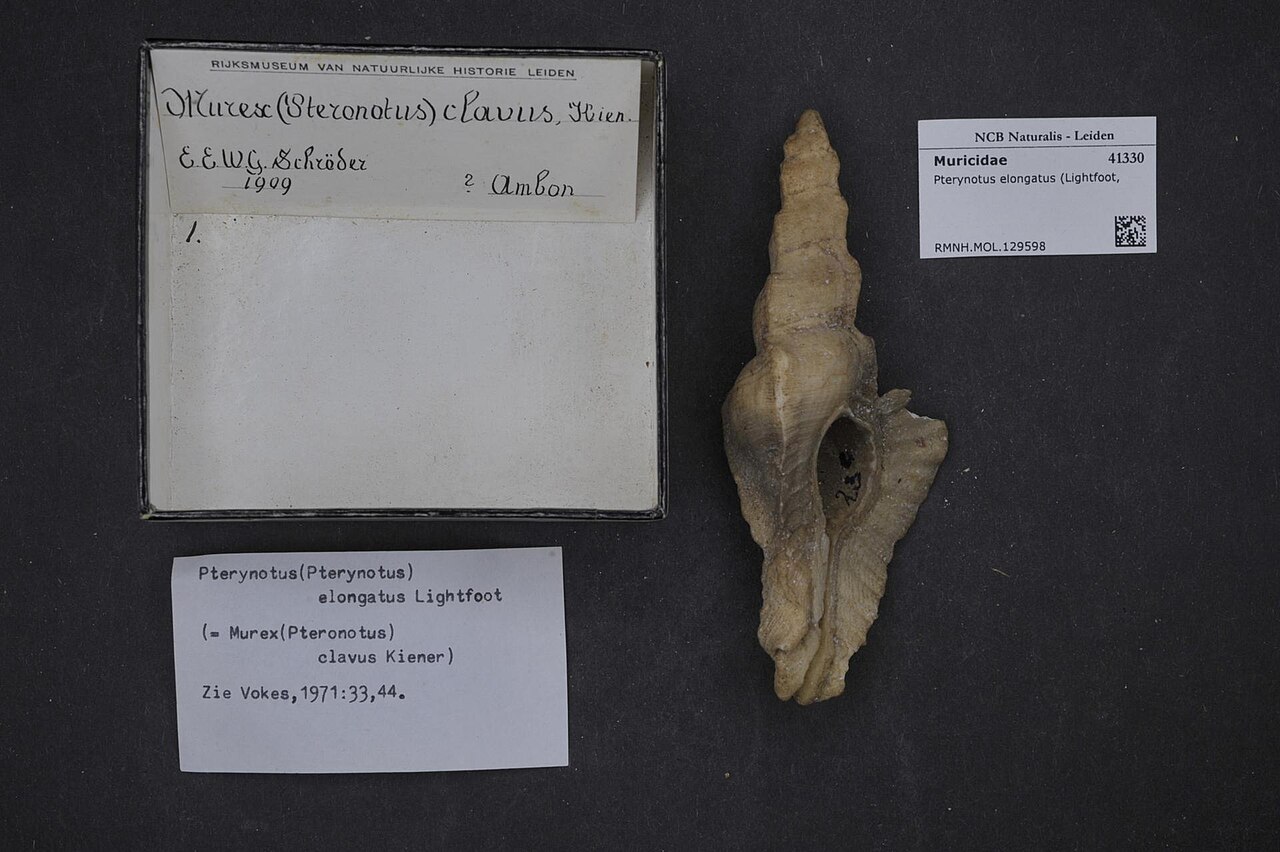
The following species are currently recognized in the genus Pterynotus: Pterynotus alatus, Pterynotus albobrunneus, Pterynotus aparrii, †Pterynotus aurorae, Pterynotus barclayanus, Pterynotus bibbeyi, Pterynotus bipinnatus, Pterynotus bouteti, †Pterynotus canhami, †Pterynotus defensus, †Pterynotus denudatus, Pterynotus elaticus, Pterynotus elongatus, †Pterynotus fusoides, †Pterynotus gaasensis, †Pterynotus granuliferus, Pterynotus laurae, Pterynotus martinetana, Pterynotus patagiatus, Pterynotus pellucidus, †Pterynotus pelouatensis, †Pterynotus poustagnacensis, †Pterynotus rembangensis, †Pterynotus robustus, †Pterynotus sabinola, †Pterynotus sandbergeri, †Pterynotus subquadrifrons, and Pterynotus tripterus.
Many former species have since been reclassified or synonymized. For example, Pterynotus acanthopterus, Pterynotus akation, Pterynotus angasi, Pterynotus atlantideus, Pterynotus bednalli, †Pterynotus bifrons, Pterynotus brianbaileyi, Pterynotus bushae, Pterynotus celinamarumai, Pterynotus cerinamarumai, Pterynotus concavopterus, †Pterynotus contabulatus, Pterynotus crauroptera, †Pterynotus crenulatus, †Pterynotus didymus, Pterynotus duffusi, Pterynotus emilyae, †Pterynotus falsiornatus, Pterynotus fernandezi, Pterynotus flemingi, Pterynotus fulgens, Pterynotus gambiensis, Pterynotus gouldi, Pterynotus guesti, Pterynotus guillei, Pterynotus havanensis, †Pterynotus kaiparaensis, Pterynotus leucas, Pterynotus levii, Pterynotus lightbourni, Pterynotus loebbeckei, Pterynotus macleani, Pterynotus maraisi, Pterynotus marshalli, †Pterynotus micropterus, Pterynotus miyokoae, Pterynotus norfolkensis, Pterynotus orchidiflorus, Pterynotus phaneus, Pterynotus phillipsi, Pterynotus phyllopterus, Pterynotus pinnatus, Pterynotus pinniger, †Pterynotus pseuderinaceus, Pterynotus purpureus, Pterynotus radwini, Pterynotus richeri, Pterynotus rubidus, and †Pterynotus sondeianus have all been moved to other genera or made synonyms of other species.
Quick Facts
- Taxon
- Pterynotus
- Type Species
- Murex pinnatus / Swainson, 1822
Facts from the source article.
Lore & Background
The genus Pterynotus was established within the Muricidae, a family of predatory marine gastropods known for their ornate shells. Many species originally placed in Pterynotus have since been reclassified into other genera such as Timbellus, Pterochelus, Chicoreus, and Purpurellus, reflecting ongoing taxonomic refinement. The genus includes both living and fossil species, with fossil representatives dating from the Eocene to the Pliocene.
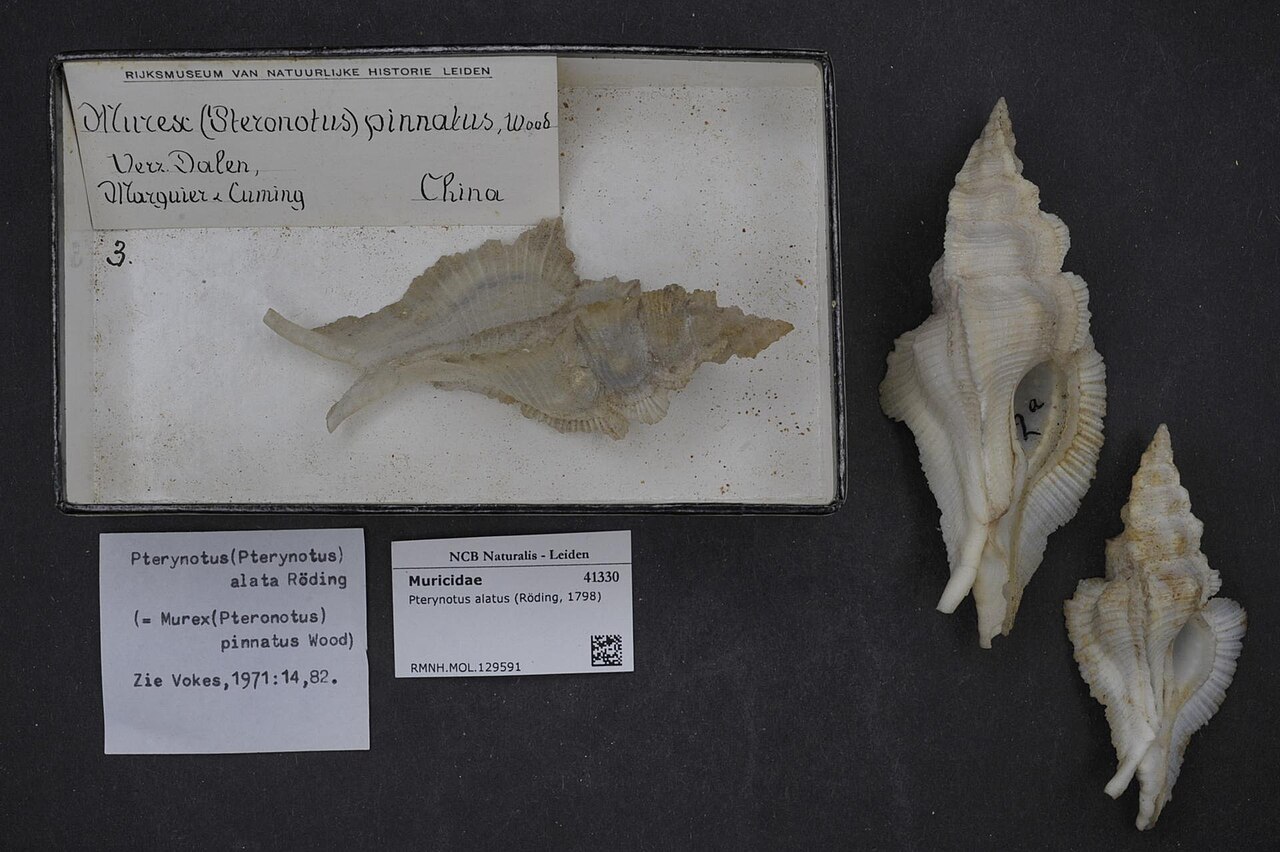
Species in Pterynotus are characterized by their winged or frilled shell ornamentation, a common feature among muricids. The type species is Pterynotus alatus (Röding, 1798), though some earlier names like Pterynotus tripterus (Born, 1778) are also recognized. The genus has a global distribution in tropical and temperate seas, with species recorded from the Indo-Pacific, Atlantic, and Mediterranean regions.
Taxonomic uncertainty persists, as evidenced by the placement of the subfamily Muricinae as incertae sedis within the family. Many former species have been moved to other genera based on morphological and phylogenetic studies, and some have been synonymized entirely. The fossil record of Pterynotus is particularly rich in European and New Zealand deposits.
Reader's Guide
Pterynotus holds significance in malacology as a genus that exemplifies the challenges of taxonomic classification within the Muricidae. Its history of reclassifications—over 40 former species have been moved to other genera—illustrates the dynamic nature of gastropod systematics. The genus serves as a case study in how morphological characters, particularly shell ornamentation, can lead to both accurate and misleading taxonomic assignments.
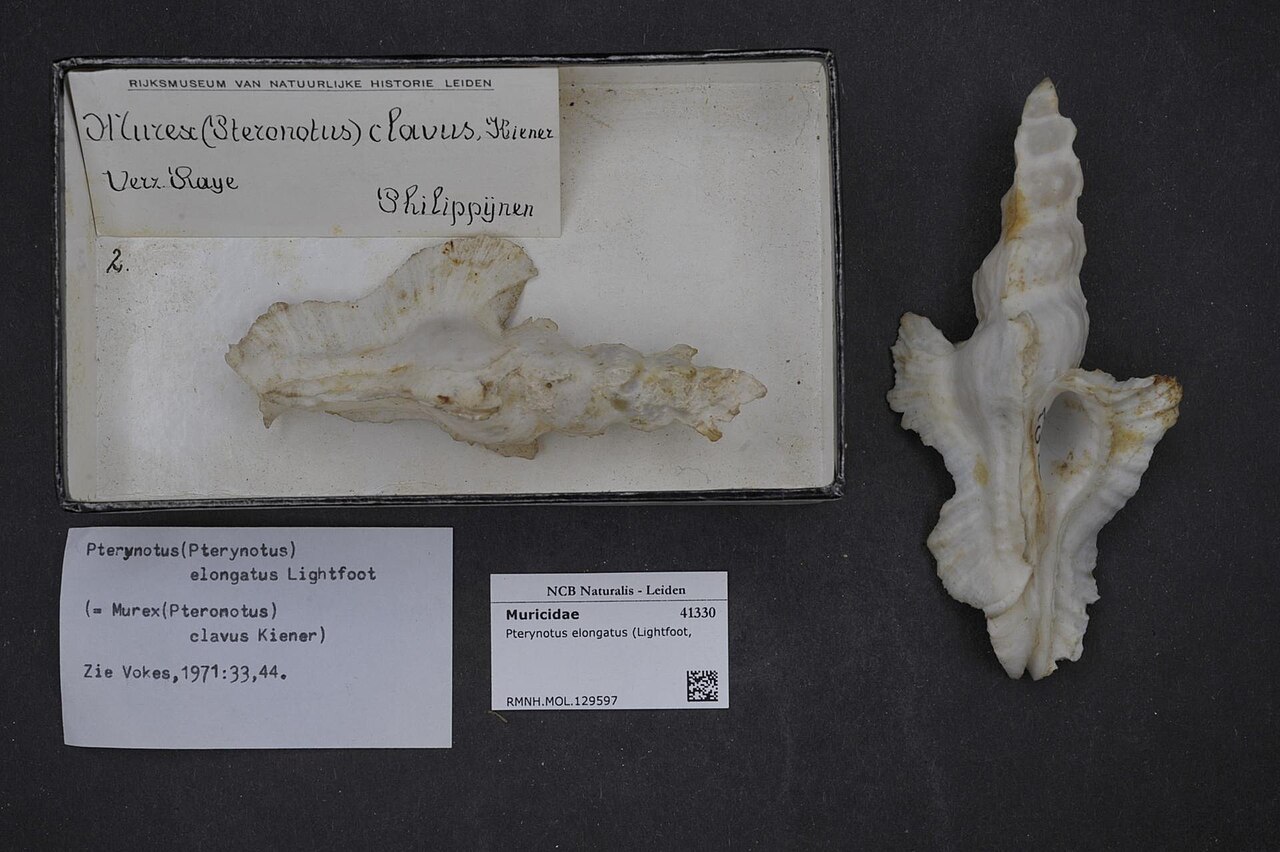
The fossil species of Pterynotus contribute to biostratigraphy and paleobiogeography, with taxa like Pterynotus aurorae and Pterynotus robustus providing temporal markers in Cenozoic marine sediments. The genus also includes species of interest to collectors, such as the winged Pterynotus alatus and the elongate Pterynotus elongatus.
In the broader context of murex snail research, Pterynotus represents a group whose boundaries have been repeatedly revised. The work of malacologists like Houart, D'Attilio, and Vokes has been instrumental in clarifying these relationships. The genus remains a subject of study, with new fossil species still being described as recently as 2025.
Did You Know?
- Pterynotus is placed in the subfamily Muricinae incertae sedis within the family Muricidae.
- The genus includes both extant species and fossil species dating back to the Eocene.
- Over 40 former Pterynotus species have been reclassified into other genera such as Timbellus, Pterochelus, and Chicoreus.
- The most recently described fossil species is Pterynotus robustus Garvie, 2025.
Taxonomic Identity & Classification
Pterynotus bipinnatus, widely recognized by its common name the two-winged murex, belongs to the order of marine gastropod mollusks that we call sea snails. Within the broader classification of shell-bearing marine invertebrates, this species sits squarely in the family Muricidae, a large and diverse group commonly referred to as murex snails or rock snails. The genus name Pterynotus and the specific epithet bipinnatus together capture the creature's most striking visual trait: the pair of delicate, feather-like wing structures that adorn the outermost whorl of its shell. As a member of Muricidae, the two-winged murex shares its evolutionary lineage with hundreds of other spiny, sculpted, and ornamented sea snails found across the world's oceans. Its placement in this family signals a close morphological and ecological kinship with other rock-dwelling gastropods that have evolved elaborate shell architecture over millions of years of marine evolution. The species stands as a particularly elegant example of the ornamental complexity that Muricidae are known for, combining structural intricacy with a refined color palette that sets it apart from many of its more aggressively spined relatives.
Shell Architecture & Sculptural Form
The shell of the two-winged murex takes an elongately fusiform shape, tapering to a sharply pointed, turreted spire that rises in a steep, acuminated profile. Seven distinct whorls compose the overall structure, each one bearing transverse ridges of delicate refinement alongside elevated striations that run across the surface. The ridges, the fine striae between them, and the interstices all display a very finely scabrous crenulation, giving the shell a textured, almost granular feel to the touch. The first six whorls are further distinguished by tuberculous nodules that dot their surfaces, while the body whorl, the largest and most prominent section, carries three varices, or raised bands. The last two of these varices are particularly remarkable, each adorned with beautifully fimbriated wing-like projections that give the species its common name. A notable peculiarity of this shell is that no frill structure appears anywhere except on those final two varices, making the winged ornamentation a singular feature. The spire itself presents a mass of prominent nodules, with each whorl approximating a heptagonal cross-section and bearing as many as seven nodules around its circumference.
Coloration & Fine Surface Detail
The overall coloration of the two-winged murex shell is a soft, snowy white that carries a subtle rose tinge across its surface, lending the specimen a gentle, warm undertone rather than a stark, clinical whiteness. The columella, the inner lip or central pillar of the aperture, presents a paler shade of rose, creating a soft tonal gradient from the body of the shell inward. The aperture itself is notably small relative to the overall shell dimensions, and the edge of the outer lip is minutely denticulated, meaning it bears tiny tooth-like projections along its margin that add a delicate serrated quality to what might otherwise be a smooth rim. The siphonal canal, the channel extending from the aperture, is rather broad and slightly elongated, a feature that distinguishes it from some of its more tightly coiled Muricidae relatives. Together, these color and surface details, the rose-tinged white, the denticulated lip, the broad siphonal canal, contribute to a shell that appears both refined and intricately finished, as though every surface has been carefully sculpted to a high degree of ornamental precision.
Geographic Range & Marine Context
The known distribution of Pterynotus bipinnatus is confined to the waters off Queensland, Australia, placing this species within the warm, biodiverse marine environments of the country's northeastern coastline. As a marine gastropod, the two-winged murex inhabits the ocean rather than freshwater or terrestrial settings, and its classification among the murex or rock snails suggests an association with rocky substrates and reef-adjacent habitats where such snails typically anchor themselves and forage. Queensland's extensive continental shelf and diverse coral and rocky reef systems provide a rich ecological backdrop for a shell-building mollusk of this kind. The restricted geographic record, limited to a single Australian state, indicates that the species may have a relatively narrow range compared to some more cosmopolitan Muricidae, or it may simply reflect the current extent of documented collections rather than the true breadth of its habitat. In either case, the Queensland waters represent the confirmed home range for this elegantly winged sea snail, and any specimens encountered by collectors or researchers are most likely to originate from that region of the Australasian marine environment.
Gallery
Frequently Asked Questions
What is Pterynotus?
Pterynotus is a genus of marine gastropod mollusks commonly known as murex or rock snails. It is placed in the subfamily Muricinae of the family Muricidae, although its precise position within that family is still unresolved (incertae sedis).
How many species are currently recognized in Pterynotus?
At least 15 living species and 12 fossil species are presently assigned to the genus. That tally has shifted repeatedly over the years as former members were synonymized or moved to other genera.
What is the oldest named Pterynotus species?
Pterynotus tripterus, described by Born back in 1778, is the earliest species to have been formally named in the genus. It has served as a foundational reference point for Pterynotus taxonomy for well over two centuries.
What is the most recently described Pterynotus fossil?
Pterynotus robustus, named by Garvie in 2025, is the newest fossil addition to the genus. It brings the count of recognized extinct Pterynotus species to at least 12.
Why is Pterynotus's taxonomy considered so messy?
The genus has been through numerous rounds of reclassification and synonymization, with species repeatedly shuffled in and out of Pterynotus across different taxonomic revisions. On top of that, its placement within Muricidae remains flagged as incertae sedis, so even its subfamily-level position is not yet firmly settled.
More in Murex Snails 1-24
Spotted an error? Know more?
Reader corrections go straight into our review queue. Suggest an edit · How this site is sourced