Urosalpinx
A genus of predatory sea snails in the murex family.

Petit de la Saussaye, 1856 · CC0
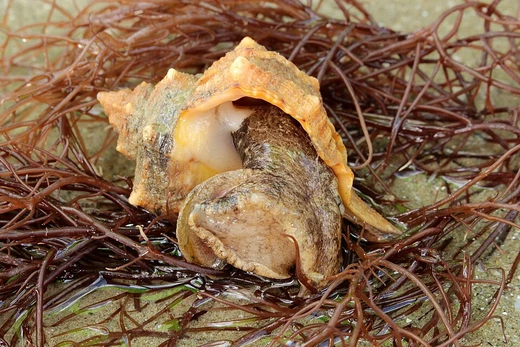
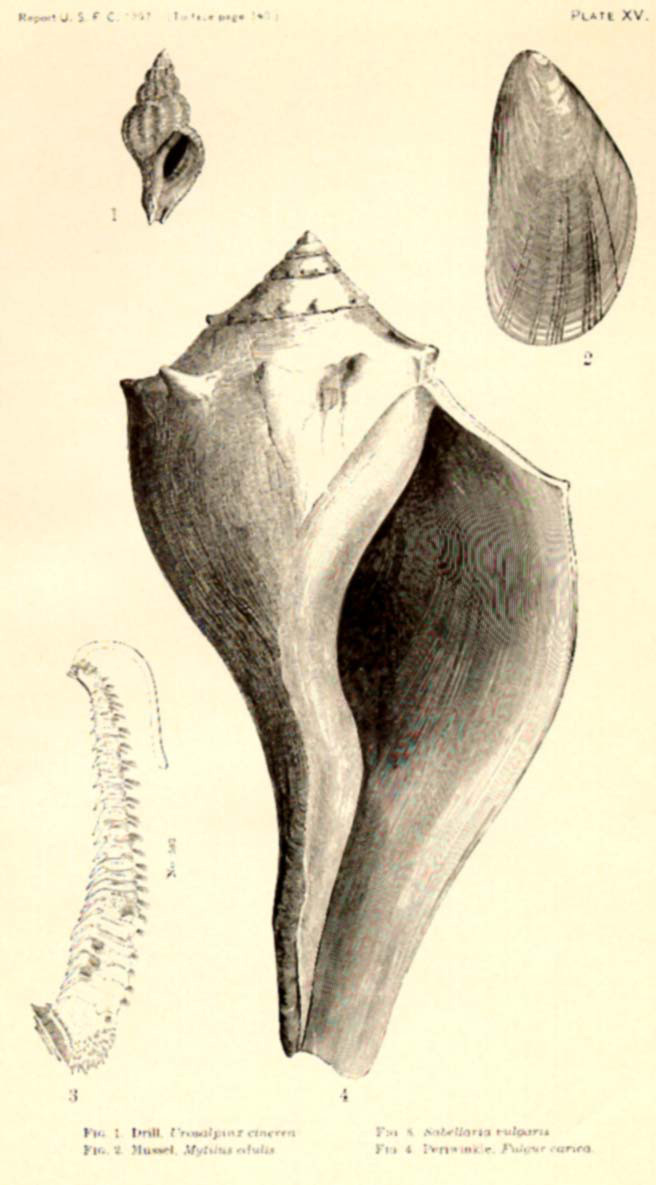
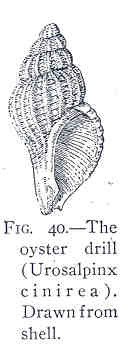
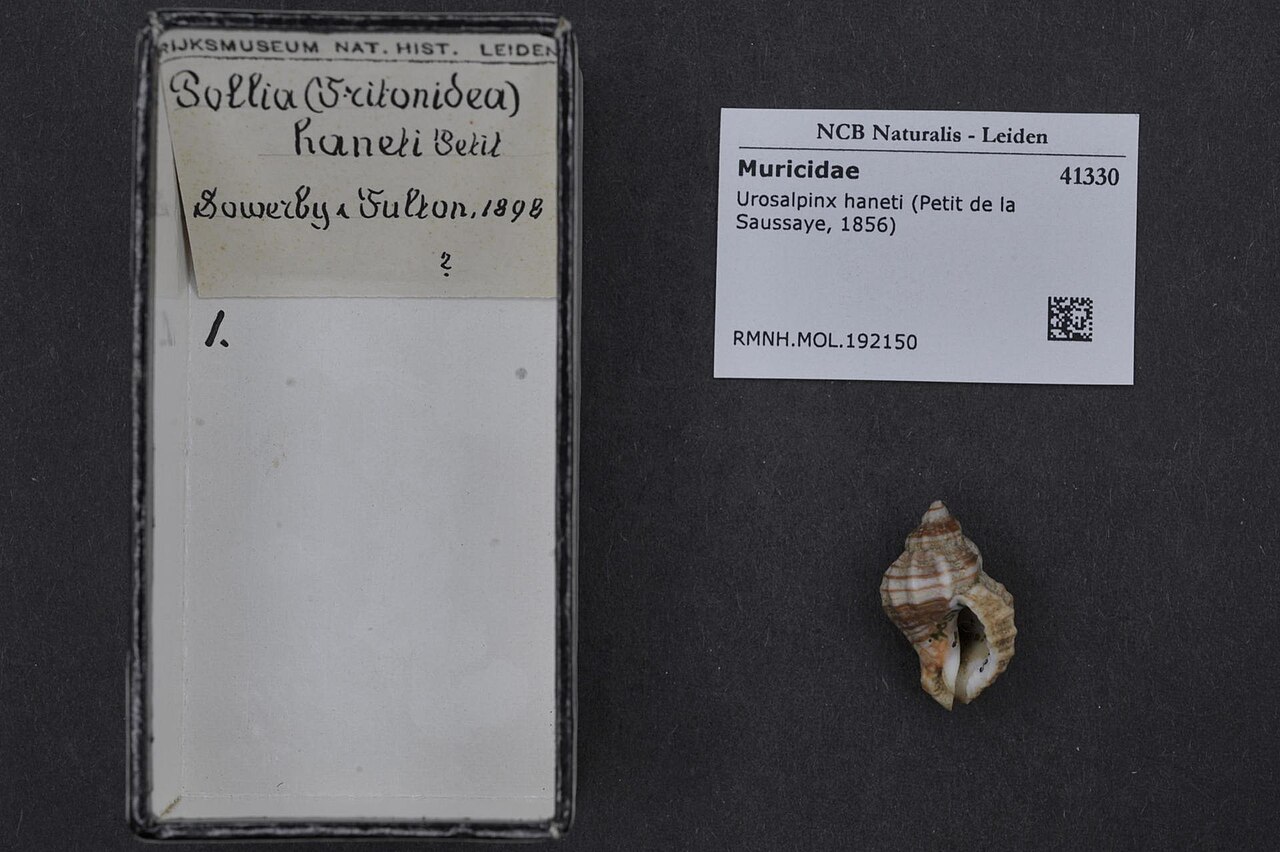
Urosalpinx is a genus of sea snails, marine gastropods belonging to the subfamily Ocenebrinae within the murex snail family, Muricidae. The shell is elongated oval or short fusiform, with longitudinal ribs or undulations and spiral striations. The aperture features a short siphonal canal, and the outer lip is toothed and lined with ridges inside. The operculum resembles that of *Purpura*, being semicordate with the nucleus positioned on the outer edge slightly below the middle. The radula is similar to that of *Trophon*, with lateral teeth having an elongated base, while the rhachidian tooth bears numerous minute denticles between the main ones, corresponding to surface ridges like those in *Murices*. The egg capsules are oblong, shouldered, widest near the summit, compressed, and carinated on each side, with a short peduncle and a very small base of attachment; the aperture is median at the summit. The genus includes both living and fossil species, with many documented from the Miocene and Pliocene of the Atlantic coastal plain and other regions.
Quick Facts
- Taxon
- Urosalpinx
Facts from the source article.
Lore & Background
The shell of Urosalpinx is elongated oval or short fusiform, longitudinally ribbed or undulated and spirally striated. The aperture has a short siphonal canal, and the outer lip is dentate and lirate within. The operculum is semicordate, with the nucleus at the outer edge a little below the middle, somewhat like that of Purpura. The lingual dentition is nearly like that of Trophon, with lateral teeth having an elongated base of attachment, while the rhachidian tooth has numerous minute denticles between the principal ones, corresponding to ridges on the surface of the tooth as in the Murices. The ova-capsules are oblong, shouldered, widest near the summit, compressed, carinated on either side, with a short peduncle; the base of attachment is very small, and the aperture is median at the summit.
Reader's Guide
Urosalpinx is significant as a genus within the Ocenebrinae, contributing to the understanding of muricid evolution and biogeography. The genus includes both living species, such as the well-known Urosalpinx cinerea, and numerous fossil taxa that have been used in biostratigraphic studies of Miocene and Pliocene deposits, particularly from the Atlantic coastal plain of North America and South America. Fossil species like Urosalpinx trossula and Urosalpinx subrusticus have been documented in formations from Virginia to Florida, and others such as Urosalpinx archipatagonica and Urosalpinx dautzembergi extend the genus's range to Patagonia and Antarctica. The genus has also been the subject of taxonomic revision, with many species formerly placed in Urosalpinx now reassigned to other genera such as Trophonopsis, Ergalatax, and Paciocinebrina. This ongoing refinement reflects the complexity of muricid systematics and the importance of detailed morphological and molecular studies.
Did You Know?
- Urosalpinx cinerea is the type species of the genus, described by Thomas Say in 1822.
- The genus includes both extant species and many fossil taxa from the Miocene and Pliocene.
- The ova-capsules of Urosalpinx are oblong, shouldered, and compressed with a median aperture at the summit.
- Several species originally described as Urosalpinx have been moved to other genera such as Trophonopsis and Ergalatax.
Taxonomic Identity and Classification
Urosalpinx auroraensis stands as a documented member of the Muricidae family, a group of marine gastropod mollusks commonly referred to as murex snails or rock snails. This extinct species belongs to the broader class of sea snails, organisms that have inhabited marine environments for hundreds of millions of years. Its placement within the Muricidae family connects it to a lineage of shell-bearing creatures, though the specific characteristics of auroraensis beyond its shell dimensions remain limited in the available record. As an extinct species, Urosalpinx auroraensis no longer persists in living populations, existing now only as fossil evidence of past marine ecosystems. Its classification as a gastropod mollusk places it among the soft-bodied, single-shelled invertebrates that have played roles in coastal and marine food webs throughout geological history. The species name suggests a geographic or contextual origin, though the primary evidence for its existence comes entirely from the fossil record rather than any surviving population.
Morphology and Shell Characteristics
The known physical dimensions of Urosalpinx auroraensis are modest by the standards of many marine gastropods. The shell of this extinct murex snail reaches a maximum length of 18 millimeters, a size that places it in the smaller range of shell-bearing mollusks. Within the family Muricidae, which encompasses a wide diversity of rock snails and murex species, an 18-millimeter shell represents a relatively compact form. This measurement provides the primary morphological data point available for the species, offering researchers a concrete reference for understanding the physical scale of this organism. The shell, as the hard external structure of a gastropod mollusk, would have served as both protection and a structural framework for the soft body within. While specific sculptural details, coloration, or aperture shape are not elaborated in the available record, the 18-millimeter maximum length anchors our understanding of this species' physical presence in its ancient marine environment.
Fossil Record and Geological Context
The physical evidence for Urosalpinx auroraensis survives exclusively in the form of fossils embedded within Pleistocene strata in South Carolina, United States. The Pleistocene epoch represents a period of dramatic climatic oscillation and repeated glacial cycles that profoundly reshaped coastal environments across eastern North America. The presence of this marine gastropod fossil in South Carolina's geological record indicates that the coastal waters of this region once supported a community of murex snails and rock snails belonging to the Muricidae family. The fact that these fossils were recovered from Pleistocene deposits rather than more recent strata underscores the species' extinction status, confirming that Urosalpinx auroraensis represents a lineage that did not persist into the modern era. The South Carolina location situates this find within the broader context of eastern North American marine geology, a region that has been the subject of extensive paleontological investigation over the decades.
Scientific Documentation and Research Context
The scientific documentation of Urosalpinx auroraensis is anchored in a small but significant body of geological and paleontological literature. Edward J. Petuch's 2003 work, Cenozoic Seas: The View From Eastern North America, provides a broader framework for understanding the marine organisms that inhabited the coastal waters of the eastern United States throughout the Cenozoic Era, a period that encompasses the Pleistocene epoch in which this species lived. Additionally, the Lee Creek Mine, documented by the Carolina Geological Society in 1992, represents a notable geological site in South Carolina that has yielded significant fossil material. The relatively limited number of references associated with Urosalpinx auroraensis reflects the species' status as a minor but valid entry in the fossil record, known primarily through its taxonomic description and the geological context of its discovery. These references collectively establish the species within the broader narrative of eastern North American marine paleontology.
Gallery
Frequently Asked Questions
What is Urosalpinx?
Urosalpinx is a genus of predatory marine gastropods classified within the murex family, Muricidae, under the subfamily Ocenebrinae. It contains more than thirty described species, a good number of which are known only from fossils.
What does a Urosalpinx shell look like?
The shell is generally elongated oval or short fusiform, marked by longitudinal ribs or undulations combined with spiral striations. The aperture carries a short siphonal canal, and the toothed outer lip is lined internally with ridges.
What is the type species of Urosalpinx?
The genus is anchored by Urosalpinx cinerea, first described by Say back in 1822. All other species in the genus are defined relative to this original taxonomic reference point.
How far back does Urosalpinx extend in the fossil record?
Urosalpinx lineages appear from the Miocene epoch through the Recent, meaning the genus has persisted for tens of millions of years. Many of its more than thirty described species are in fact fossil taxa rather than living forms.
What is distinctive about the Urosalpinx operculum?
The operculum is semicordate, closely resembling that of Purpura, with the nucleus set on the outer edge just below the midpoint. This shape, together with the radula's elongated lateral-tooth bases, helps separate Urosalpinx from other murex genera.
More in Murex Snails 1-24
Spotted an error? Know more?
Reader corrections go straight into our review queue. Suggest an edit · How this site is sourced