Muricidae
Predatory sea snails with ornate shells and historical dye value.

Wikimedia Commons · CC0
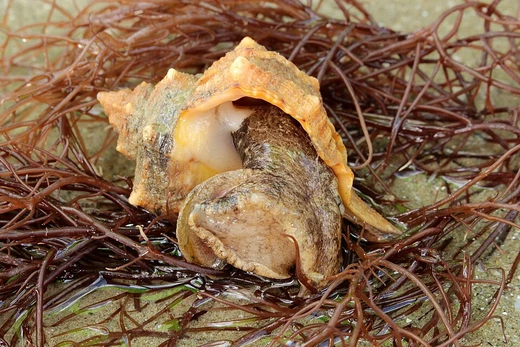
The Muricidae, commonly called murex or rock snails, are a large and diverse family of predatory sea snails. These marine gastropod mollusks range from small to large in size. There are over 1,700 living species, making up nearly 10% of the Neogastropoda order, and another 1,200 fossil species have been identified. While many subfamilies are recognized, experts often disagree on how to divide them and define the genera. The shells of many muricids are unusual and prized by collectors and interior designers.
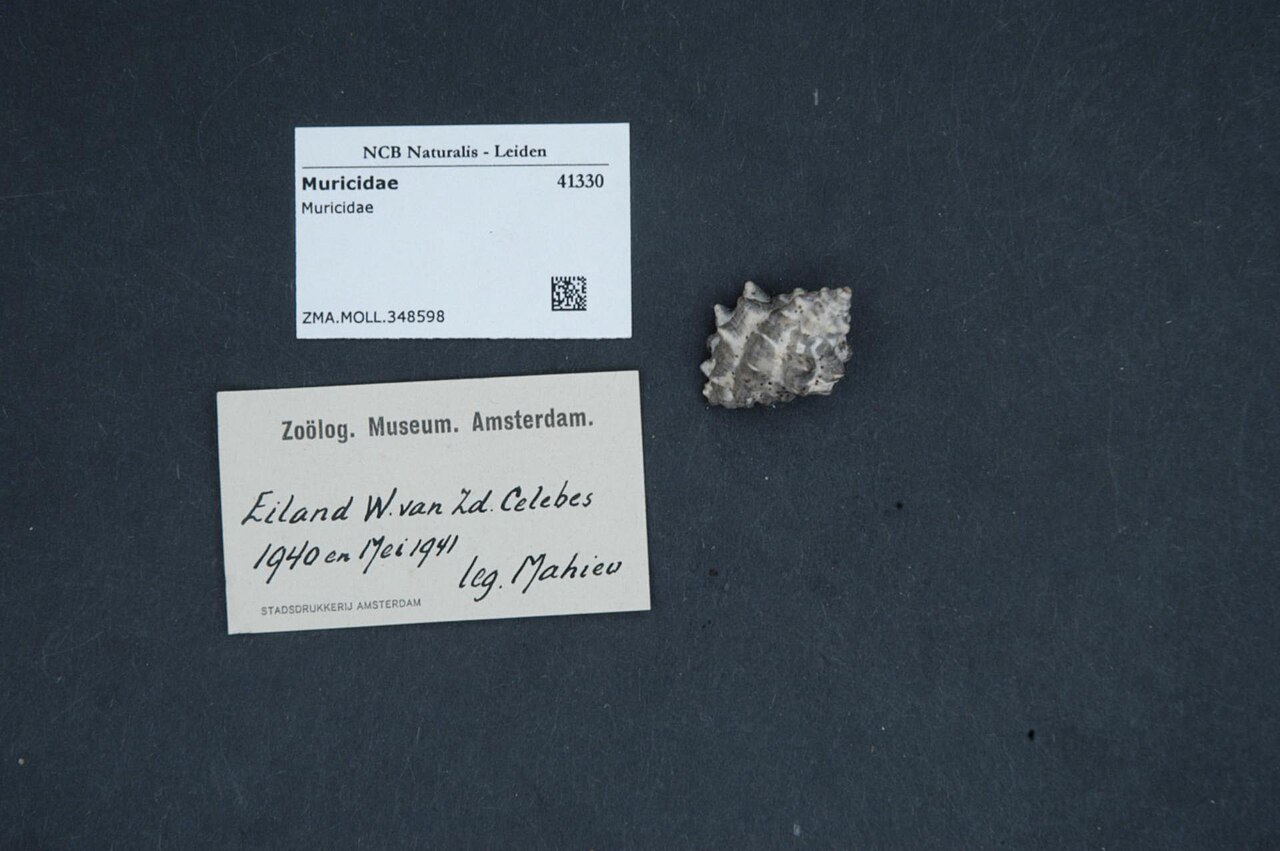
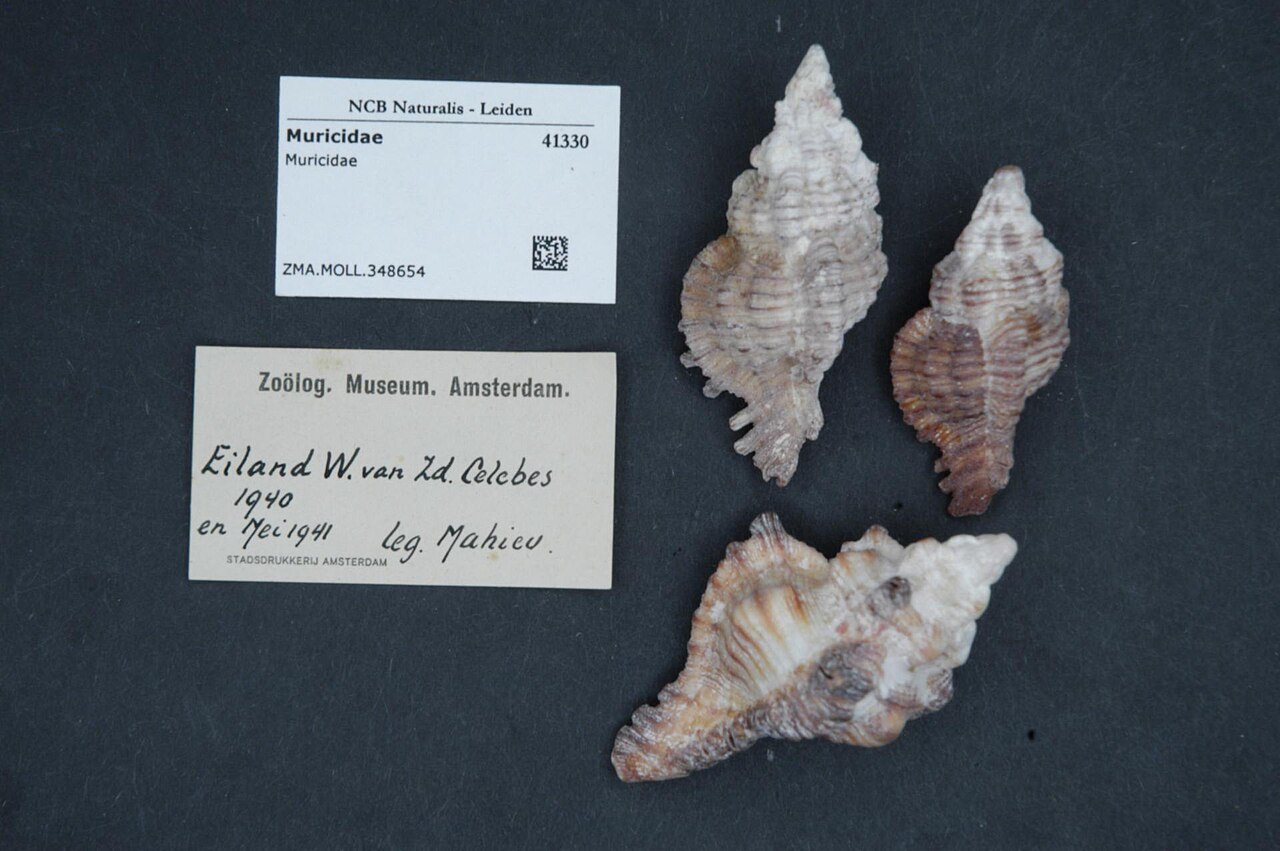
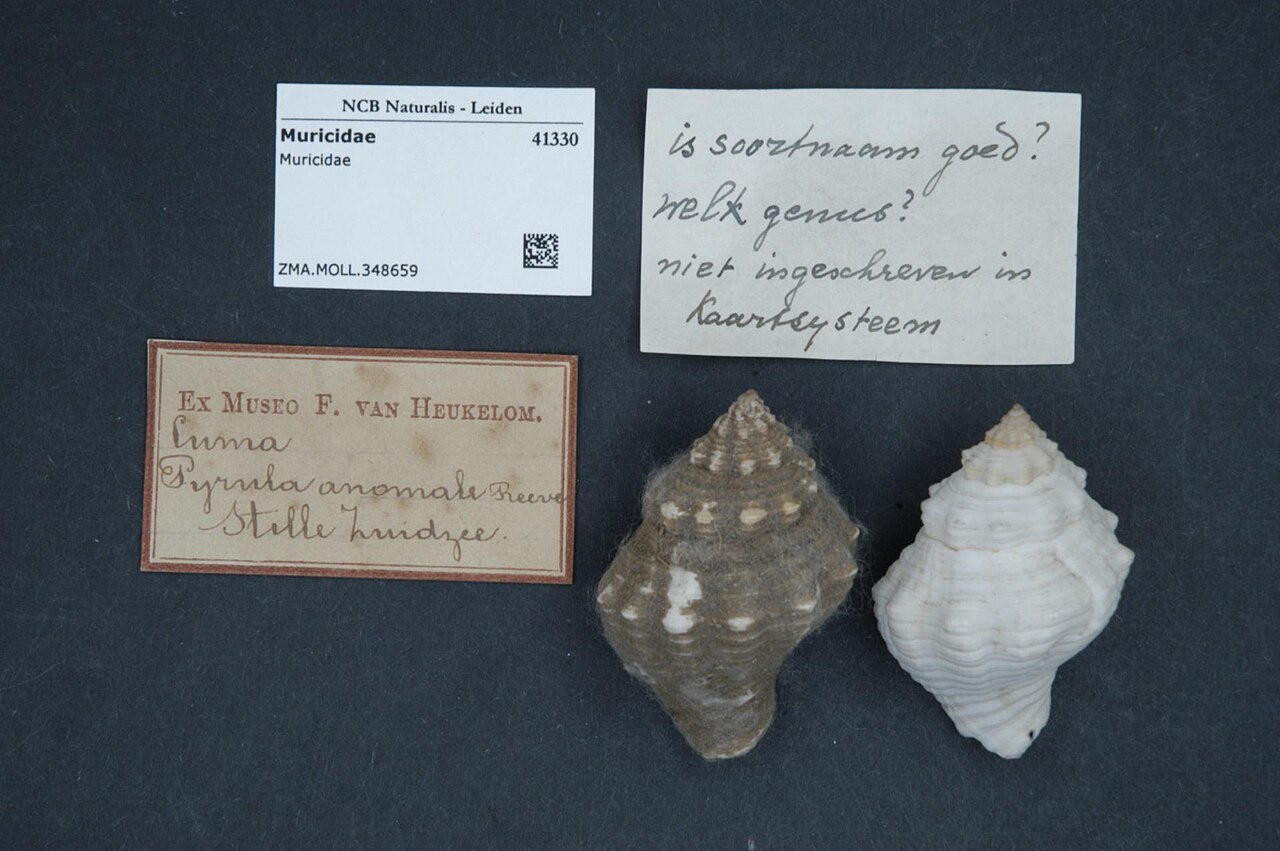
Muricid shells vary in shape but typically have a raised spire and strong sculpture, including spiral ridges and often three or more axial varices per whorl. These varices frequently bear spines, tubercles, or blade-like projections. The shell lacks a periostracum. The aperture can be oval or more contracted, with a well-defined anterior siphonal canal that may be very long. The outer lip is often toothed on the inside, sometimes with a tooth-like process on its edge. The columella is smooth or weakly ridged. The operculum is horny, of variable thickness, with the nucleus near the front end or about midway along the outer margin. Many muricids grow in spurts, staying the same size for a while as a varix develops, then rapidly growing to the next stage, which creates the series of varices on each whorl.
Most muricids are active carnivores, preying on other gastropods, bivalves, and barnacles. They typically access the soft parts of their prey by boring a hole through the shell, using a softening secretion and the scraping action of their radula. Because of this carnivory, some species are considered pests, as they can cause significant damage to natural bivalve beds and commercial shellfish farms. Muricids lay their eggs in protective, horny capsules, the size and shape of which vary by species. From these capsules, either crawling juveniles or, more rarely, planktonic larvae hatch.
Early Mediterranean peoples, possibly the Phoenicians first, harvested members of this family to extract a vivid, stable, and expensive dye known as Tyrian, imperial, or royal purple. The family Muricidae first appears in the fossil record during the Aptian age of the Cretaceous period.
Quick Facts
- Taxon
- Muricidae
Facts from the source article.
Lore & Background
Muricid shells are variably shaped, generally with a raised spire and strong sculpture with spiral ridges and often axial varices (typically three or more varices on each whorl), also frequently bearing spines, tubercles, or blade-like processes. The periostracum is absent in this family. The aperture is variable in shape; it may be ovate to more or less contracted, with a well-marked anterior siphonal canal that may be very long. The shell's outer lip is often denticulated inside, sometimes with a tooth-like process on its margin. The columella is smoothish to weakly ridged. The operculum is corneous and of variable thickness, with the nucleus near the anterior end or at about midlength of the outer margin. Many muricids have episodic growth, which means their shells grow in spurts, remaining the same size for a while (during which time the varix develops) before rapidly growing to the next size stage, resulting in a series of varices on each whorl.
Most species of muricids are carnivorous, active predators that feed on other gastropods, bivalves, and barnacles. Access to the soft parts of the prey is typically obtained by boring a hole through the shell by means of a softening secretion and the scraping action of the radula. Because of their carnivory, some species may be considered pests because they can cause considerable destruction both in exploited natural beds of bivalves, and in farmed areas of commercial bivalves. Muricids lay eggs in protective, corneous capsules, the size and shape of which vary by species. From these capsules the crawling juveniles, or more rarely planktonic larvae, hatch.
Members of the family were harvested by early Mediterranean peoples, with the Phoenicians possibly the first to do so, to extract an expensive, vivid, stable dye known as Tyrian purple, imperial purple, or royal purple. The family Muricidae first appears in the fossil record during the Aptian age of the Cretaceous period.
Reader's Guide
The Muricidae family holds significance both ecologically and historically. Ecologically, these predatory snails play a role in controlling populations of other gastropods, bivalves, and barnacles, though their carnivory can lead to them being considered pests in commercial bivalve beds and natural exploited beds. Their method of boring through prey shells using a softening secretion and radula is a distinctive feeding adaptation. Historically, members of the family were harvested by early Mediterranean peoples, with the Phoenicians possibly the first to do so, to extract an expensive, vivid, stable dye known as Tyrian purple, imperial purple, or royal purple. This dye was highly valued in antiquity. The family's fossil record extends back to the Aptian age of the Cretaceous period, indicating a long evolutionary history. The shells of many muricids are considered attractive by shell collectors and interior designers, contributing to their cultural and commercial interest. The taxonomic complexity of the family, with numerous subfamilies and ongoing disagreement among experts about subfamily divisions and generic definitions, reflects the diversity and evolutionary richness of the group.
Did You Know?
- Muricidae represent almost 10% of the Neogastropoda.
- Many muricids have episodic growth, growing in spurts with varices forming between growth stages.
- Early Mediterranean peoples, possibly the Phoenicians, harvested muricids to extract Tyrian purple dye.
Ancient Roots of a Name
The name murex traces back to the Latin word mūrex, which likely shares a linguistic ancestor with the Greek μύαξ (myax), a term for sea mussel. Scholars have noted a possible deeper connection to the Greek μῦς (mys), meaning "mouse," suggesting that ancient observers saw a resemblance between the elongated, spiny forms of these mollusks and the small rodent. Aristotle himself referenced these creatures in his History of Animals, using the Greek term πορφύρα (porphyra). What makes this nomenclature remarkable is its extraordinary longevity: murex stands as one of the oldest classical seashell names still actively employed within modern scientific taxonomy. Even today, the common name persists for numerous species scattered throughout the family Muricidae—organisms that were originally slotted under the Latin genus Murex but have since been redistributed into separate genera as taxonomic understanding has deepened. The term thus bridges millennia of human observation with contemporary malacological practice.
The Royal Purple Legacy
For centuries, the mucus extracted from the hypobranchial glands of two particular sea snails—historically called Murex brandaris and Murex trunculus, now reclassified as Bolinus brandaris and Hexaplex trunculus—yielded the extraordinarily costly pigments known as Tyrian purple and tekhelet. The ancient Phoenicians developed the labor-intensive process of harvesting this rare animal-produced organobromine compound, which the snails synthesize through a specialized bromide peroxidase enzyme acting on dissolved bromide in seawater. The resulting dye was reserved for the most prestigious garments: royal robes, ceremonial and ritual clothing, and textiles denoting high social rank. Its significance extended into religious practice; it is hypothesized that the same purple featured prominently in the ancient Temple in Jerusalem, adorning the vestments of the High Priest of Israel. Some Jewish communities continue to use it today in the ritual fringes, or tzitzit, attached to four-cornered garments. While a full scholarly consensus on the Biblical source of the "blue" dye remains elusive, the most recent archaeological research on regional dyes points to Hexaplex trunculus as the source of the ancient tekhelet.
A Taxonomic Tangle
The genus Murex carries an unusually heavy burden of synonyms, a direct consequence of how early taxonomists handled muricoid diversity. When Linnaeus first circumscribed the genus, it swallowed a vast array of taxa that modern malacologists now distribute across the entire superfamily Muricoidea. Throughout the nineteenth century, the definition was progressively narrowed: Lamarck and his contemporaries first confined it to members of the family Muricidae, then restricted it further to just the subfamilies Muricinae and Ocenebrinae. Yet prominent malacologists of that era—Kiener, Reeve, Küster, Kobelt, and Sowerby—continued to lump all muricoid forms under the single name Murex. This practice generated an enormous web of synonymy. Today, the World Register of Marine Species recognizes only a handful of valid species within the genus, while dozens of former Murex names have been reassigned to genera such as Vokesimurex, Ocinebrina, Chicoreus, and many others. The result is that a single common name, murex, still echoes through countless scientific synonyms scattered across the literature.
Deep Time and a Narrow Home
The fossil record reveals that murex-lineage snails have persisted for an extraordinary span, with specimens documented from the Cretaceous through the Quaternary—roughly 125.45 million years to the present. Fossils attributed to this genus have been recovered from sites around the globe, and approximately twenty-five extinct species have been identified, testifying to a once-broad biogeographic range. Yet the living genus tells a far more restricted story. As demonstrated by Ponder and Vokes in 1988, Murex is exclusively an Indo-Pacific genus. Species from the western Atlantic that were once assigned to Murex have since been transferred to the genus Haustellum, underscoring how much the boundaries of this group have shifted. In their current range, most Murex species occupy the intertidal or shallow subtidal zone, sheltering among rocks and coral formations. Their elongate, highly sculptured shells—adorned with spines or fronds and often revealing brightly colored inner surfaces—make them among the most visually striking members of the Muricidae family.
Gallery
Frequently Asked Questions
Who is Muricidae?
Muricidae is a sprawling family of predatory sea snails, often nicknamed murex or rock snails, that sits within the Neogastropoda order. It is one of the most species-rich groups in marine gastropods, with over 1,700 living species and roughly 1,200 fossil species already identified.
What are Muricidae's powers or role?
As active marine predators, muricids subdue smaller prey with a radula armed with venomous teeth. Their shells are also famous for a raised spire and bold, strong sculpture, which is why collectors and interior designers prize them so highly.
Why is Muricidae important?
The family makes up almost 10% of all Neogastropoda, anchoring a huge share of predatory sea-snail diversity. Certain murex species were historically harvested for a prized purple dye, and their ornate shells continue to be sought after in collecting and decorative design.
When did Muricidae first appear?
The earliest muricid fossils trace back to the Aptian age of the Cretaceous period, meaning the family has been evolving in the seas for well over one hundred million years.
More in Murex Snails 1-24
Spotted an error? Know more?
Reader corrections go straight into our review queue. Suggest an edit · How this site is sourced