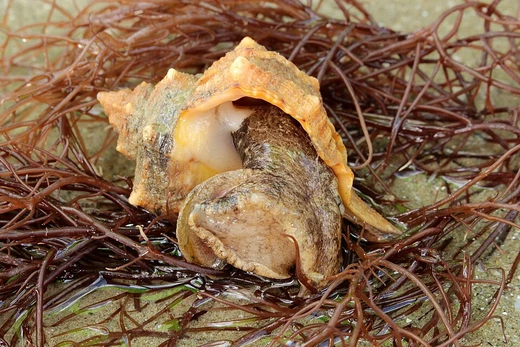
Murex
A genus of spiny sea snails historically used for purple dye.

Didier Descouens · CC BY-SA 4.0
Murex is a genus of predatory tropical sea snails that range from medium to large in size. These carnivorous marine gastropods belong to the family Muricidae and are often called murexes or rock snails. The name "murex" is one of the oldest classical names for seashells still in use by scientists. In ancient times, the term was applied to spiny sea snails, particularly those linked to the production of purple dye.
The word *murex* comes from Latin, likely related to the Greek word for sea mussel. This connection may share a root with the Greek word for "mouse," due to a perceived resemblance between the shape of certain mollusks and mice. Aristotle referred to these mollusks in his *History of Animals* using the Greek term *porphyra*.
Fossils of this genus are known from the Cretaceous period through the Quaternary, with an age range from about 125.45 million years ago to the present. Fossils have been found worldwide, and roughly 25 extinct species are known.
Murex is exclusively an Indo-Pacific genus, as established by Ponder and Vokes in 1988. Species from the western Atlantic once placed in Murex are now assigned to the genus *Haustellum*. Most Murex species live in intertidal or shallow subtidal zones, among rocks and corals.
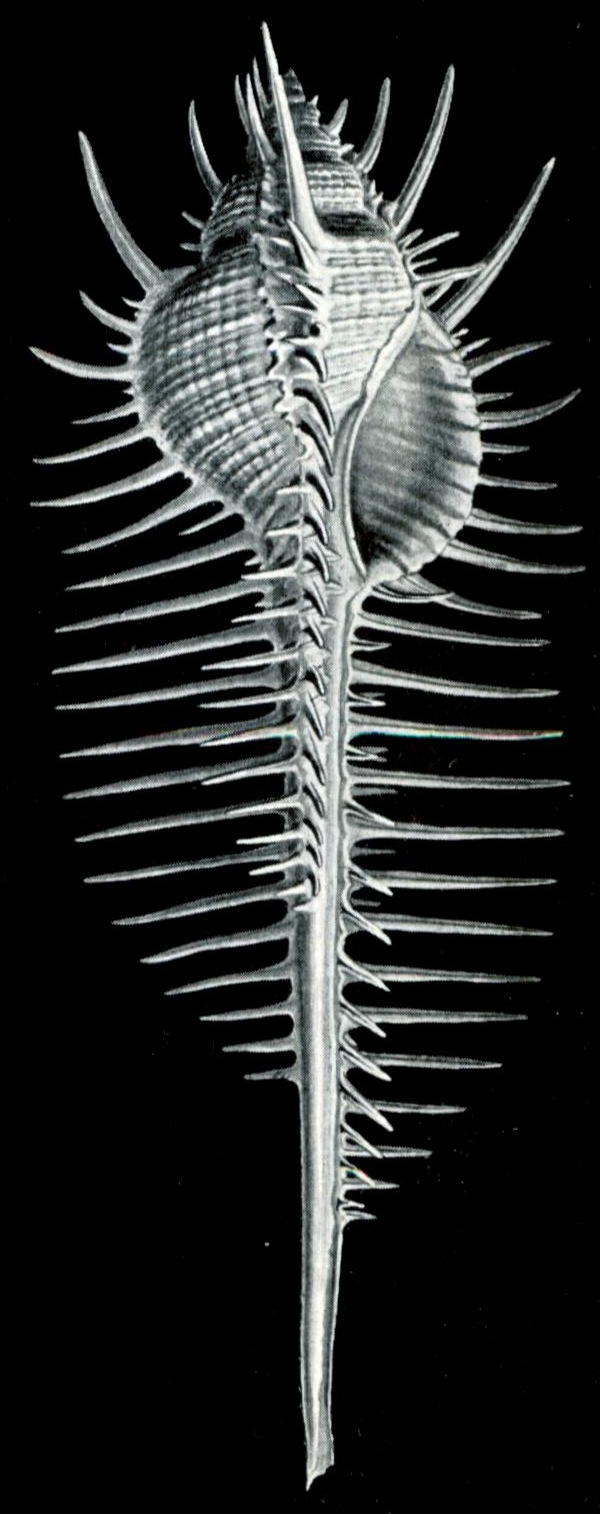
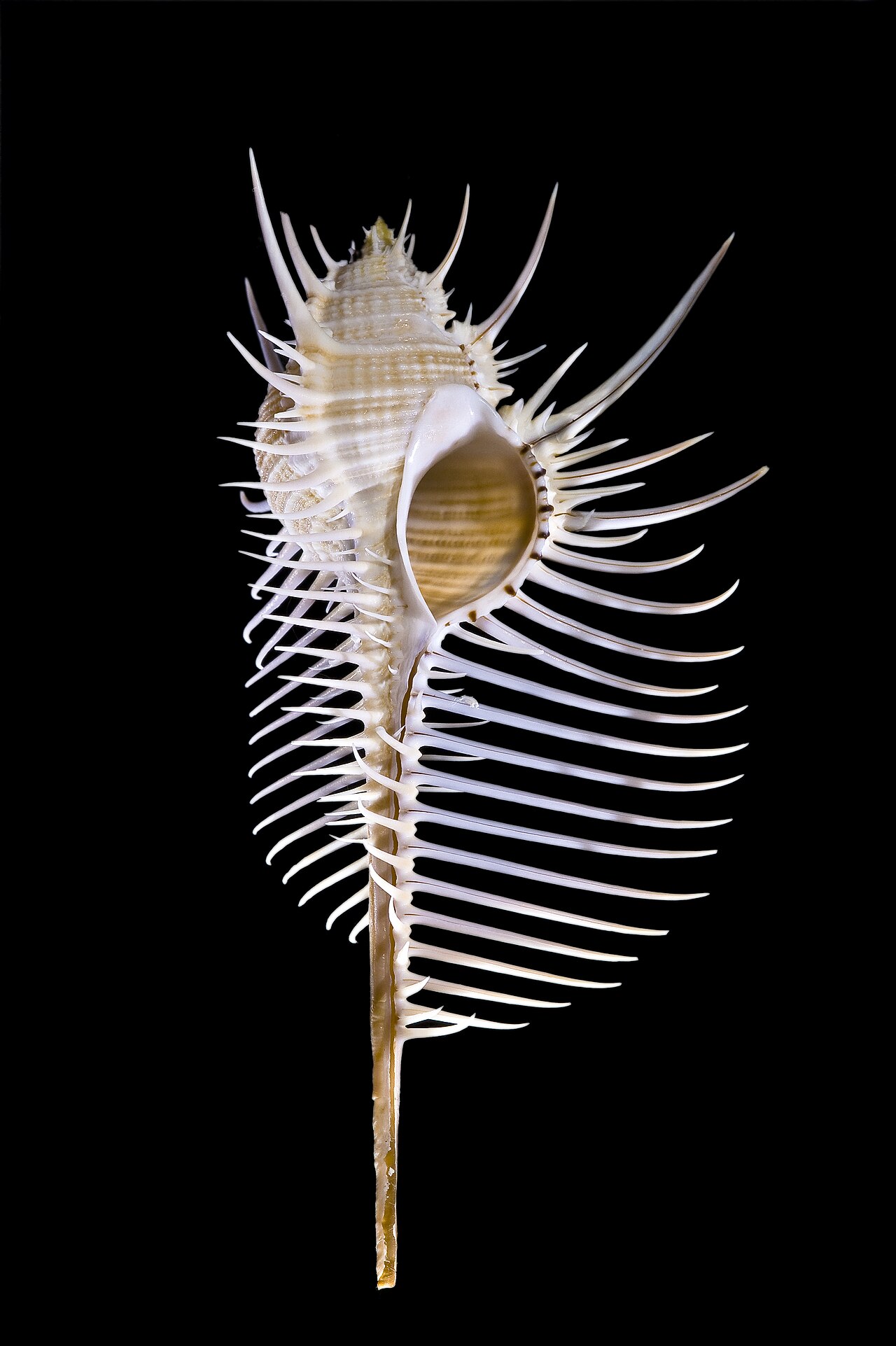
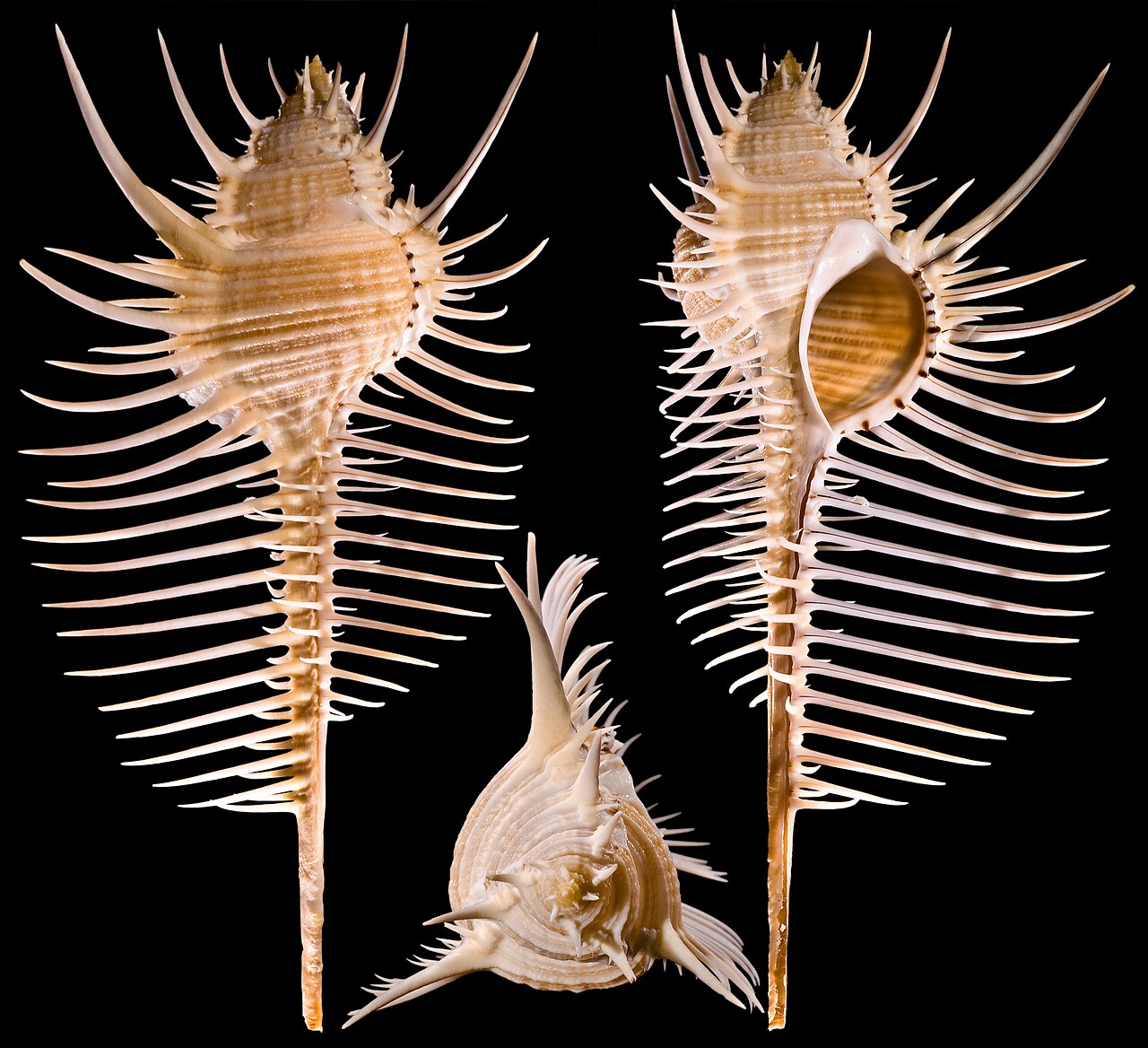
The shells of this genus are often showy, with elongated shapes that are highly sculptured with spines or fronds. The inner surfaces of these ornate shells are frequently brightly colored.
Historically, the costly and labor-intensive dyes Tyrian purple (also called royal purple) and tekhelet were made by the ancient Phoenicians using mucus from the hypobranchial gland of two species commonly called "murex": *Murex brandaris* and *Murex trunculus* (now classified as *Bolinus brandaris* and *Hexaplex trunculus*). This dye is a rare animal-produced organobromine compound, created by the snails using a specific bromide peroxidase enzyme that acts on dissolved bromide in seawater. The dye was used in royal robes, ceremonial or ritual garments, and clothing indicating high rank. It is hypothesized that this was the same dye used in the ancient Temple in Jerusalem and for the clothing of the High Priest of Israel; it is still sometimes used by Jews today in ritual fringes (tzitzit) on four-cornered garments.
Quick Facts
- Taxon
- Murex
- Type Species
- Murex tribulus / Linnaeus, 1758
Facts from the source article.
Lore & Background
The name Murex originates from the Latin word mūrex, likely related to the Greek word for sea mussel, with a possible further link to the Greek word for 'mouse' due to a perceived resemblance in shape. Aristotle described these mollusks in his History of Animals using the Greek term porphyra. The genus is known in the fossil record from the Cretaceous to the Quaternary, with fossils found worldwide and about 25 extinct species identified.
Murex is solely an Indo-Pacific genus, as demonstrated by Ponder & Vokes (1988); species from the western Atlantic formerly placed here are now in the genus Haustellum. Most Murex species live in the intertidal or shallow subtidal zone among rocks and corals. Their elongate shells are highly sculptured with spines or fronds, and the inner surfaces are often brightly coloured.
The genus as originally defined by Linnaeus encompassed many taxa now placed elsewhere in the superfamily Muricoidea. During the 19th century, the definition was restricted by Lamarck and contemporaries first to species in the family Muricidae, then further to the subfamilies Muricinae and Ocenebrinae. Malacologists of that century treated all muricoid forms as belonging to Murex, which is the main reason the genus has so many synonyms.
Reader's Guide
The most significant legacy of Murex lies in its historical role as the source of Tyrian purple, also called royal purple, and the dye tekhelet. This costly and labour-intensive dye was made by the ancient Phoenicians using mucus from the hypobranchial gland of two species commonly referred to as murex: Murex brandaris and Murex trunculus (now classified as Bolinus brandaris and Hexaplex trunculus). The dye is a rare animal-produced organobromine compound, which the snails produce using a specific bromide peroxidase enzyme that operates on dissolved bromide in seawater.
This dye was used in royal robes, ceremonial or ritual garments, and garments indicating high rank. It is hypothesised that the dye was the same as that featured prominently in the ancient Temple in Jerusalem and in the clothing of the High Priest of Israel. It is sometimes still used by Jews today in the ritual fringes (tzitzit) on four-cornered garments. A consensus has yet to be reached regarding the Biblical source of the 'blue' dye, though the latest archaeological research on dyes in the region indicates that Murex trunculus snails were indeed used for the ancient tekhelet dye.
The genus Murex remains one of the oldest classical seashell names still used by the scientific community, and its species continue to be studied for their taxonomy, fossil history, and cultural significance.
Did You Know?
- The costly dye Tyrian purple was made from mucus of the hypobranchial gland of Murex brandaris and Murex trunculus.
- The genus Murex is solely Indo-Pacific; Atlantic species formerly in this genus are now placed in Haustellum.
A Name in Constant Flux
The genus Murex carries one of the most tangled taxonomic histories in malacology. When Linnaeus first assembled the group, it swallowed up an enormous range of taxa that modern researchers now scatter across the superfamily Muricoidea. Through the nineteenth century the definition was repeatedly narrowed: Lamarck and his colleagues first confined Murex to the family Muricidae, then tightened it further to just the subfamilies Muricinae and Ocenebrinae. Yet prominent malacologists of that era—Kiener, Reeve, Küster and Kobelt, and Sowerby—continued to lump virtually every muricoid form under the single name Murex, a practice that left behind a vast web of synonyms still catalogued today. The genus was also geographically pruned. Ponder and Vokes demonstrated in 1988 that Murex is strictly an Indo-Pacific group, and western Atlantic species once included in it were reassigned to the genus Haustellum. Even the famous dye-producing snails, long called Murex brandaris and Murex trunculus, now carry the names Bolinus brandaris and Hexaplex trunculus. What remains is a comparatively small but visually striking genus, ringed by a cloud of names that once pointed to it.
The Colour of Kings
Few creatures in the ancient world commanded as much economic and spiritual significance as the murex snail. The Phoenicians developed a painstaking, labour-intensive process for extracting a vivid purple dye from the mucus of the hypobranchial gland of two species—then known as Murex brandaris and Murex trunculus, now reclassified as Bolinus brandaris and Hexaplex trunculus. The resulting pigment, a rare animal-produced organobromine compound, is synthesised by a specific bromide peroxidase enzyme acting on dissolved bromide in seawater. This costly substance, called Tyrian purple or royal purple, was reserved for the robes of monarchs, ceremonial garments, and clothing that signalled high rank. Its reach extended into sacred contexts: it is hypothesised that the same dye appeared in the ancient Temple in Jerusalem, adorning the garments of the High Priest. The related blue dye tekhelet, used in the ritual fringes (tzitzit) on four-cornered garments, is still sometimes produced by observant Jews today. Although a full consensus on the Biblical source of the blue dye has not yet been reached, the latest archaeological research on regional dyes points to Murex trunculus as the source of the ancient tekhelet.
Architecture of the Reef
Murex snails are among the most visually dramatic molluscs in tropical waters. These medium-to-large predatory carnivores belong to the family Muricidae and are commonly called murexes or rock snails. Their elongate shells are highly sculptured, bristling with spines or fronds that give them a spiky, almost architectural silhouette. The inner surfaces of these ornate shells are often brightly coloured, adding a hidden flash of pigment behind the rugged exterior. The genus is exclusively Indo-Pacific, a range confirmed by Ponder and Vokes in 1988. Most species inhabit the intertidal zone or the shallow subtidal region, where they live among rocks and coral formations. Their predatory, carnivorous nature makes them active hunters within these structured reef environments. The combination of their spiny, sculptured exteriors and vivid internal colouring has made them a subject of fascination since antiquity, when the name murex was applied broadly to spiny sea snails, especially those linked to the production of purple dye. Today the genus remains one of the oldest classical seashell names still in active scientific use, a living link between ancient natural history and modern taxonomy.
Ancient Names, Ancient Shells
The name murex stretches back to the earliest days of Western natural philosophy. It derives from the Latin word mūrex, likely cognate with the Greek μύαξ (myax), meaning sea mussel. The shared root may extend further, linking to the Greek μῦς (mys), meaning mouse, on the basis of a perceived resemblance between certain mollusk shapes and the small rodent. Aristotle described these creatures in his History of Animals, using the Greek term πορφύρα (porphyra), a word that would later become central to the language of purple dye. In antiquity, the name was applied broadly to spiny sea snails, with particular emphasis on those species associated with the production of the prized purple pigment. The genus has also left a deep mark in the geological record. Fossils of Murex species span from the Cretaceous through the Quaternary, covering roughly 125.45 million years to the present. These fossils have been recovered from sites all over the world, and approximately twenty-five extinct species have been identified within the genus. This extraordinary temporal and geographic spread underscores that the murex lineage is a long-enduring branch of the molluscan tree, whose name has survived virtually unchanged from the classical era to modern scientific literature.
Gallery
Frequently Asked Questions
What is a murex snail?
Murex refers to a genus of medium-to-large predatory sea snails found in tropical waters. These carnivorous gastropods belong to the family Muricidae and are commonly nicknamed "rock snails" or "murexes."
Where do murex snails live?
Murex species inhabit the Indo-Pacific region, typically in intertidal or shallow subtidal zones. They favor rocky and coral environments where they can hunt for prey.
How long have murex snails existed?
Fossil evidence places the murex lineage from the Cretaceous period through to the present Quaternary, spanning roughly 125 million years. About 25 species within the genus are now extinct.
Why were murex snails important in ancient history?
In antiquity, certain spiny murex species were harvested to produce a prized purple dye. This made the genus one of the most economically significant marine animals of the classical world.
What does the word "murex" actually mean?
The term derives from Latin and is likely connected to a Greek word for sea mussel. Some etymologists suggest it may share a root with the Greek word for "mouse," possibly due to a visual resemblance.
More in Murex Snails 1-24
Spotted an error? Know more?
Reader corrections go straight into our review queue. Suggest an edit · How this site is sourced