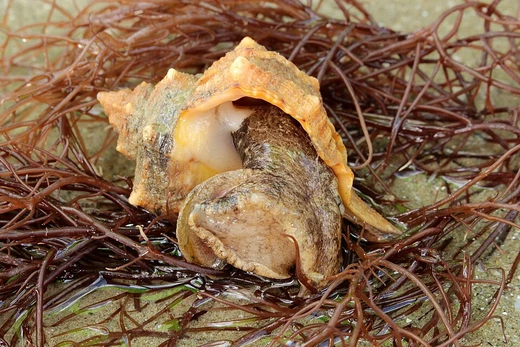
Haustellum
A genus of murex snails with a globose shape and no labral spine.

Haustellum is a genus of medium-sized marine gastropods belonging to the family Muricidae, commonly known as murex or rock snails. Like several other genera in this family, its classification has undergone multiple revisions. The genus currently contains eight or nine species.
The genus was redefined by Ponder and Vokes in 1988 and again by Vokes in 1990, who included both American and Indo-Pacific species. Haustellum differs from the true Murex (Murex sensu stricto) by lacking a labral spine. In 1994, Petuch established the genus Vokesimurex for the American species with long canals that had been placed in Haustellum by Vokes, such as Murex messorius. Later, in 1999, Houart moved fourteen Indo-Pacific species and three subspecies from Haustellum into Vokesimurex.
Members of Haustellum are generally distinguished from Vokesimurex by a globose, low-spired shell shape, a more rounded aperture, a smooth columella, a shallower anal notch, and the absence of a cord spine.
Species currently accepted in the genus include Haustellum barbieri, H. bengalense, H. bondarevi, H. damarcoi, H. fallax, H. franchii, H. haustellum, H. kurodai, H. langleitae, H. longicaudum, H. lorenzi, H. tweedianum, H. vicdani, and H. wilsoni. Several former members have been reassigned to other genera. For example, Haustellum bellegladeensis, H. bobyini, H. danilai, H. dentifer, H. dolichourus, H. elenense, H. gallinago, H. hirasei, H. kiiensis, H. malabaricum, H. mindanaoensis, H. multiplicatus, H. purdyae, H. rectirostris, and H. sobrinus are now placed in Vokesimurex. Haustellum brandaris and H. clavatum are synonyms of Bolinus brandaris, while H. nobile is a synonym of Murex pecten pecten, and H. laeve is a synonym of Haustellum haustellum.
No extinct species are known from the fossil record. The oldest member is the type species, Haustellum haustellum, which originated in the Indo-Pacific province. It has been recorded from the Miocene of Borneo, the Pliocene of Java, and the Plio-Pleistocene of the Malaysian Archipelago.
Quick Facts
- Taxon
- Haustellum
- Type Species
- Murex haustellum
- Type Species Authority
- Linnaeus, 1758
Facts from the source article.
Lore & Background
The genus Haustellum has undergone multiple taxonomic revisions. Ponder & Vokes (1988) and Vokes (1990) included American and Indo-Pacific species in Haustellum, distinguishing it from Murex sensu stricto by the absence of a labral spine. Petuch (1994) later introduced Vokesimurex for the American long-canalled species previously placed in Haustellum sensu Vokes (1990), such as Murex messorius. Houart (1999) transferred 14 Indo-Pacific species and three subspecies of Haustellum into Vokesimurex.
Members of Haustellum generally differ from those of Vokesimurex in having a globose and low-spired shape, a more rounded aperture, a smooth columella, a less deep anal notch, and no cord spine. The type species is Haustellum haustellum, described by Linnaeus in 1758. The oldest known fossil record of the genus is from the Miocene of Borneo, with additional records from the Pliocene of Java, Indonesia, and the Plio-Pleistocene of the Malaysian Archipelago.
Reader's Guide
The significance of Haustellum lies in its role as a case study in the taxonomic complexity of the Muricidae. The genus has been redefined multiple times, with species shifting between Haustellum and the related genus Vokesimurex based on morphological characters such as the presence or absence of a labral spine, shell shape, and columellar features. The current definition restricts Haustellum to eight or nine species, all characterized by a globose, low-spired shell, a rounded aperture, a smooth columella, and the absence of a cord spine. The genus has a fossil record extending back to the Miocene in the Indo-Pacific region, with the type species Haustellum haustellum recorded from Borneo, Java, and the Malaysian Archipelago. Many species originally assigned to Haustellum have since been synonymized or transferred to other genera, reflecting ongoing refinement in muricid systematics. The genus remains a subject of study for malacologists interested in the evolutionary relationships and morphological variation within the murex snails.
Did You Know?
- Haustellum lacks a labral spine, distinguishing it from Murex sensu stricto.
- The genus currently contains eight to nine species.
- The oldest fossil record of Haustellum is from the Miocene of Borneo.
- Many species once placed in Haustellum have been transferred to the genus Vokesimurex.
Frequently Asked Questions
What is Haustellum?
Haustellum is a genus of medium-sized marine gastropods in the Muricidae family, the same group that encompasses the familiar murex and rock snails. It currently groups together eight to nine species spanning both American and Indo-Pacific coastlines.
How do you tell Haustellum apart from a true Murex?
The most reliable field mark is the absence of a labral spine, a feature that true Murex (sensu stricto) retains. Haustellum shells also tend to be rounder and lower-spired, with a smoother columella and a shallower anal notch than their close relatives.
How many species are in the genus Haustellum?
Taxonomists currently recognize eight or nine species, though that number has wavered as the group's boundaries were redrawn. Ponder and Vokes redefined the genus in 1988, and Vokes broadened it again in 1990 to pull in both American and Indo-Pacific members.
What does a Haustellum shell actually look like?
You'll notice a distinctly globose, low-spired body with a wide, rounded aperture and a clean, smooth columella. The anal notch is comparatively shallow, and the shell lacks the cord spine that shows up in several other muricid genera.
How far back does the fossil record for Haustellum go?
The oldest known fossils of this genus come from Miocene-age deposits in Borneo, pushing its history back millions of years. The type species, Haustellum haustellum, was first formally named by Linnaeus in 1758.
More in Murex Snails 1-24
Spotted an error? Know more?
Reader corrections go straight into our review queue. Suggest an edit · How this site is sourced