Rapaninae
Predatory sea snails in the family Muricidae, formerly Thaidinae.

Rapaninae is a subfamily of predatory marine gastropod mollusks within the family Muricidae. Prior to 1993, this group was classified under the name Thaidinae.
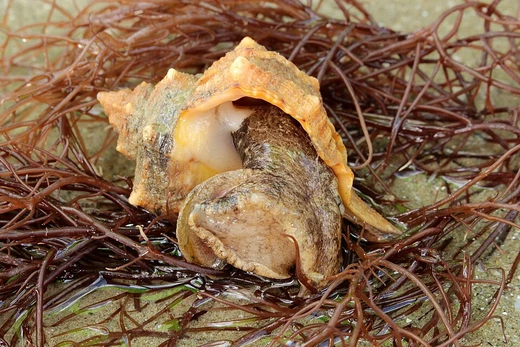
The shell is generally somewhat pear-shaped, often with an extended front end, and has a short spire. The inner lip is smooth and convex. While a varix is typically absent, strong axial sculpture is common. The operculum is oval and blunt, with an elongated nucleus that forms the outer or rear edge.
Genera in this subfamily include Acanthais, Agnewia, †Califrapana, †Chesathais, Concholepas, Cymia, Dicathais, Drupa, Drupina, †Ecphora, Indothais, Mancinella, Menathais, Nassa, Neorapana, Neothais, Phycothais, Pinaxia, Plicopurpura, Purpura, Rapana, Reishia, Semiricinula, Stramonita, Taurasia, Thais, Thaisella, Tribulus, Tylothais, Vasula, and Vexilla.
Several genera are considered synonyms. These include Canrena (synonym of Drupa), Conchopatella and Conchulus (synonyms of Concholepas), Conothais (synonym of Pinaxia), Cuma and Cumopsis (synonyms of Cymia), Iopas (synonym of Nassa), Menathais (synonym of Thais), Microtoma and Patellipurpura (synonyms of Plicopurpura), Pentadactylus (synonym of Drupa), Planithais (synonym of Tribulus), Provexillum (synonym of Vexilla), Purpura (synonym of Trunculariopsis), Purpurella (synonym of Plicopurpura), Ricinella, Ricinula, and Sistrum (all synonyms of Drupa), and Simplicotaurasia (synonym of Taurasia).
Quick Facts
- Taxon
- Rapaninae
Facts from the source article.
Lore & Background
The shell in this subfamily is usually more or less pyriform, and often produced anteriorly. The spire is short. The inner lip is convex and smooth. Shells typically do not have a varix, but strong axial sculpture is often present. The operculum is ovate, blunt, with an elongate nucleus forming the outer or hinder edge.
Genera within Rapaninae include Acanthais, Agnewia, Concholepas, Cymia, Dicathais, Drupa, Drupina, Indothais, Mancinella, Menathais, Nassa, Neorapana, Neothais, Phycothais, Pinaxia, Plicopurpura, Purpura, Rapana, Reishia, Semiricinula, Stramonita, Taurasia, Thais, Thaisella, Tribulus, Tylothais, Vasula, Vexilla, and several extinct genera such as Califrapana, Chesathais, and Ecphora. Many genera have been brought into synonymy, including Canrena, Conchopatella, Conchulus, Conothais, Cuma, Cumopsis, Iopas, Menathais, Microtoma, Patellipurpura, Pentadactylus, Planithais, Provexillum, Purpura, Purpurella, Ricinella, Ricinula, Simplicotaurasia, and Sistrum.
Reader's Guide
Rapaninae represents a significant subfamily within the Muricidae, notable for its predatory ecology and morphological diversity. The subfamily's former designation as Thaidinae reflects taxonomic revisions that culminated in the name change in 1993. The shell characteristics—pyriform shape, short spire, smooth convex inner lip, and absence of a varix—distinguish it from related groups. The presence of strong axial sculpture in many species suggests adaptations for shell strength and predation. The operculum's ovate, blunt form with an elongate nucleus is a consistent diagnostic feature. The extensive list of genera, including both extant and fossil taxa, indicates a long evolutionary history and wide geographic distribution. The many synonymized genera highlight ongoing taxonomic refinement, with names like Drupa, Concholepas, and Thais representing well-known lineages. The inclusion of extinct genera such as Ecphora and Califrapana provides paleontological context, linking the subfamily to Miocene deposits. Overall, Rapaninae is a key group for understanding muricid evolution, shell morphology, and predatory adaptations in marine gastropods.
Did You Know?
- Rapaninae was known as Thaidinae until 1993.
- The shell is usually pyriform and often produced anteriorly, with a short spire.
- Genera within Rapaninae include Drupa, Concholepas, Thais, and Rapana.
More in Murex Snails 1-24
Spotted an error? Know more?
Reader corrections go straight into our review queue. Suggest an edit · How this site is sourced