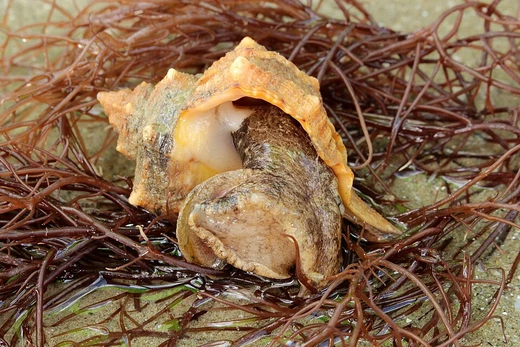
Rapana
Large predatory sea snails with a low spire and calcitic shell.

Rapana is a genus of large, predatory marine snails belonging to the Muricidae family, commonly known as rock snails. Their shells feature a large body whorl, a wide aperture, and a low spire, with a thin calcitic layer covering the surface. The rachidian teeth have three prominent cusps and lack marginal cusps; instead, the outer sides of the lateral cusps have a comb-like structure.
The genus includes three recognized species: *Rapana bezoar*, *Rapana rapiformis*, and *Rapana venosa*. Several other names once considered part of this genus have since been reclassified as synonyms or assigned to other genera, such as *Rapa rapa*, *Coralliophila clathrata*, *Coralliophila erosa*, *Babelomurex japonicus*, *Babelomurex lischkeanus*, *Coralliophila mira*, *Coralliophila nodosa*, *Coralliophila pulchella*, *Latirus rhodostoma*, *Califrapana vaquerosensis*, *Fascioplex liraecostata*, *Fascioplex neozelanica*, and *Mipus fusiformis*.
Quick Facts
- Taxon
- Rapana
Facts from the source article.
Lore & Background
The genus Rapana belongs to the family Muricidae, commonly known as rock snails. Its shell is characterized by a large body whorl and a correspondingly large aperture, with a low spire. The surface is covered in a thin calcitic layer. The rachidian teeth of the radula have three large cusps but no marginal cusps; instead, the outer sides of the lateral cusps bear a comb-like region.
Species within the genus include Rapana bezoar, Rapana rapiformis, and Rapana venosa. Numerous names have been synonymized with these or transferred to other genera. For example, Rapana bella is a synonym of Rapa rapa, while Rapana bulbosa is a synonym of Rapana rapiformis. Several species originally described as Rapana, such as Rapana clathrata and Rapana coralliophila, are now placed in the genus Coralliophila. Fossil taxa like Rapana imperialis and Rapana serrai are considered synonyms of Califrapana vaquerosensis.
The genus has a complex taxonomic history, with many names now regarded as synonyms or reassigned to other families. This reflects ongoing refinement in the classification of muricid gastropods.
Reader's Guide
Rapana snails are notable as large predatory members of the Muricidae, a family that includes many ecologically important rock snails. Their distinctive shell morphology—a large body whorl, low spire, and calcitic surface—aids in identification. The radular structure, with three large cusps and a comb-like lateral region, is a key anatomical feature distinguishing them from related genera.
The genus includes several living species, such as Rapana bezoar, Rapana rapiformis, and Rapana venosa, the last of which has been recorded under numerous synonyms (e.g., Rapana pechiliensis, Rapana pontica, Rapana thomasiana). The extensive synonymy reflects both historical confusion and the wide geographic and morphological variation within the genus. Many names originally assigned to Rapana have since been transferred to other genera, particularly Coralliophila and Babelomurex, indicating that early taxonomists often placed species in Rapana based on superficial shell similarities.
Fossil representatives, such as those once called Rapana imperialis and Rapana serrai, are now assigned to the extinct genus Califrapana. This shows that the concept of Rapana has narrowed over time as phylogenetic understanding improved. The genus remains a subject of study for malacologists interested in muricid evolution and biogeography.
Did You Know?
- The shell of Rapana has a large body whorl and a low spire, covered in a thin calcitic layer.
- The rachidian teeth have three large cusps and a comb-like region on the outer sides of the lateral cusps.
- Rapana venosa has several synonyms, including Rapana pechiliensis, Rapana pontica, and Rapana thomasiana.
- Fossil species once placed in Rapana, such as Rapana imperialis, are now considered synonyms of Califrapana vaquerosensis.
More in Murex Snails 1-24
Spotted an error? Know more?
Reader corrections go straight into our review queue. Suggest an edit · How this site is sourced