Pteropurpura festiva
Predatory sea snail resisting Asian mussel invasion in Southern California.

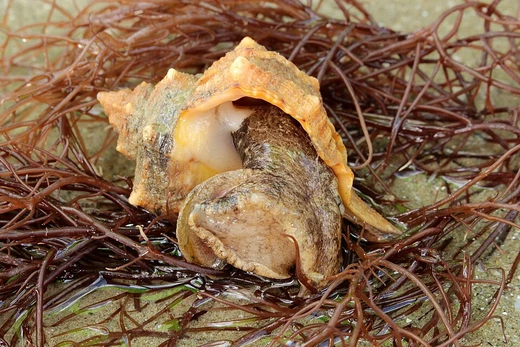
Pteropurpura festiva, called the festive murex, is a predatory sea snail from the Eastern Pacific, belonging to the rock snail family Muricidae. It grows between 34 and 67 mm in length. The shell, which ranges from 20 to 67 mm, is elongately ovate with six convex whorls, each bearing three low, reflexed varices that are finely frilled along the front. Between these varices, a rib features a large, blunt knob on the shoulder. The wide outer lip is finely toothed with 5–7 inner teeth, while the columella is simple and smooth. The oval aperture has a varix extending into a short, deep, recurved siphonal canal. Shell color varies from white to light brown, crossed by evenly spaced, thin, incised spiral lines of dark brown.
This species was formerly known as *Murex festivus*. Its attractive shell is common in San Diego, and the name “The Festivus” was adopted for the San Diego Shell Club’s publication, which began in 1970, later became a scientific malacology journal, and as of 2021 had been published for over 50 years.
A formidable predator, it feeds on mussels, limpets, barnacles, and other snails. Through this predation, it helps resist the invasion of the Asian mussel (*Musculista senhousia*) in Southern California. The snail is abundant in the intertidal zone and mud flats from Southern California (most records from Santa Barbara, Los Angeles, and San Diego) south to Baja California, Mexico.
Quick Facts
- Taxon
- Pteropurpura festiva
Facts from the source article.
Lore & Background
The shell of Pteropurpura festiva is elongately ovate and contains six convex whorls with three low, reflexed varices per whorl, finely frilled on the front. Between these varices, a rib shows a large, blunt knob on the shoulder. The wide outer lip is finely dentate with 5–7 teeth inside, while the columella is simple and smooth. The oval aperture has a varix extending to the short, deep and recurved siphonal canal. The ground color varies from white to light brown, crossed by evenly spaced, thin, incised, spiral dark brown lines.
This species was previously known as Murex festivus. Because the shell is attractive and common in San Diego, the name 'The Festivus' was used for the San Diego Shell Club publication, which started in 1970, became a science journal on malacology, and as of 2021 has been published for over 50 years.
It is a formidable predator on mussels, limpets, barnacles and other snails. Through this biotic characteristic, it is responsible for resistance to the Asian mussel (Musculista senhousia) invasion in Southern California.
Reader's Guide
The festive murex holds significance both as a common intertidal predator and as a species whose attractive shell lent its name to a long-running malacological journal. Its predatory habits—feeding on mussels, limpets, barnacles, and other snails—have given it an ecological role in resisting the invasion of the Asian mussel (Musculista senhousia) in Southern California. This biotic resistance highlights the species' importance in maintaining native community structure. The shell's beauty and abundance in San Diego led to the founding of the San Diego Shell Club publication 'The Festivus' in 1970, which evolved into a scientific journal on malacology and has been published for over 50 years as of 2021. The species' distribution ranges from Southern California (with most records from Santa Barbara, Los Angeles, and San Diego) to Baja California, Mexico, where it occurs abundantly in the intertidal zone and mud flats. Its legacy is thus twofold: as a native predator that helps control an invasive species, and as the namesake of a lasting scientific publication.
Did You Know?
- The festive murex was previously known as Murex festivus.
- Its shell is common in San Diego and gave its name to the malacology journal 'The Festivus'.
More in Murex Snails 1-24
Spotted an error? Know more?
Reader corrections go straight into our review queue. Suggest an edit · How this site is sourced