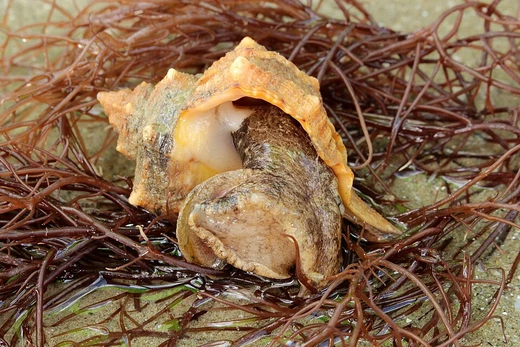
Ocenebrinae
A subfamily of predatory sea snails within the murex family.

Ocenebrinae is a taxonomic subfamily of predatory sea snails, marine gastropod mollusks, within the large family Muricidae, commonly known as the murex and rock snails. This subfamily includes numerous genera, both extant and fossil, and is notable for its taxonomic complexity, with some genera alternatively grouped into a separate subfamily called Haustrinae.
Quick Facts
- Taxon
- Ocenebrinae
Facts from the source article.
Lore & Background
The subfamily Ocenebrinae was established within the family Muricidae, which encompasses the murex and rock snails. Its classification has been subject to revision; in one version of current gastropod taxonomy, three of its genera are placed in a separate small subfamily called Haustrinae. The subfamily contains a diverse array of genera, including both living and fossil forms, such as Acanthina, Nucella, Ocenebra, and many others. Fossil genera like Ecphora are also recognized within the group. Numerous genera have been brought into synonymy over time, reflecting ongoing taxonomic refinement; for example, Monoceros Lamarck, 1809 is a junior homonym of Monoceros Lacépède, 1798 and is considered a synonym of Acanthina. The subfamily's history is documented through molecular phylogenetic studies, such as a 2017 analysis that provided a framework for the group.
Reader's Guide
The subfamily Ocenebrinae holds significance within the Muricidae as a taxonomically rich and debated group of predatory marine gastropods. Its legacy is tied to the complexity of its classification, with multiple genera historically reassigned or synonymized, reflecting the challenges of molluscan systematics. The inclusion of both extant and fossil genera underscores its deep evolutionary history, while alternative taxonomic arrangements—such as the separation of some genera into Haustrinae—highlight ongoing scientific discourse. The subfamily's predatory ecology and its representation in the fossil record contribute to its importance in understanding muricid evolution and biogeography. Molecular studies, including a 2017 phylogenetic analysis, have helped clarify relationships within the group, though taxonomic uncertainties persist. The extensive list of synonyms and homonyms, such as the invalid junior homonym Monoceros, illustrates the meticulous work required to stabilize nomenclature. Overall, Ocenebrinae serves as a case study in the dynamic nature of biological classification and the interplay between morphological and molecular data.
Did You Know?
- Ocenebrinae is a subfamily within the family Muricidae, which includes murex and rock snails.
- In one taxonomic version, three genera of Ocenebrinae are placed in a separate subfamily called Haustrinae.
- The genus Monoceros Lamarck, 1809 is an invalid junior homonym and is considered a synonym of Acanthina.
- Fossil genera such as Ecphora are included within Ocenebrinae.
More in Murex Snails 1-24
Spotted an error? Know more?
Reader corrections go straight into our review queue. Suggest an edit · How this site is sourced