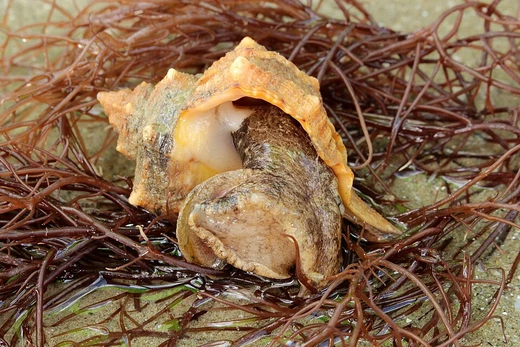
Nucella ostrina
A predatory murex snail of the northeastern Pacific intertidal zone.

Nucella ostrina, also called the northern striped dogwinkle, is a sea snail belonging to the Muricidae family—the murex or rock snails. This marine gastropod mollusk goes by many other common names, including emarginate dogwinkle, short-spired purple dogwinkle, striped dogwinkle, ribbed dogwinkle, emarginate whelk, ribbed rock whelk, rock thais, short-spired purple snail, and rock whelk.
The shell of this dogwinkle is sturdy and has three faint whorls. It can reach 4 cm in length, though 3 cm or less is more typical. The opening, or aperture, is less than half the shell’s diameter and can be sealed shut with a brown, horny operculum. The shell’s exterior is marked with spiral ridges; heavy ridges often alternate with finer ones. In rougher, more exposed areas, both the heavy ridges and any coarse nodules on them may be partially worn smooth. The ridges are usually pale, while the furrows between them are dark—commonly brown, gray, black, orange, or yellow. Inside, the shell is purple.
This species is native to the northeastern Pacific Ocean. Its range runs down the western coast of North America from the Aleutian Islands in Alaska to Cayucos, California. It lives in the intertidal zone on rocky shores, often near mussel beds, and especially in spots that get hit by waves.
Like other members of its family, this dogwinkle is a predator. While individual snails have their own food preferences, the population as a whole mostly eats mussels and barnacles (Balanus glandula), but also sometimes periwinkles (Littorina sitkana and Littorina planaxis) or limpets (Collisella scabra). The bay mussel (Mytilus trossulus) is usually preferred over the California mussel (Mytilus californianus). Once it picks its prey, the dogwinkle drills into the shell with its radula, injects digestive enzymes to liquefy the tissues, and then sucks out the contents.
The dogwinkle itself is eaten by the purple sea star (Pisaster ochraceus) and the red rock crab (Cancer productus). It lays its eggs in clusters of stalked capsules, called “sea oats,” which are attached to rocks high in the intertidal zone. Each capsule holds about 550 eggs, but most are infertile and are eaten by the developing young. Only 10 to 20 juveniles hatch from each capsule after three or four months, skipping any intermediate larval stage.
Quick Facts
- Genus
- Nucella
- Species
- ostrina
Facts from the source article.
Lore & Background
The shell of Nucella ostrina is robust with three indistinct whorls, reaching up to 4 cm in length but more typically 3 cm or less. The exterior bears spiral ridges, often with heavy ridges alternating with finer ones; these heavy ridges may have coarse nodules, though in more exposed locations both nodules and ridges can be partially smoothed. The ridges tend to be pale, while the furrows between them are dark—commonly brown, gray, black, orange, or yellow. The interior of the shell is purple, and the aperture can be closed by a brown, horny operculum.
This dogwinkle is a predator, with each individual having its own food preferences, but the population as a whole feeds predominantly on mussels and barnacles (Balanus glandula), and sometimes on periwinkles (Littorina sitkana and Littorina planaxis) or limpets (Collisella scabra). The bay mussel (Mytilus trossulus) is usually preferred over the California mussel (Mytilus californianus). After selecting prey, the dogwinkle drills into the shell with its radula, injects digestive enzymes to liquefy the tissues, and sucks out the contents.
N. ostrina is itself preyed upon by the purple sea star (Pisaster ochraceus) and the red rock crab (Cancer productus). It lays eggs in clusters of stalked capsules known as 'sea oats,' attached to rocks high in the intertidal zone. Each capsule contains around 550 eggs, most of which are infertile and consumed by the developing juveniles; 10 to 20 juveniles hatch after three or four months, without an intermediate larval stage.
Reader's Guide
Nucella ostrina holds significance as a common intertidal predator along the northeastern Pacific coast, playing a key role in controlling populations of mussels and barnacles in wave-exposed rocky habitats. Its feeding behavior—drilling into prey with a radula and using digestive enzymes—exemplifies the predatory strategy typical of muricid snails. The species' reproductive strategy, with stalked egg capsules containing many infertile eggs that nourish developing juveniles, is a notable adaptation that ensures high survival rates without a free-swimming larval stage. The variety of common names, including northern striped dogwinkle, emarginate dogwinkle, and rock thais, reflects its widespread recognition and morphological variation across its range from Alaska to California. Its shell, with alternating pale ridges and dark furrows, and purple interior, makes it a distinctive component of the intertidal fauna. The species' interactions with predators such as the purple sea star and red rock crab further illustrate its place in the coastal food web. Overall, N. ostrina is a representative example of the ecological and morphological diversity within the Muricidae family.
More in Murex Snails 1-24
Spotted an error? Know more?
Reader corrections go straight into our review queue. Suggest an edit · How this site is sourced