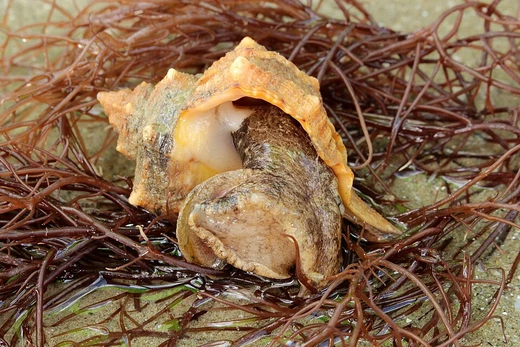
Nucella lamellosa
A predatory whelk of the eastern Pacific intertidal zone.

The frilled dogwinkle, also called the wrinkled purple whelk, is a type of sea snail found in the eastern Pacific Ocean. It belongs to the Muricidae family, which includes murex and rock snails. Its range runs along the intertidal zone from the Aleutian Islands down to central California.
This snail is large, with a strong shell that can reach 100 mm in length and 50 mm in width. The shell has no more than seven whorls and a horny operculum. Its spire is well developed, with a short notch for the siphon. The snail varies a lot in color, shape, and surface texture. Some individuals are smooth, others rough, and some have frilled lamellae, or angular plates. These features may result from abrasion and wave action. When spiral sculpture is present, it appears as one or two ridges per whorl, and the whorls are flattened near their joints, making them look angled. Colors include white, grey, brown, or orange, occasionally purplish, and sometimes the shell has spiral bands.
The whelk lives in shallow waters from the Bering Strait and Aleutian Islands to central California. It is found intertidally on rocks from the mid to lower shore and is one of the most common whelks in this habitat in the Pacific Northwest.
It is a predator, feeding mostly on mussels and barnacles. It uses its radula to scrape through the prey’s shell and extract the soft tissue. In turn, the whelk is eaten by crabs like the red rock crab *Cancer productus* and the seastar *Pisaster ochraceus*. When crabs are present, the whelk’s shell tends to grow thicker and more robust, making it harder for the crab to crush. This may be due to chemicals the crabs release into the water, since the shell thickness is unaffected by the invasive crab *Carcinus maenas*, which also eats whelks.
In the presence of seastars, the whelk’s shell tends to become longer with a higher spire, allowing the animal to retract its soft tissues as far as possible from the predator. If both crabs and seastars are present, the shell shape that evolves reflects the response to whichever predator causes the most deaths. The whelks also show behavioral responses to both predators by seeking refuge.
Breeding happens in hidden spots, such as under rocks. Many whelks gather to mate and lay eggs in capsules that look like clusters of oats, dangling from the substrate.
Quick Facts
- Taxon
- Nucella lamellosa
Facts from the source article.
Lore & Background
Nucella lamellosa is a large snail with a strong shell, growing to a length of 100 mm and width of 50 mm. The shell has no more than seven whorls and a horny operculum. The spire is well developed, with a short notch to accommodate the siphon. This snail is rather variable in colour, shape and surface texture; some specimens are smooth, others rough, and others have frilled lamellae. Some of these features may be as a result of abrasion and wave action. When present, the spiral sculpture takes the form of one or two ridges per whorl, the whorls being flattened near their joints making them appear angled. The snail can be white, grey, brown or orange, occasionally purplish, and is sometimes spirally banded.
This whelk is a predator, feeding largely on mussels and barnacles. The radula is used to scrape through the shell of the prey and the soft tissue is extracted. The whelk is itself eaten by crabs such as the red rock crab Cancer productus and the seastar Pisaster ochraceus. In the presence of the crabs, there is a tendency for the whelk's shell to grow thicker and more robust, and thus less easy for the crab to crush. This may be as a result of chemicals released into the water by the crabs, because the thickness of the whelk's shell seems unaffected by the presence of Carcinus maenas, a recently introduced invasive species of crab that also feeds on whelks. A different response in shell morphology was evinced in the presence of the seastar: the shell tended to get longer with a high spire, enabling the whelk to retract its soft tissues as far as possible from the seastar. If both crabs and seastars were present, the shell phenotype that tended to evolve reflected the response to the predator that caused the greatest mortality. The whelks also show behavioural responses to both crabs and seastars by seeking refuge.
Breeding takes place in hidden locations such as under rocks, with many whelks congregating to mate and lay eggs in capsules which resemble clusters of oats as they dangle from the substrate.
Reader's Guide
Nucella lamellosa is one of the commonest whelks in the intertidal zone of the Pacific Northwest, found from the Bering Strait and Aleutian Islands to central California. Its significance lies in its role as a predator of mussels and barnacles, shaping the intertidal community. The species is notable for its phenotypic plasticity in response to predators: shell thickness increases in the presence of crushing crabs like Cancer productus, while shell length and spire height increase in the presence of the seastar Pisaster ochraceus. These induced defenses appear to be mediated by chemical cues from the predators, as the invasive crab Carcinus maenas does not trigger the same thickening response. When both predators are present, the shell morphology that evolves reflects the predator causing the greatest mortality. The whelk also exhibits behavioral responses, seeking refuge from both crabs and seastars. Its variable shell morphology—smooth, rough, or frilled—may partly result from abrasion and wave action. Breeding aggregations under rocks produce egg capsules that resemble clusters of oats, a distinctive reproductive strategy. The species thus serves as a model for understanding predator-prey coevolution and inducible defenses in marine gastropods.
Did You Know?
- Its shell may grow thicker in the presence of the crab Cancer productus, possibly due to chemical cues.
- The egg capsules of this whelk resemble clusters of oats dangling from the substrate.
More in Murex Snails 1-24
Spotted an error? Know more?
Reader corrections go straight into our review queue. Suggest an edit · How this site is sourced