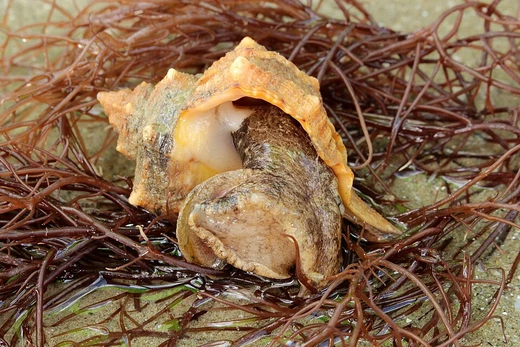
Nucella canaliculata
A predatory murex snail of the northeastern Pacific intertidal zone.

The channeled dog winkle, also called the channeled purple, is a sea snail in the murex family. Its shell is sturdy, with a tall spire, a short notch for the siphon, and up to seven whorls. Deep grooves separate the whorls, which are covered in many low, evenly sized spiral ridges. The shell’s surface is dull; young snails are often orange, while older ones are grayish or pale brown. The aperture’s edges are frequently yellow, and the animal’s soft body is shielded by a horny operculum. The shell reaches about 4 cm at most. This species differs from the frilled dog winkle by lacking frilled decorations, and from the northern striped dog winkle by having ridges of uniform size.
This dog winkle lives along North America’s Pacific coast, from the Aleutian Islands down to San Luis Obispo County, California, though it is rare north of Puget Sound or south of San Francisco Bay. It inhabits both exposed and sheltered rocks in the intertidal zone, and is especially common in wave-beaten areas of the Olympic Peninsula and near mussel beds.
A predator, it feeds on mussels and barnacles by drilling a hole through their shells. Research shows it is more successful drilling into the barnacle *Semibalanus cariosus* between its lateral plates rather than through them. After drilling, it injects a toxin that relaxes the barnacle’s muscles and opens its opercular valves, allowing the dog winkle to eat the soft tissues easily.
Quick Facts
- Taxon
- Nucella canaliculata
Facts from the source article.
Lore & Background
Nucella canaliculata has a robust shell with a strong spire, a short notch to house the siphon, and up to seven whorls. The whorls are demarcated from each other by deep grooves and are sculpted with many low spiral ridges of approximately even size. The surface of the shell is matt; small individuals are often orange while larger ones are grayish or pale brown. The margins of the aperture are often yellow, and the animal's soft parts are protected by a horny operculum. This dog winkle can be distinguished from the frilled dog winkle (Nucella lamellosa) by the absence of frilled decoration, and from the northern striped dog winkle (Nucella ostrina) by the evenness of the size of the sculpted ridges.
Its range extends from the Aleutian Islands off Alaska to San Luis Obispo County, California, but it is uncommon to the north of Puget Sound or to the south of San Francisco Bay. It is found on both exposed and sheltered rocks in the intertidal zone and is particularly common in wave-exposed areas of the Olympic Peninsula and near mussel beds.
N. canaliculata is a predator and feeds on mussels and barnacles by drilling a hole through the shell. Researchers found that the dog winkle was more successful at drilling into the barnacle Semibalanus cariosus when it drills between the lateral plates rather than through them. A toxin is then injected through the hole which causes the barnacle's muscles to relax and the opercular valves to gape, whereupon the dog winkle can easily consume the soft tissues.
Reader's Guide
The channeled dog winkle holds significance as a common intertidal predator along the Pacific coast of North America, particularly in wave-exposed areas of the Olympic Peninsula and near mussel beds. Its feeding behavior—drilling through barnacle shells and injecting a toxin to relax the prey's muscles—illustrates a specialized predatory adaptation within the Muricidae family. The species is also notable for its morphological distinctions from related dog winkles: it lacks the frilled decoration of Nucella lamellosa and has evenly sized spiral ridges unlike Nucella ostrina. Its shell, reaching about 4 cm, varies in color from orange in small individuals to grayish or pale brown in larger ones, with a matt surface and often yellow aperture margins. The species' distribution, from the Aleutian Islands to San Luis Obispo County, California, with reduced frequency north of Puget Sound and south of San Francisco Bay, reflects its ecological preferences for both exposed and sheltered intertidal rocks. The documented drilling success on the barnacle Semibalanus cariosus when targeting between lateral plates highlights the precision of its predatory strategy. These characteristics contribute to its role in intertidal community dynamics and its recognition as a distinct species within the northeastern Pacific muricid fauna.
More in Murex Snails 1-24
Spotted an error? Know more?
Reader corrections go straight into our review queue. Suggest an edit · How this site is sourced