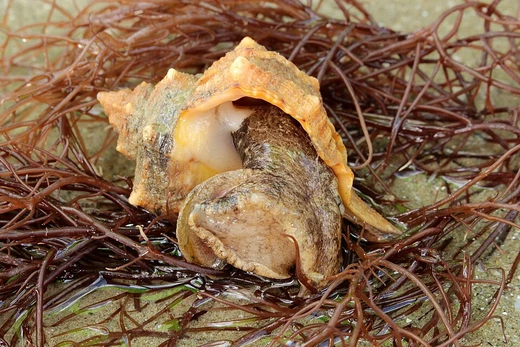
Muricopsinae
A polyphyletic subfamily of predatory sea snails in Muricidae.

Muricopsinae is a subfamily within the larger family Muricidae, which includes murex and rock snails. These are predatory sea snails, specifically marine gastropod mollusks. Research published in September 2010 found that this subfamily is polyphyletic.
Members of this group are identified by features of their operculum and radula. Their shells are fusiform to biconic, meaning they are broad in the middle and taper at both ends, ranging from 5 mm to 85 mm in length. Shell color is white or brown, overlaid with muted shades of brown, orange, red, or purple. The aperture is broadly oval to nearly round and varies in size. Unlike other Muricidae, the siphonal canal is moderately long. Each convex whorl has four or more prominent varices—thickened axial ridges—that may bear leafy or spiny projections. The operculum resembles that of the Muricinae subfamily: unguiculate, thickened at the edge, and depressed with rings in the center. The rachiglossan radula has a three-dimensional rachidian tooth with a raised central cusp and two lateral teeth per row, similar to the Ocenebrinae subfamily.
Genera within Muricopsinae occur worldwide, mainly in tropical and subtropical waters, at depths from 0 to 300 meters.
The recognized genera include Acanthotrophon, Bizetiella, Eofavartia, Favartia, Homalocantha, Maxwellia, Murexsul, Muricopsis, Pazinotus, Pradoxa, Pygmaepterys, Rolandiella, Subpterynotus, Vitularia, and Xastilia. Several former genera are now considered synonyms: Minnimurex is accepted as Murexiella; Murexiella is accepted as Favartia (Murexiella); Paradoxa and Paradoxon are both accepted as Pradoxa; Risomurex is accepted as Muricopsis (Risomurex); and Transtrafer is accepted as Vitularia.
Quick Facts
- Taxon
- Muricopsinae
Facts from the source article.
Lore & Background
The subfamily Muricopsinae has been delineated based on the characteristics of the operculum and the radula. The shell is wide in the middle and tapers at both ends, making it fusiform to biconic, with a length varying between 5 mm and 85 mm. Its color is white or brown, covered with subdued shades of brown, orange, red or purple markings. The aperture is broadly oval to almost round and of variable size. Contrary to other Muricidae, the siphonal canal is of moderate length. Like other murex shells, each convex whorl shows a variable number (four or more) of more or less prominent varices, which in turn show foliaceous or spinose projections.
The operculum is the same as in the subfamily Muricinae: unguiculate, thickened at the margin and depressed and annulate in the middle. The rachiglossan radula has in each row a three-dimensional rachidian tooth with a raised central cusp and two lateral teeth, as in the subfamily Ocenebrinae. The genera in this subfamily are distributed worldwide, mainly in tropical and subtropical waters, at depths between 0 and 300 m.
Reader's Guide
Muricopsinae holds significance as a subfamily within the large and diverse family Muricidae, distinguished by opercular and radular characteristics. Its polyphyletic status, revealed in a September 2010 study, indicates that the group does not share a single common ancestor, which has implications for taxonomic classification and evolutionary understanding of muricid snails. The subfamily includes a wide array of genera, such as Acanthotrophon, Favartia, Muricopsis, and Vitularia, among others, reflecting morphological diversity in shell shape, size, and ornamentation. Several genera previously recognized have become synonyms, illustrating ongoing taxonomic refinement. The shells, ranging from 5 mm to 85 mm, exhibit fusiform to biconic shapes with variable varices and foliaceous or spinose projections, typical of murex snails. The moderate siphonal canal sets them apart from other Muricidae. Distributed worldwide in tropical and subtropical waters from the intertidal zone to depths of 300 meters, these predatory snails occupy a broad ecological range. The legacy of Muricopsinae lies in its contribution to the study of muricid phylogeny and the challenges of classifying polyphyletic groups, as well as in the aesthetic and biological interest of its diverse shell forms.
Did You Know?
- A study released in September 2010 showed that Muricopsinae is polyphyletic.
- The subfamily has been delineated based on characteristics of the operculum and the radula.
- The shell length varies between 5 mm and 85 mm.
More in Murex Snails 1-24
Spotted an error? Know more?
Reader corrections go straight into our review queue. Suggest an edit · How this site is sourced