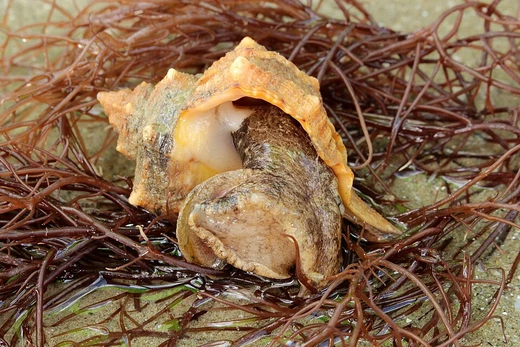
Coralliophilinae
Coral-dwelling snails that feed exclusively on anthozoans.

Coralliophilinae is a subfamily of marine gastropod mollusks, comprising roughly 200 to 250 species of sea snails. Commonly called coral snails or coral shells, they are part of the larger family Muricidae, which includes murex and rock snails. Before the 2005 revision of gastropod taxonomy by Bouchet and Rocroi, this group was classified as its own family, the Coralliophilidae. Genetic studies using molecular markers have since confirmed that the subfamily is monophyletic.
These snails are found worldwide in temperate and tropical seas, always living on or near corals. Their range includes the mid-Atlantic seamounts, the Canary Islands, deep-water coral banks in the Mediterranean, the region from the Florida Keys to Brazil, the Indo-Pacific, the southwest Pacific, and the Austral Islands. Their wide distribution is likely due to ocean currents and a planktotrophic larval stage.
Coral snails are specialized feeders, eating only anthozoans. They bore into their prey, though a few species live among soft corals and anemones, using a long, extendable proboscis to consume soft tissue. Some also feed on sea fans.
Genera in the subfamily include *Babelomurex*, *Coralliophila*, *Emozamia*, *Hirtomurex*, *Latiaxis*, *Leptoconchus*, *Liniaxis*, *Magilus*, *Mipus*, *Rapa*, and *Rhizochilus*. Many former genera have been synonymized, mostly under *Coralliophila* or *Babelomurex*. Systematics at the species level is challenging because many adults show wide morphological variation that depends on their substrate. The shape of the protoconch is often a useful taxonomic trait.
Quick Facts
- Taxon
- Coralliophilinae
Facts from the source article.
Lore & Background
The coral snails occur worldwide in temperate and tropical seas, found in diverse locations such as the mid-Atlantic seamounts, the Canary Islands, deep water coral banks in the Mediterranean, from the Florida Keys to Brazil, the Indo-Pacific Region, the southwest Pacific, and the Austral Islands. Their wide dispersal is attributed to oceanic currents and planktotrophic larval development.
These snails are specialist feeders, feeding exclusively on anthozoans by boring into them. A few live between soft corals and anemones and use their long, extensible proboscis to ingest soft tissue; some feed on sea fans. Within the subfamily, systematics at the species level is problematic because many adult species show broad intraspecific morphologic variability that also depends on the substrate they inhabit. The morphology of the protoconch is usually very helpful as a taxonomic character.
Reader's Guide
The subfamily Coralliophilinae holds significance as a monophyletic group within the Muricidae, confirmed by molecular markers. Its taxonomic history includes a period when it was considered a distinct family, the Coralliophilidae, before being reclassified as a subfamily. The group comprises about 200–250 species, with genera including Babelomurex, Coralliophila, Emozamia, Hirtomurex, Latiaxis, Leptoconchus, Liniaxis, Magilus, Mipus, Rapa, and Rhizochilus. Many genera have been brought into synonymy, particularly with Coralliophila and Babelomurex, reflecting ongoing taxonomic refinement. The coral snails' ecological role as specialist feeders on anthozoans, including boring into corals and feeding on sea fans, underscores their specialized niche in marine ecosystems. Their global distribution across temperate and tropical seas, facilitated by oceanic currents and planktotrophic larvae, highlights their adaptability. The problematic species-level systematics, due to intraspecific variability linked to substrate, makes the protoconch morphology a key diagnostic tool for researchers.
Did You Know?
- Coralliophilinae was once classified as a distinct family, the Coralliophilidae.
- These snails feed exclusively on anthozoans by boring into them.
- The subfamily includes about 200–250 species worldwide.
- Genetic research with molecular markers has confirmed the subfamily is monophyletic.
More in Murex Snails 1-24
Spotted an error? Know more?
Reader corrections go straight into our review queue. Suggest an edit · How this site is sourced