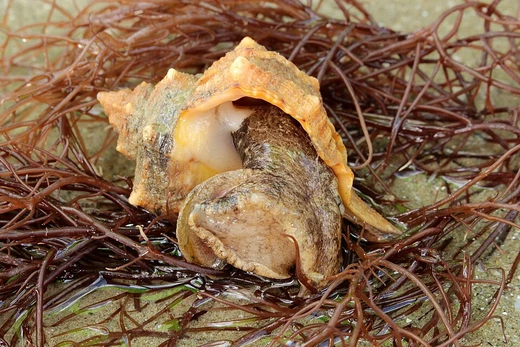
Bolinus
A genus of spiny, predatory sea snails known for purple dye.

Bolinus is a genus of marine gastropod mollusks, commonly known as murex or rock snails, belonging to the family Muricidae. These sea snails appear in the fossil record from the Miocene through the Pliocene epochs, with fossilized shells uncovered in Cyprus, Austria, Italy, and Turkey. Since ancient times, certain species in this genus have been valued both as a source of purple dye and as a popular food item.
Adult Bolinus shells typically range from 60 to 200 millimeters in size. They are thick, spiny, and usually pale or golden brown, featuring a long, straight siphonal canal and a rounded, broad body whorl. These snails are carnivorous and predatory.
Their distribution is mainly along the Atlantic coast of Africa and within the Mediterranean Sea. They inhabit shallow waters, preferring gravelly or rocky substrates.
Species within the genus include *Bolinus brandaris*, *Bolinus cornutus*, *Bolinus brandaris nivea*, *brandaris* form *trispinosus*, *Bolinus brandaris longispinus*, and numerous other forms such as *coronatus*, *trituberculatus*, *bicaudatus*, *cagliaritanus*, *brevis*, *polii*, *elongata*, *coronatus x polii*, *varicosus*, and *rubiginosus*, as well as a species described by Stigwan and Fabiod in 2019.
Quick Facts
- Taxon
- Bolinus
- Type Species
- Murex brandaris
- Type Species Authority
- Linnaeus, 1758
Facts from the source article.
Lore & Background
Bolinus species have thick, spiny shells with a long and straight siphonal canal and a rounded, broad body whorl. Adult shells typically reach 60 to 200 mm in size and are pale or golden brown. These snails are carnivorous and predatory, inhabiting shallow waters along the Atlantic coast of Africa and in the Mediterranean Sea, where they prefer gravelled or rocky substrates.
The genus is represented in the fossil record from the Miocene through the Pliocene, with fossil shells documented in Cyprus, Austria, Italy and Turkey. Several species and forms are recognized within the genus, including Bolinus brandaris, Bolinus cornutus, and numerous named forms such as brandaris form trispinosus, brandaris form coronatus, and brandaris form rubiginosus, among others.
Reader's Guide
Bolinus holds significance both as a source of purple dye in ancient times and as a popular food source. The genus is well represented in the fossil record, with shells found across Europe and the Mediterranean region, indicating its long-standing presence in these waters. The spiny, thick shells of Bolinus species are distinctive among muricids, and the variety of named forms—such as brandaris form bicaudatus, brandaris form elongata, and brandaris form polii—reflects morphological diversity within the genus. Modern taxonomic references, including works by Merle, Garrigues and Pointier (2011) and Gofas, Le Renard and Bouchet (2001), have catalogued both fossil and recent species. The genus continues to be studied for its evolutionary history and its role in human culture, from ancient dye production to contemporary malacology.
Did You Know?
- Bolinus is known in the fossil record from the Miocene to the Pliocene period.
- Fossil shells of Bolinus have been found in Cyprus, Austria, Italy and Turkey.
- Some species were used since ancient times as a source for purple dye and as food.
- Adult shells of Bolinus species can reach a size of about 60–200 mm.
More in Murex Snails 1-24
Spotted an error? Know more?
Reader corrections go straight into our review queue. Suggest an edit · How this site is sourced