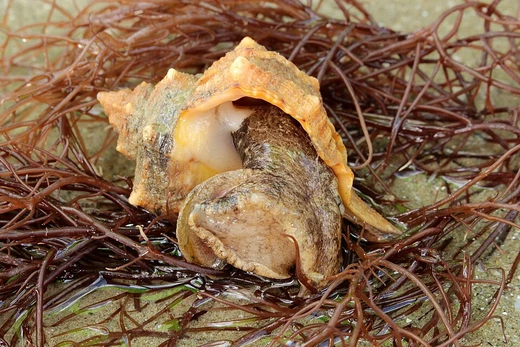
Bolinus brandaris
A predatory sea snail historically used for Tyrian purple dye.

Bolinus brandaris, originally described as Murex brandaris by Linnaeus, is a medium-sized predatory sea snail in the family Muricidae. Commonly known as the purple dye murex or spiny dye-murex, it is an edible marine gastropod mollusc notable for its historical use by the Phoenicians to extract imperial Tyrian purple dye.
Quick Facts
- Taxon
- Bolinus brandaris
Facts from the source article.
Lore & Background
Bolinus brandaris lives in the central and western Mediterranean Sea and has also been found on isolated coral atoll beaches in the Indian Ocean and South China Sea. It inhabits rocks in shallow water. The adult shell reaches about 6 to 9 cm, is usually golden brown, and has a very long siphonal canal, a rounded body whorl with a low spire, and a row of spines corresponding to the end of each growth stage.
This species is known in the fossil record from the Pliocene, with fossil shells found in Cyprus, Spain, and Italy. It was used by the Phoenicians in ancient times to extract imperial Tyrian purple dye. Like many muricids, it produces a milky, colorless secretion that turns into a powerful, lasting dye when exposed to air. The dye is secreted in the mucus of the hypobranchial glands.
Bolinus brandaris is a cannibalistic species. Evidence suggests that intensive breeding by the ancient Minoans resulted in pierced shells, possibly by other snails, due to population density in breeding tanks. In Spain, particularly on the Mediterranean coast and the Gulf of Cádiz, it is called cañaílla and is appreciated as food. It has also been a popular food source under various names, including sconciglio, from which the word scungilli derives.
Reader's Guide
Bolinus brandaris holds significant historical and cultural importance as the primary mollusc species used by the Phoenicians to produce Tyrian purple, a highly prized imperial dye in antiquity. The dye, secreted from the hypobranchial glands, is initially milky and colorless but develops into a powerful and lasting purple color upon exposure to air. This species, along with Hexaplex trunculus (banded dye-murex, which produced a purple-blue or indigo dye), was central to ancient dye industries.
The species is also notable for its role as a food source, known under names such as sconciglio (from which scungilli derives) and cañaílla in Spain, where it is appreciated on the Mediterranean coast and the Gulf of Cádiz. Its cannibalistic behavior, evidenced by pierced shells possibly caused by other snails in high-density breeding tanks used by the Minoans, adds to its biological interest. The shell, with its distinctive golden brown color, long siphonal canal, and spines, is a recognizable feature of the Muricidae family. The species is also present in the fossil record from the Pliocene, with remains found in Cyprus, Spain, and Italy, indicating its long-standing presence in the Mediterranean region.
Did You Know?
- The adult shell of Bolinus brandaris reaches about 6 to 9 cm.
- The species is cannibalistic; evidence suggests Minoan breeding tanks led to pierced shells from other snails.
Frequently Asked Questions
What is Bolinus brandaris?
Bolinus brandaris is a medium-sized predatory sea snail in the Muricidae family, originally named Murex brandaris by Linnaeus. It goes by the common names purple dye murex and spiny dye-murex, and it is also an edible marine gastropod.
What does a Bolinus brandaris shell look like?
The shell is golden brown and spiny, reaching a length of about 6 to 9 centimeters in a fully mature individual.
Where does Bolinus brandaris live in the wild?
You'll find it clinging to rocks in shallow water throughout the central and western Mediterranean Sea. It also turns up on isolated coral atoll beaches in the Indian Ocean and the South China Sea.
Why is Bolinus brandaris historically famous?
The Phoenicians harvested this snail to extract the prized Tyrian purple dye used to color imperial fabrics. That ancient dye-making role is the source of its 'purple dye murex' nickname.
How old is the Bolinus brandaris lineage?
Fossils place this group in the Pliocene epoch, spanning roughly 3.6 to 2.588 million years ago. Specimens have been recovered from deposits in Cyprus, Spain, and Italy.
More in Murex Snails 1-24
Spotted an error? Know more?
Reader corrections go straight into our review queue. Suggest an edit · How this site is sourced