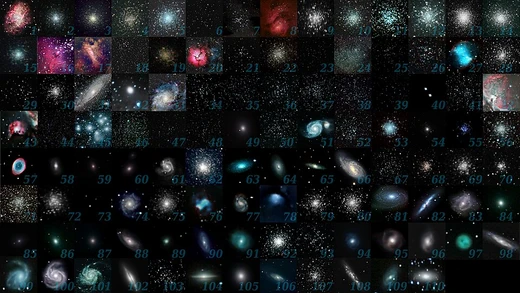
Messier 107
A very loose globular cluster near the equator in Ophiuchus.

Messier 107 (M107), also known as NGC 6171 or the Crucifix Cluster, is a very loose globular cluster located close to the equator in the constellation Ophiuchus. It is the last such object in the Messier Catalogue.
Quick Facts
- Epoch
- J2000
- Class
- X
- Constellation Name
- Ophiuchus
- Ra
- 16 · 32 · 31.86
- Dec
- –13 · 03 · 13.6
- Dist Ly
- 20.9 kly
- Appmag V
- 7.9
- Radius Ly
- 30 ly
- Metal Fe
- –0.95
- Age
- 13.95 Gyr
- Names
- C 1629-129, GCl 44, M 107, NGC 6171
Facts from the source article.
Lore & Background
Messier 107 was discovered by Pierre Méchain in April 1782, then independently by William Herschel in 1793. John Herschel, in his 1864 General Catalogue, described it as a 'globular cluster of stars, large, very rich, very much compressed, round, well resolved, clearly consisting of stars.' It was not until 1947 that Helen Sawyer Hogg added it and three other objects found by Méchain to the modern Catalogue, the latter having contributed several of the suggested observation objects which Messier had verified and added. The cluster is to be found 2.5° south and slightly west of the star Zeta Ophiuchi.
M107 is close to the galactic plane and about 20,900 light-years from Earth and 9,800 ly (3,000 pc) from the Galactic Center. Its orbit is partly as far out as the galactic halo, as is between 9,200–12,400 ly (2,820–3,790 pc) from the Galactic Center, the lower figure, the 'perigalactic distance' sees it enter and leave the galactic bar. There are 22 known RR Lyrae variable stars in this cluster and a probable SX Phoenicis variable.
Reader's Guide
Messier 107 is notable as the last object in the Messier Catalogue, a fact that underscores its late addition to the collection. Its discovery history involves two independent astronomers: Pierre Méchain in April 1782 and William Herschel in 1793, with John Herschel later providing a detailed description in his 1864 General Catalogue. The cluster was not formally included in the modern Messier Catalogue until 1947, when Helen Sawyer Hogg added it along with three other Méchain discoveries. This delayed inclusion highlights the evolving nature of the catalogue and the contributions of later astronomers. The cluster's position close to the galactic plane and its orbit, which takes it into the galactic bar and out to the halo, provide context for its structure and variable star population, including 22 known RR Lyrae variables and a probable SX Phoenicis variable. Its location 2.5° south and slightly west of Zeta Ophiuchi aids amateur observers in locating it.
Did You Know?
- M107 was discovered by Pierre Méchain in April 1782 and independently by William Herschel in 1793.
- It was not added to the modern Messier Catalogue until 1947 by Helen Sawyer Hogg.
- The cluster contains 22 known RR Lyrae variable stars and a probable SX Phoenicis variable.
- Its orbit ranges from 9,200 to 12,400 light-years from the Galactic Center, entering and leaving the galactic bar.
More in Messier Objects, Part 3 1-24
Spotted an error? Know more?
Reader corrections go straight into our review queue. Suggest an edit · How this site is sourced