Messier 86
Elliptical or lenticular galaxy with highest Messier blue shift.

Sloan Digital Sky Survey · CC BY 4.0
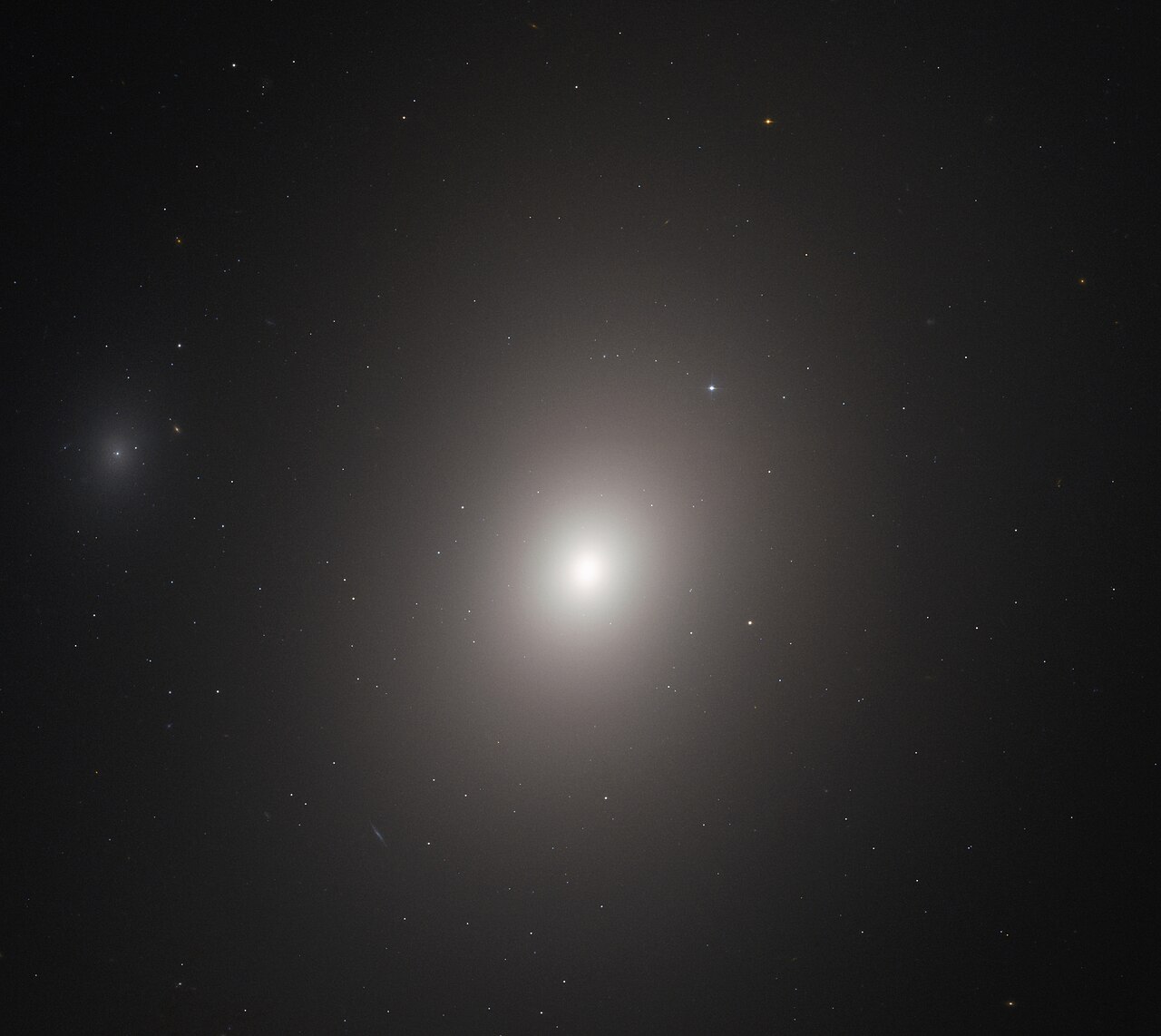
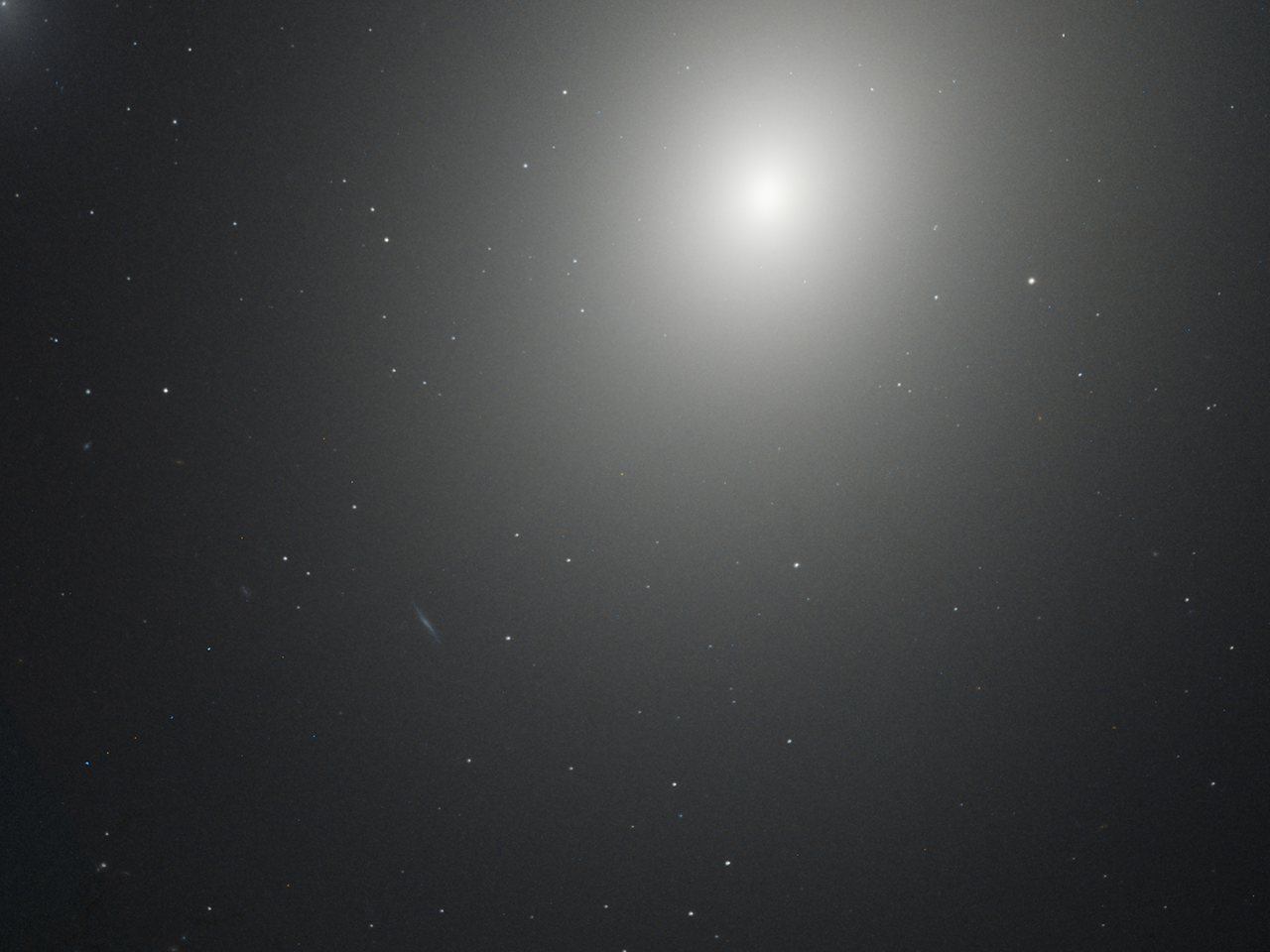
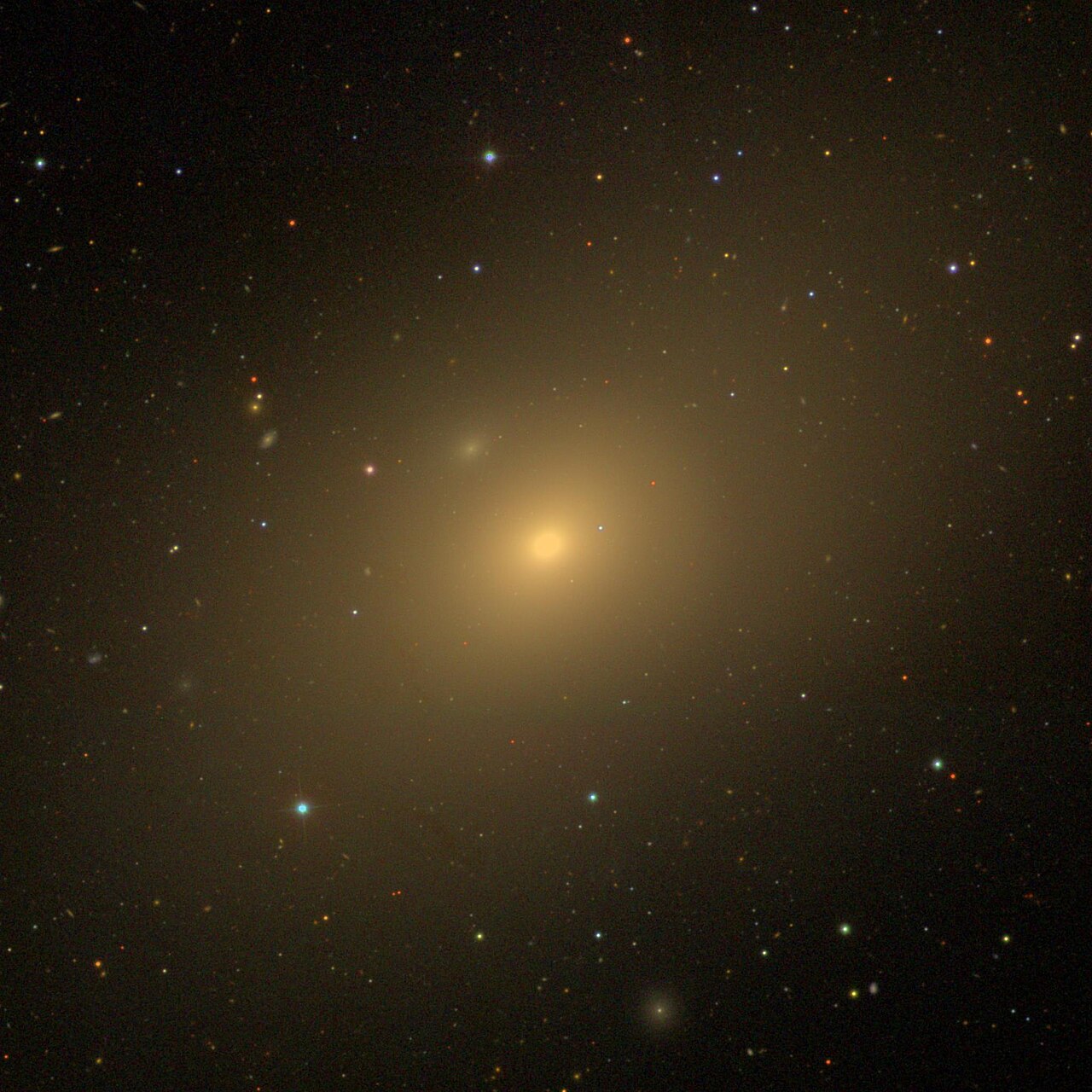
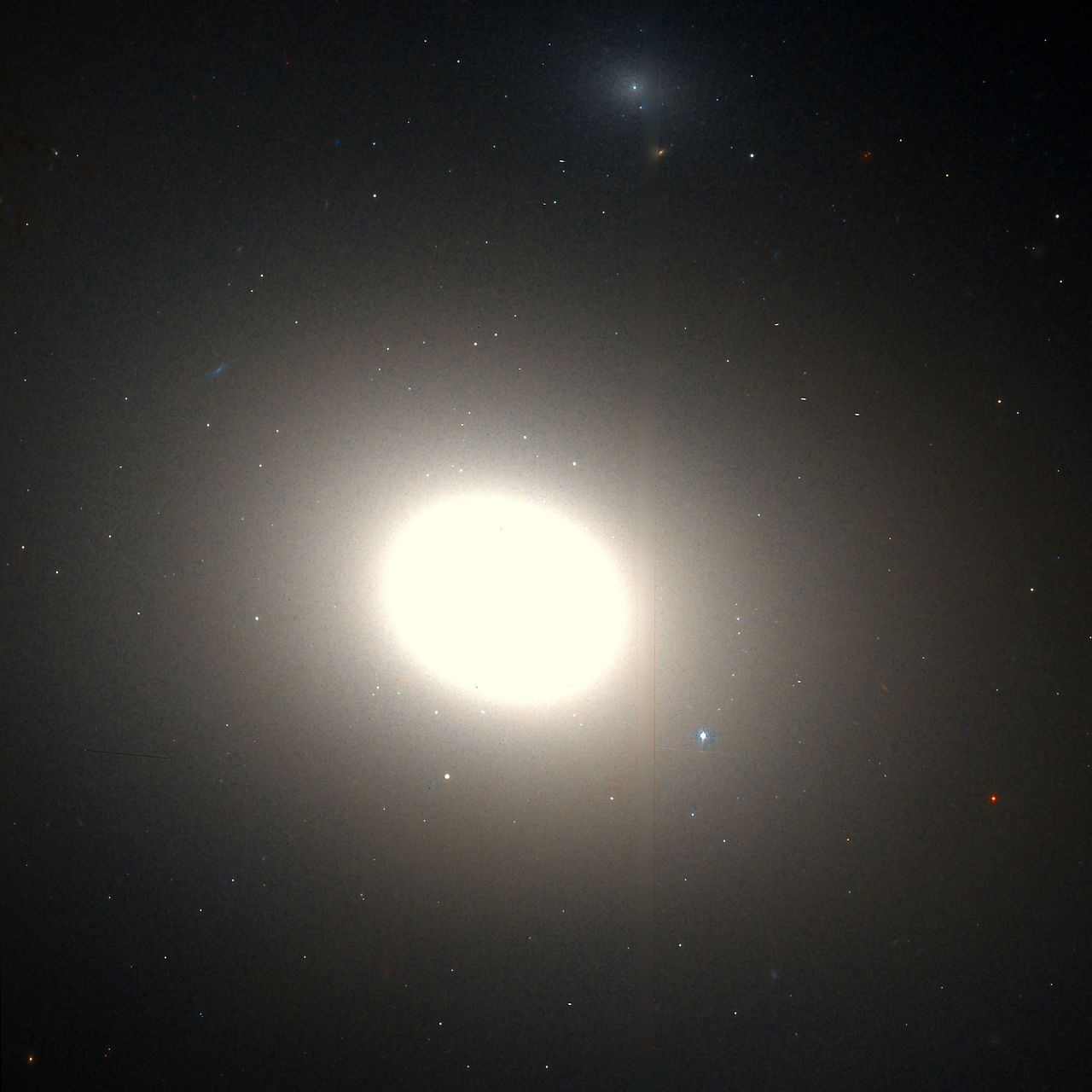
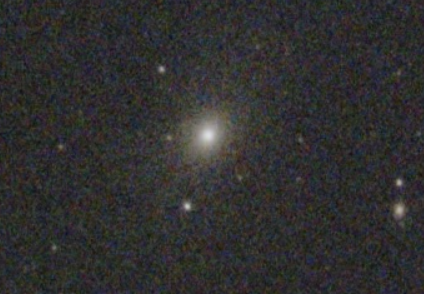
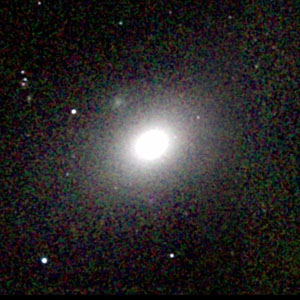
Messier 86 (M86 or NGC 4406) is a bright galaxy in the constellation Virgo, classified as either elliptical or lenticular. It sits at the core of the Virgo Cluster, forming a prominent pair with Messier 84. Unlike most Messier objects, M86 shows a blueshift, meaning its net motion is toward the Milky Way at 244 km/s—a result of both galaxies falling toward the cluster center from opposite directions.
The galaxy hosts roughly 3,800 globular clusters, and its halo contains stellar streams, likely the remains of dwarf galaxies it has absorbed. Several filaments of ionized gas connect M86 to the severely disrupted spiral NGC 4438, suggesting M86 has pulled gas and dust from that galaxy. As M86 races through the Virgo intracluster medium, it undergoes ram-pressure stripping, losing its own interstellar medium and leaving a long trail of hot X-ray-emitting gas, detected by the Chandra telescope. Despite this stripping, the inner parts of M86 retain a metal composition (magnesium, silicon, sulfur) that matches the broader universe more closely than its own stellar population does, indicating that ram pressure cannot fully strip the galaxy’s core.
Quick Facts
- Epoch
- J2000
- Ra
- 12 · 26 · 11.7
- Dec
- +12 · 56 · 46
- Dist Ly
- 52 ± 3 Mly (15.9 ± 1.0 Mpc)jensenetal2003
- Z
- −0.000814 ± 0.000017 (−244 ± 5 km/s)
- Appmag V
- 8.9seds
- Constellation Name
- Virgo
- Notes
- displays a rare blue shift
- Names
- NGC 4406, UGC 7532, PGC 40653, VCC 0881
Facts from the source article.
Lore & Background
Messier 86 was discovered by Charles Messier in 1781. It lies in the heart of the Virgo Cluster of galaxies and forms a most conspicuous group with another large galaxy known as Messier 84. It displays the highest blue shift of all Messier objects, as it is, net of its other vectors of travel, approaching the Milky Way at 244 km/s. This is due to both galaxies falling roughly towards the center of the Virgo cluster from opposing ends.
Messier 86 has a rich array of globular clusters, with a total number of around 3,800. Its halo also has a number of stellar streams interpreted as remnants of dwarf galaxies that have been disrupted and absorbed by this galaxy.
Messier 86 is linked by several filaments of ionized gas to the severely disrupted spiral galaxy NGC 4438, indicating that M86 may have stripped some gas and interstellar dust from the spiral. It is also suffering ram-pressure stripping as it moves at high speed through Virgo's intracluster medium, losing its interstellar medium and leaving behind a very long trail of X-ray emitting hot gas that has been detected with the help of the Chandra space telescope. The metal composition of magnesium, silicon and sulfur in the M86 galaxy is more similar to the rest of the universe than its own stellar population. This suggests that even ram pressure stripping is insufficient to strip the inner parts of the galaxy.
Reader's Guide
Messier 86's significance lies in its extreme motion and its role as a probe of galaxy interactions within the Virgo Cluster. As the Messier object with the highest blue shift, it is approaching the Milky Way at 244 km/s, a result of both it and Messier 84 falling toward the cluster center from opposite sides. Its rich system of about 3,800 globular clusters and stellar streams from disrupted dwarf galaxies reveal a history of galactic mergers and accretion. The galaxy's interaction with the spiral NGC 4438, via filaments of ionized gas, suggests it has stripped material from that galaxy. Additionally, ram-pressure stripping as M86 moves through the intracluster medium has created a long X-ray trail of hot gas, detected by Chandra. The metal composition of magnesium, silicon, and sulfur in M86 being more similar to the rest of the universe than to its own stellar population indicates that even ram-pressure stripping cannot remove the inner parts of the galaxy. These features make M86 a key object for studying galaxy evolution, cluster dynamics, and the effects of environmental stripping.
Did You Know?
- It has around 3,800 globular clusters.
- Its halo contains stellar streams interpreted as remnants of disrupted dwarf galaxies.
- A long trail of X-ray emitting hot gas from ram-pressure stripping has been detected by the Chandra space telescope.
The Comet Hunter's Frustration
Charles Messier, a French astronomer of the eighteenth century, had a singular obsession: tracking down comets as they swept through the solar system. Yet his relentless sky-watching kept producing the same frustrating result—bright, steady smudges of light that were not comets at all. Rather than discard these observations, Messier decided to catalogue them, building a list of non-comet objects that had repeatedly derailed his searches. He did not work alone; his assistant Pierre Méchain contributed significantly to the growing inventory. What began as a practical workaround for a comet hunter's annoyance became one of the most celebrated compilations in all of astronomy. Today, the objects on that list are still routinely identified by their Messier designations, a testament to how a list born out of professional irritation has endured for over two centuries as a foundational reference for anyone who looks beyond the solar system.
A List That Kept Growing
The catalogue Messier assembled was far from static. A preliminary edition appeared in 1774 within the Memoirs of the French Academy of Sciences, listing forty-five objects that had not yet been assigned numbers. Of those, eighteen were Messier's own discoveries while the remainder had been spotted earlier by other observers. By 1780 the count had climbed to seventy, and the definitive version—published in 1781 in the Connaissance des Temps for the year 1784—contained one hundred and three entries. A long-standing controversy surrounded entry one hundred and two, which many believed was a duplicate of M101 or perhaps the galaxy now catalogued as NGC 5866, and for decades the official total was treated as one hundred and two. Yet side notes in Messier's and Méchain's manuscripts revealed they had known of additional objects. Nicolas Camille Flammarion added M104 in 1921, Helen Sawyer Hogg contributed M105 through M107 in 1947, Owen Gingerich appended M108 and M109 in 1960, and Kenneth Glyn Jones closed the set with M110 in 1967, bringing the final count to one hundred and ten.
A Tour of the Deep Sky
The objects Messier catalogued span an extraordinary range of celestial phenomena. The list includes diffuse nebulae, planetary nebulae, open star clusters, globular clusters, and galaxies—essentially the full spectrum of what astronomers call deep-sky objects. Among the most iconic entries are M1, the Crab Nebula, the glowing remnant of a supernova explosion, and M31, the great spiral Andromeda Galaxy, the nearest major galactic neighbor to the Milky Way. What makes the catalogue particularly valuable to astrophysics is that nearly every entry represents one of the closest and most luminous examples of its class as seen from Earth. This proximity means they have been intensively examined with professional-grade instruments capable of resolving fine structural detail. A dedicated reference work, the Concise Catalog of Deep-sky Objects, compiles astrophysical summaries for each entry, making the collection not merely a visual tour but a rich dataset for understanding the physics of stellar systems and interstellar matter.
From Paris to the World's Backyards
Messier conducted his observations from the Hôtel de Cluny in Paris, a location that is now the Musée national du Moyen Âge. Working with a modest refracting telescope of roughly one hundred millimetres aperture, he could identify the brightest deep-sky objects visible from European latitudes. His field of view was constrained by geography: he catalogued only objects between the north celestial pole and a celestial latitude of approximately minus thirty-five point seven degrees, which meant southern-sky wonders like the Magellanic Clouds were entirely absent from his list. Despite these limitations, the catalogue's objects remain among the most rewarding targets for visual observation and astrophotography. Modern amateur astronomers with larger-aperture instruments can resolve details that would have been invisible to Messier's small telescope. Each early spring, dedicated observers gather for what is known as a Messier marathon, attempting to view every single object in the catalogue over the course of one night—a tradition that keeps the eighteenth-century list vibrantly alive in the eyes of a new generation of stargazers.
Gallery
Frequently Asked Questions
What kind of object is Messier 86 and where do I find it in the sky?
M86 is a bright elliptical or lenticular galaxy sitting at the core of the Virgo Cluster in the constellation Virgo. It forms a visually striking pair with its close neighbor, Messier 84.
Why does Messier 86 show a blueshift instead of the usual redshift?
M86 is approaching the Milky Way at roughly 244 km/s, making it the highest-blueshifted entry in the entire Messier catalog. This occurs because M86 and M84 are both falling toward the cluster's center from opposite directions, and M86's inward velocity happens to point toward us.
How many globular clusters does M86 host?
The galaxy contains roughly 3,800 globular clusters scattered through its halo. Its outer regions also display stellar streams that are likely the stripped remains of dwarf galaxies it has absorbed over time.
Who cataloged Messier 86 and when was it discovered?
Charles Messier recorded the galaxy in 1781 as part of his famous deep-sky catalog. It carries the secondary designation NGC 4406 in the New General Catalogue.
Are there any notable gas structures linked to M86?
Several filaments of ionized gas stretch from M86 toward neighboring cluster members, forming visible bridges between the galaxies. These gaseous connections are generally attributed to gravitational interactions within the dense Virgo Cluster environment.
More in Messier Objects, Part 3 1-24
Spotted an error? Know more?
Reader corrections go straight into our review queue. Suggest an edit · How this site is sourced