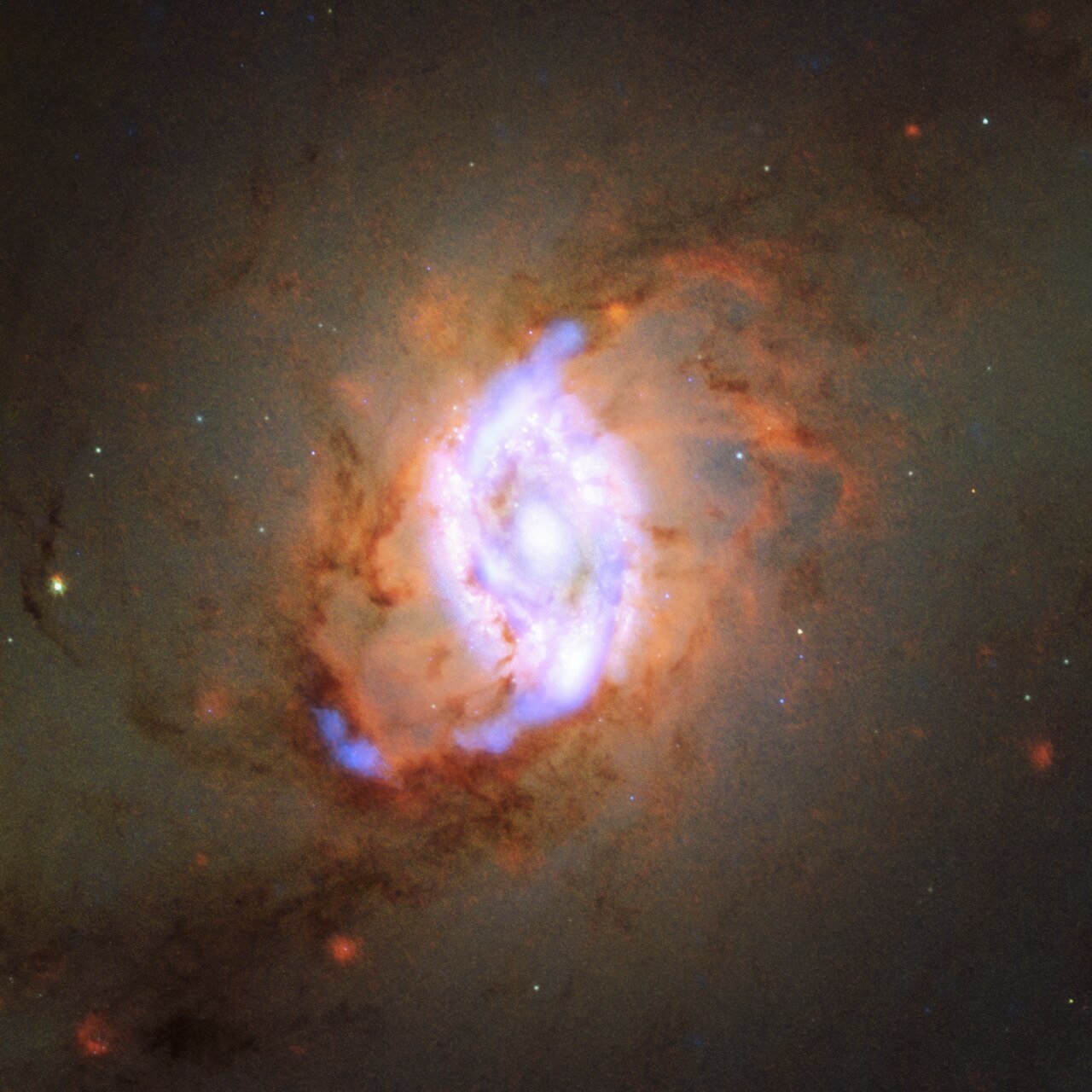
Messier 95
Barred spiral galaxy with a star-forming inner ring.

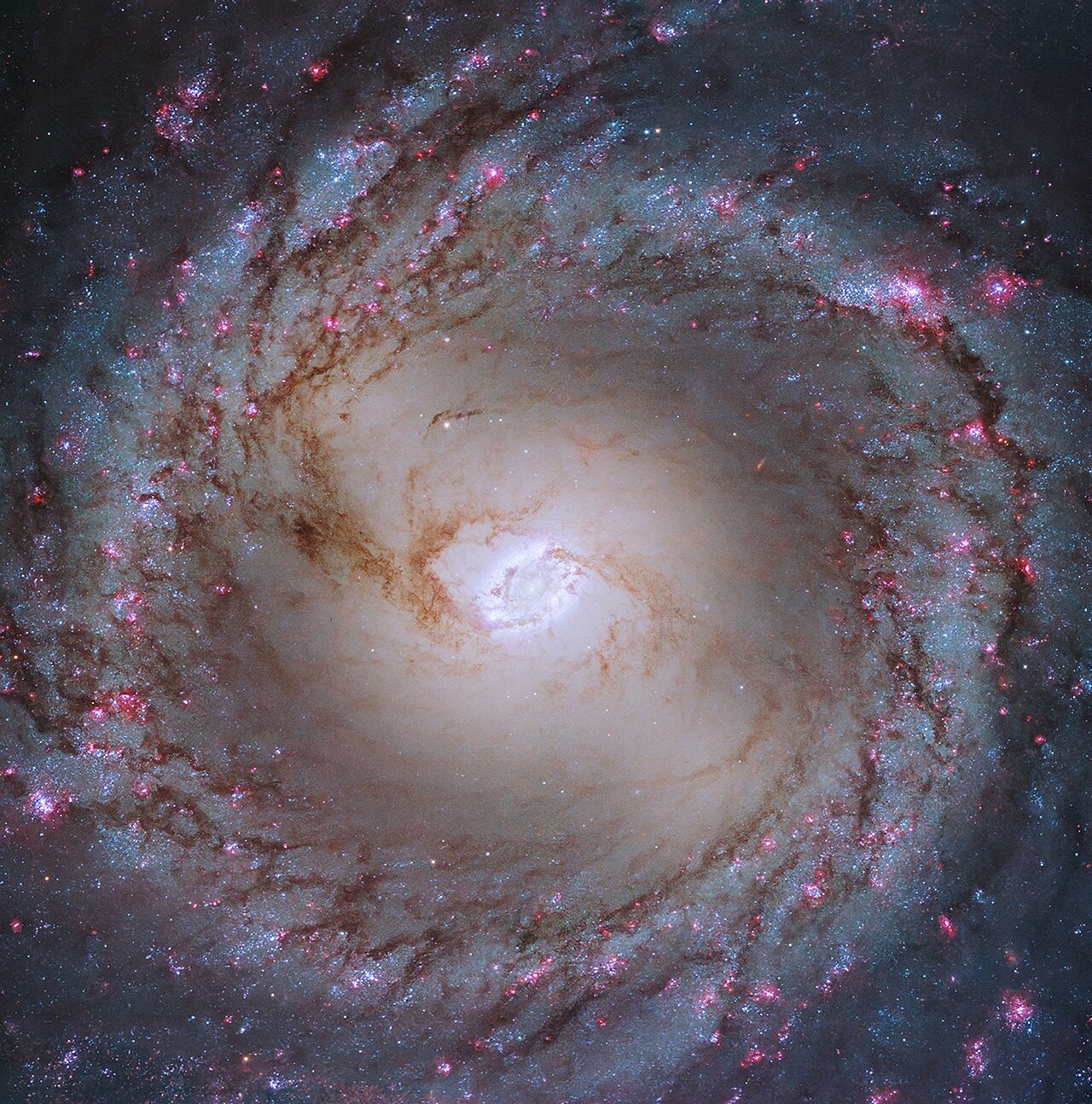
Image credit: NASA, ESA, J. Lee (STScI), and R. Chandar (University of Toledo); · CC0
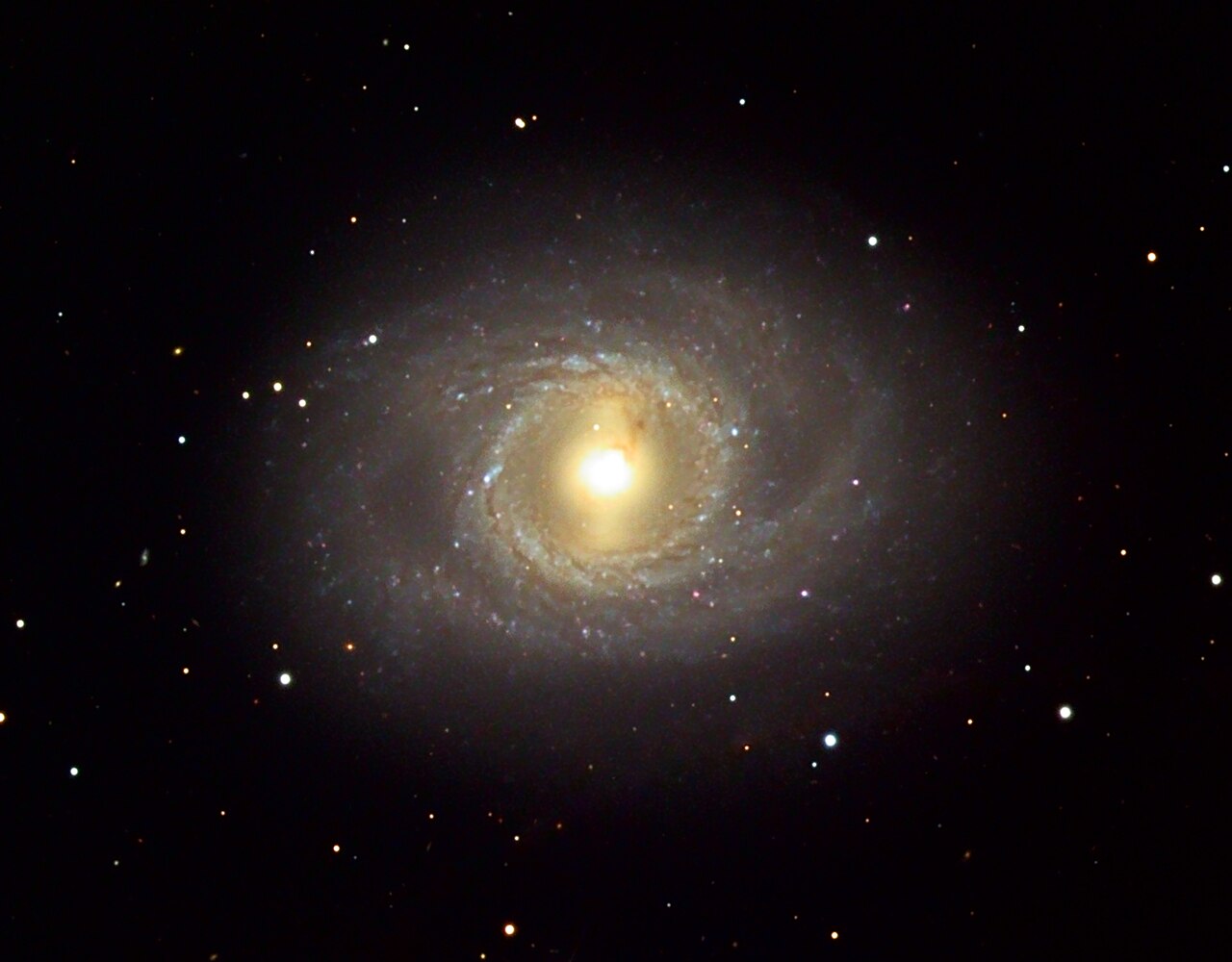
Messier 95 (also catalogued as M95 and NGC 3351) is a barred spiral galaxy situated roughly 33 million light-years from Earth in the zodiac constellation Leo. It was first spotted by French astronomer Pierre Méchain in 1781, and fellow countryman Charles Messier added it to his catalogue four days later. The galaxy belongs to the M96 Group, a collection of galaxies in Leo that also includes Messier 96 and Messier 105.
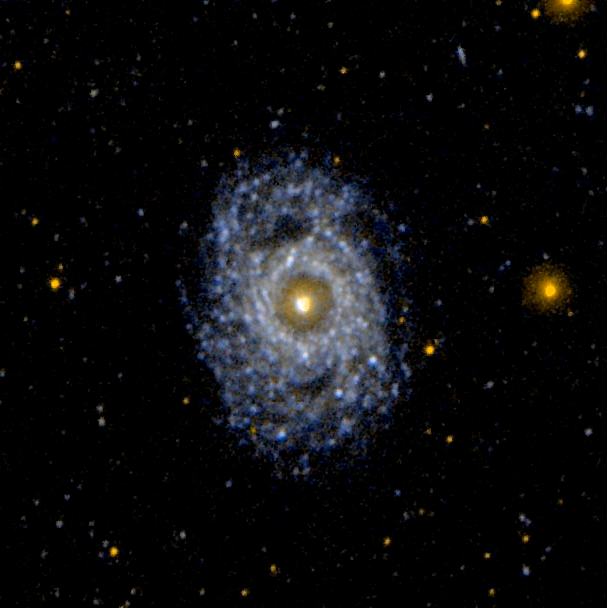
Classified as SB(r)b, M95’s “SBb” designation means it is a barred spiral whose arms fall in the middle of the tightness-to-looseness scale, while the “(r)” indicates an inner ring encircling the bar. This ring is a star-forming region shaped like a ring around the galaxy’s nucleus, measuring about 70,000 light-years (21,000 parsecs) across and roughly 2,400 light-years (750 parsecs) thick. The spiral arms extend outward from this ring.
The ring structure contains roughly 350 million solar masses of molecular gas and produces new stars at a rate of about 0.38 solar masses per year. Star formation occurs in at least five distinct zones, each between 100 and 150 parsecs in diameter, which themselves consist of several star clusters ranging from 1.7 to 4.9 parsecs across. These individual clusters hold between 1.8 and 8.7 million solar masses of stars and may be evolving into globular clusters.
One supernova has been observed in M95: SN 2012aw, a Type II-P (plateau) core-collapse event. It was discovered independently by Paolo Fagotti and Jure Skvarc on 16 March 2012, reaching magnitude 15. Its light curve showed a pronounced flattening after 27 days, characteristic of a Type II-P supernova. The progenitor star—a red supergiant with an estimated mass of 12.5 ± 1.5 solar masses—was later confirmed to have vanished in near-infrared images of the region.
Quick Facts
- Epoch
- J2000
- Ra
- 10 · 43 · 57.7ned
- Dec
- +11 · 42 · 14
- Constellation Name
- Leo
- Z
- 778 ± 4 km/s
- Dist Ly
- 32.6 ± 1.4 Mly (10.0 ± 0.4 Mpc)jensenetal2003
- Appmag V
- 9.7seds
- Names
- NGC 3351, UGC 5850, PGC 32007
Facts from the source article.
Lore & Background
Messier 95 was discovered by Pierre Méchain in 1781 and catalogued by his compatriot Charles Messier four days later. Its morphological classification is SB(r)b, indicating a barred spiral with arms of intermediate tightness and an inner ring surrounding the bar. This ring is a circumnuclear star-forming region about 70,000 light-years in diameter and 2,400 light-years thick, with the spiral structure extending outward from it.
The ring contains approximately 3.5×10^8 solar masses of molecular gas and has a star formation rate of 0.38 solar masses per year. Star formation occurs in at least five regions, each 100 to 150 parsecs across, composed of several star clusters ranging from 1.7 to 4.9 parsecs in size. These clusters contain (1.8–8.7)×10^6 solar masses of stars and may be on the path to forming globular clusters.
M95 is one of several galaxies in the M96 Group, a group of galaxies in Leo that also includes M96 and M105. In 2012, its most recent supernova was discovered.
Reader's Guide
Messier 95 is significant as a nearby barred spiral galaxy that provides a clear example of a ring-shaped star-forming region surrounding a bar. Its classification SB(r)b helps astronomers understand the range of spiral arm tightness and the role of bars in galactic structure. The detailed study of its inner ring, with measured molecular gas mass and star formation rate, offers insights into how star formation proceeds in such environments. The discovery of supernova SN 2012aw, a Type II-P core-collapse event, allowed astronomers to identify its progenitor as a red supergiant of about 12.5 solar masses, contributing to knowledge of massive star evolution. As part of the M96 Group, M95 is a key member of a nearby galaxy cluster that aids in studying group dynamics and galaxy interactions. Its legacy includes being a target for amateur and professional observations, with images available across multiple wavelengths.
Did You Know?
- M95 was discovered by Pierre Méchain in 1781 and catalogued by Charles Messier four days later.
- The ring contains about 3.5×10^8 solar masses of molecular gas and forms stars at a rate of 0.38 solar masses per year.
- The only observed supernova in M95, SN 2012aw, was a Type II-P plateau supernova with a progenitor mass of 12.5±1.5 solar masses.
A Comet Hunter's Legacy
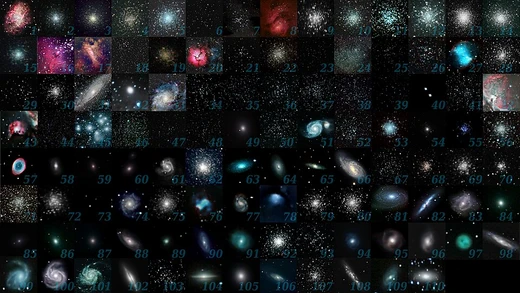
The Messier catalogue, of which M95 is a member, was born not from a desire to survey the cosmos but from the practical frustration of a comet seeker. Charles Messier, a French astronomer, spent his nights scanning the sky for new comets, only to repeatedly encounter fixed objects—nebulae, star clusters, and galaxies—that mimicked the fuzzy appearance of a comet's tail. To save himself and fellow observers from the same confusion, he began compiling a list of these non-comet objects. Working alongside his assistant Pierre Méchain, Messier assembled what would become one of the most celebrated catalogues in all of astronomy. The preliminary version surfaced in 1774 within the Memoirs of the French Academy of Sciences, and the list grew steadily over the following years. Today, objects on this list are still routinely identified by their Messier designations, a testament to how a practical workaround for one astronomer's nightly routine became a foundational reference for the entire field.
From Forty-Five to One Hundred and Ten
The catalogue that now includes M95 did not arrive in a single stroke. The 1774 first edition listed just 45 objects, unnumbered, of which Messier himself had discovered eighteen while the remainder had been noted earlier by other observers. By 1780 the count had climbed to 70, and the final version Messier published in 1781—appearing in the Connaissance des Temps for the year 1784—contained 103 entries. Yet the story did not end there. Marginal notes left by Messier and Méchain in their manuscripts revealed that they had known of additional objects never formally entered into the printed list. Nicolas Camille Flammarion was the first to act on these hints, adding M104 in 1921 after spotting a relevant annotation in a copy of the 1781 edition. Helen Sawyer Hogg contributed M105 through M107 in 1947, Owen Gingerich added M108 and M109 in 1960, and Kenneth Glyn Jones appended M110 in 1967. The long-standing confusion over M102—believed for decades to be a duplicate of M101, though some later sources link it to the galaxy NGC 5866—further complicated the count. In total, the catalogue now stands at 110 objects.
Visible from the Northern Sky
M95 belongs to a collection that was deliberately constrained by geography. Messier worked from Paris and could only survey the portion of the sky stretching from the north celestial pole down to a celestial latitude of roughly minus 35.7 degrees. Objects visible exclusively from far southern latitudes, such as the Large and Small Magellanic Clouds, were never part of his list. What the catalogue does encompass, however, is nearly every spectacular example of the five major deep-sky categories—diffuse nebulae, planetary nebulae, open clusters, globular clusters, and galaxies—that can be seen from European latitudes. Moreover, almost all entries rank among the closest members of their respective classes, making them prime targets for professional instruments that can resolve fine structural detail. Because they were bright enough to be studied with the modest 100-millimetre refracting telescope Messier used from downtown Paris, these objects remain the brightest and most rewarding deep-sky targets for modern amateur astronomers. In early spring, enthusiasts even gather for Messier marathons, attempting to observe every entry in a single night.
The Paris Observatory at the Hôtel de Cluny
Messier conducted his astronomical work at the Hôtel de Cluny in Paris, a building that today houses the Musée national du Moyen Âge. From this urban vantage point, he relied on a relatively small-aperture refracting telescope of approximately 100 millimetres—roughly four inches—to study the night sky. The practical limitations of that instrument and his northern latitude shaped the catalogue's contents in lasting ways. The objects he and Méchain recorded were necessarily those bright enough to be resolved with such modest optics and visible enough from a mid-northern European position. This dual constraint means the catalogue skews toward the brightest, nearest examples of each deep-sky class, a fact that has made the list extraordinarily useful for both professional research and amateur observation. The final edition was published in the Connaissance des Temps pour l'Année 1784, France's official yearly publication of astronomical ephemerides, cementing the list's place in the formal record of eighteenth-century astronomy. A summary of the astrophysics behind each entry can be found in the Concise Catalog of Deep-sky Objects, a modern companion that continues the tradition of making these objects accessible to a wider audience.
Gallery
Frequently Asked Questions
Who discovered Messier 95?
French astronomer Pierre Méchain first observed the galaxy in 1781, and Charles Messier incorporated it into his catalogue just four days later. It carries the alternate designation NGC 3351 in modern star charts.
What type of galaxy is Messier 95?
M95 is classified as a barred spiral galaxy with the subtype SB(r)b, meaning its spiral arms sit in the middle of the tight-to-loose spectrum and it hosts a star-forming inner ring around its central bar.
Where can you find Messier 95 in the sky?
It lies in the zodiac constellation Leo, roughly 33 million light-years from Earth. It is part of the M96 Group, a small cluster of galaxies that also includes Messier 96 and Messier 105.
What does the (r) in M95's SB(r)b classification indicate?
The parenthetical 'r' tells you the galaxy possesses an inner ring structure where active star formation takes place. Combined with the 'b' rating, it describes a barred spiral with moderately wound arms and that luminous inner ring.
How far away is Messier 95?
The galaxy sits at an estimated distance of about 33 million light-years from our solar system. At that range, it is a deep-sky target that benefits from dark skies and moderate-to-large telescopes for seeing its spiral structure.
More in Messier Objects, Part 3 1-24
Spotted an error? Know more?
Reader corrections go straight into our review queue. Suggest an edit · How this site is sourced