Messier 91
Faintest Messier object, lost for nearly two centuries.

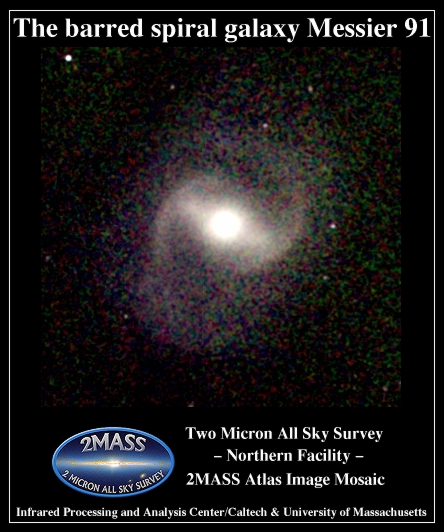
Two Micron All Sky Survey (2MASS), a joint project of the University of Massachu · Public domain
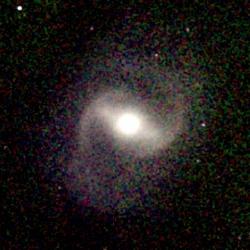
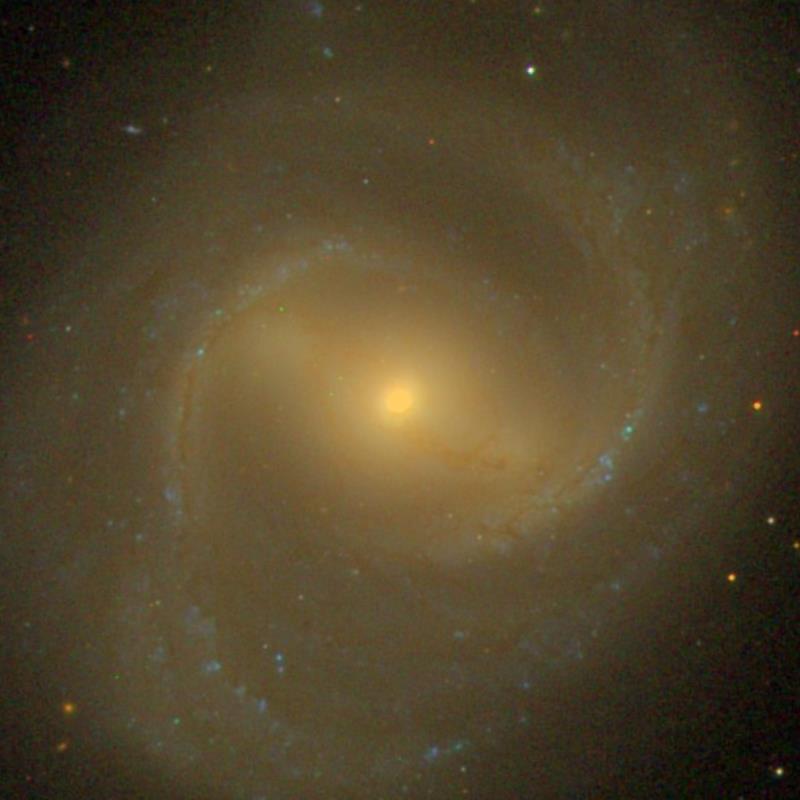
Messier 91 (also known as NGC 4548 or M91) is a barred spiral galaxy located in the south of Coma Berenices. It is part of the local supercluster and the Virgo Cluster of galaxies, approximately 63 million light-years away from the Milky Way. It is notable as the last of a group of eight 'nebulae' discovered by Charles Messier in 1781, and as the faintest object in the Messier catalog, with an apparent magnitude of 10.2.
Quick Facts
- Epoch
- J2000
- Ra
- 12 · 35 · 26.4
- Dec
- +14 · 29 · 47
- Dist Ly
- 63 ± 16 Mly (19 ± 5 Mpc)tonryetal2001
- Z
- 486 ± 4 km/s
- Appmag V
- 10.2sedsm91
- Constellation Name
- Coma Berenices
- Names
- NGC 4548, UGC 7753, PGC 41934
Facts from the source article.
Lore & Background
Messier 91 was discovered in 1781 by Charles Messier, who described it as a nebula without stars, fainter than M90. Due to a bookkeeping error by Messier, its position was mistakenly logged from Messier 58 instead of the correct reference galaxy M89, causing M91 to become one of the few missing entries in the Messier catalog for many years. It was not until 1969 that amateur astronomer William C. Williams solved the mystery by measuring its right ascension and declination relative to M89, matching Messier's figures to 0.1 arcminute in right ascension and 1 arcminute in declination. Some sources contend that the nearby spiral galaxy NGC 4571 was considered a candidate by William Herschel, who had catalogued NGC 4548 in 1784.
The galaxy's inclusion in the Virgo Cluster was confirmed in 1997 from observations of Cepheid variables, which placed it at 52±6 million light-years away. Its bar is very conspicuous, with a position angle of 65 to 245 degrees when measured from north to east. M91 exhibits a peculiar local velocity toward us through the Virgo cluster of about 700 km/s within the cluster's recession velocity of about 1100 km/s, producing an observed recessional velocity of only about 400 km/s. It is classified as an anemic galaxy, meaning a spiral galaxy with little star formation and gas compared with other galaxies of its type.
Reader's Guide
Messier 91's significance lies in its role as a 'lost' Messier object, resolved only in 1969 by amateur astronomer William C. Williams through careful positional correction. This episode highlights the challenges of early astronomical cataloging and the importance of precise reference points. As the faintest object in the Messier catalog, it represents the observational limits of Messier's era. Its classification as an anemic galaxy—a spiral with low star formation and gas—offers insight into galaxy evolution within dense cluster environments. The 1997 Cepheid-based distance measurement confirmed its membership in the Virgo Cluster, while its peculiar velocity relative to the cluster illustrates complex dynamics within galaxy groups. The object's history also underscores the transition from the term 'nebula' to 'galaxy' in the 20th century, as astronomers realized these objects were extragalactic.
Did You Know?
- The galaxy was lost for nearly two centuries due to a bookkeeping error by Messier, who logged its position from the wrong reference galaxy.
- Amateur astronomer William C. Williams identified M91 as NGC 4548 in 1969 by correcting the reference point to M89.
A Comet Hunter's Legacy
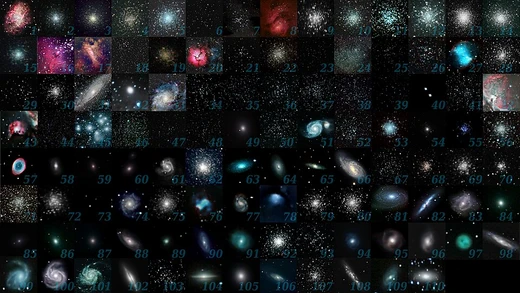
The story of Messier 91 begins not with the object itself but with the frustration of a French astronomer chasing comets. Charles Messier, working from the Hôtel de Cluny in Paris, kept encountering bright, steady patches of light that stubbornly refused to drift like the comets he sought. Together with his assistant Pierre Méchain, he began cataloguing these non-comet objects so he could skip them in future searches. What started as a practical workaround became one of the most celebrated lists in all of astronomy. M91, numbered ninety-one in the final 103-object edition published in 1781, sits within this collection of nebulae, star clusters, and galaxies. Though Messier had no particular interest in studying these objects for their own sake, his catalogue inadvertently preserved a snapshot of the most visually striking deep-sky targets visible from Earth's Northern Hemisphere. Today, M91 and its numbered neighbors are still referenced by their Messier designations, a testament to how a comet hunter's annoyance list outlived its original purpose by centuries.
From Parisian Rooftops to Global Skies
Messier 91 belongs to a family of objects bright enough to be resolved through the modest roughly 100-millimetre refracting telescope Messier used while observing from downtown Paris. That accessibility is precisely what makes M91 and its catalogue companions so beloved by modern amateur astronomers. Because these objects sit among the brightest and most visually striking examples of their respective deep-sky classes, they remain prime targets for visual observation and astrophotography, even when viewed through instruments with far larger apertures than Messier's. The catalogue's geographic scope is limited to the sky visible from the north celestial pole down to roughly 35.7 degrees south celestial latitude, meaning M91 is comfortably within reach of observers in Europe and North America. In early spring, dedicated stargazers sometimes attempt Messier marathons, a single-night challenge to spot every object in the list. M91, as a member of this northern-hemisphere collection, is one of the many targets that makes such an ambitious overnight sweep possible.
The Growing List
When Messier first published his preliminary catalogue in 1774 through the Memoirs of the French Academy of Sciences, it contained just 45 unnumbered objects. By the time the definitive edition appeared in the Connaissance des Temps for 1784, the list had swollen to 103 entries, and M91 held its place among them. Yet the story did not end there. Side notes in Messier's and Méchain's manuscripts hinted at additional objects they had known about but never formally included. Over the following decades, other astronomers pieced together these fragments: Flammarion added M104 in 1921, Sawyer Hogg contributed M105 through M107 in 1947, Gingerich appended M108 and M109 in 1960, and Jones added M110 in 1967. The long-debated M102, observed by Méchain and later thought to be a duplicate of M101, also complicated the count. Through all these additions, M91's position as the ninety-first entry remained stable, anchoring the middle of a list that grew from a small working note into a 110-object canon still referenced by name in observatories worldwide.
Objects of Enduring Study
Although Messier compiled his list as a practical aid for comet hunting, the objects it contains have since become central to astrophysical research. The catalogue encompasses nearly all of the most spectacular examples of five major deep-sky classes—diffuse nebulae, planetary nebulae, open clusters, globular clusters, and galaxies—visible from European latitudes. Crucially, almost every Messier object ranks among the closest members of its type to Earth. This proximity means that professional-grade instruments can resolve fine structural details that smaller telescopes cannot, making M91 and its siblings heavily studied targets. A dedicated reference work, the Concise Catalog of Deep-sky Objects, provides a summary of the astrophysics for each entry. The fact that Messier could identify these objects with a small refractor from a Parisian building underscores their intrinsic brightness. More than two centuries after the first preliminary list, M91 continues to serve as both a benchmark for amateur observation and a subject for professional inquiry.
Gallery
Frequently Asked Questions
What is Messier 91 and what type of object is it?
M91 is a barred spiral galaxy sitting in the southern part of the constellation Coma Berenices. It belongs to the Virgo Cluster of galaxies and lies roughly 63 million light-years beyond the Milky Way.
Why is Messier 91 often called the faintest entry in the Messier catalog?
With an apparent magnitude of 10.2, no other object on Messier's list is harder to see. Its extreme dimness meant it was effectively lost to stargazers for close to two hundred years after Messier first recorded it.
Who discovered Messier 91 and what year was it catalogued?
Charles Messier identified the galaxy in 1781, where it served as the final member of a group of eight nebulae he added that year. It also carries the New General Catalogue designation NGC 4548.
How can I find Messier 91 in the night sky?
Aim your telescope toward the southern region of Coma Berenices, where the galaxy sits among fainter background stars. Because of its 10.2 magnitude, you will need at minimum a moderate-aperture scope and reasonably dark skies to bring it into view.
What makes Messier 91 historically significant among deep-sky objects?
It marks the last of the eight nebulae Messier logged in a single 1781 observing session, capping off that particular discovery run. Its near-invisibility for almost two centuries also made it a notable test of an observer's equipment and patience.
More in Messier Objects, Part 3 1-24
Spotted an error? Know more?
Reader corrections go straight into our review queue. Suggest an edit · How this site is sourced