Messier 93
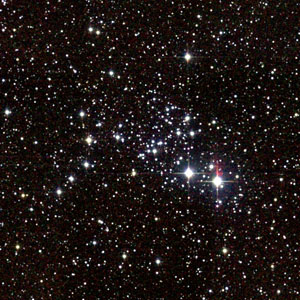
An open cluster in Puppis with a starfish-like appearance.

Giuseppe Donatiello · CC0
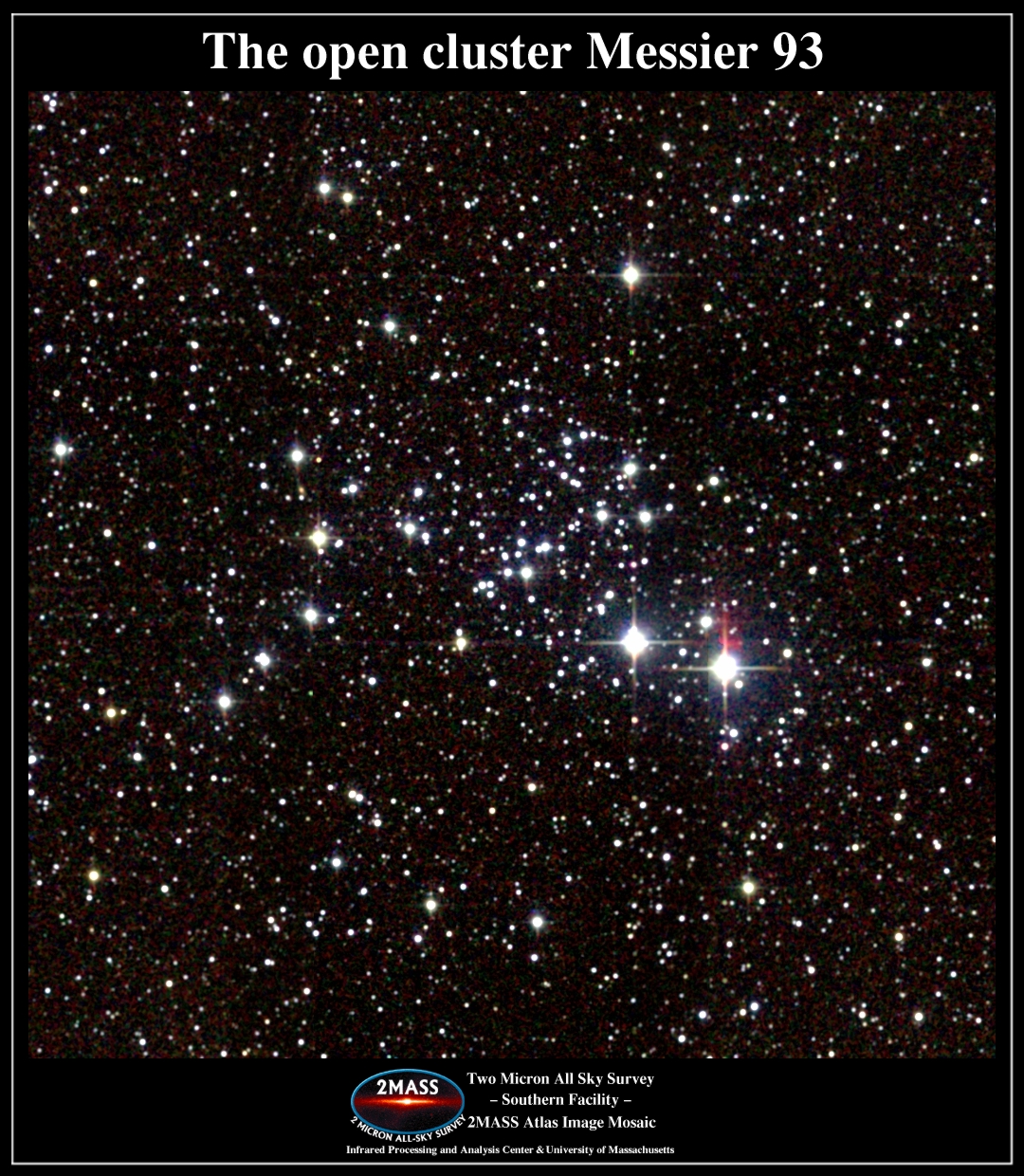
Messier 93 (M93, NGC 2447, the Critter Cluster) is an open star cluster found in the southern constellation Puppis, which represents the poop deck of the legendary ship Argo. Charles Messier discovered it in 1781 and added it to his catalog of comet-like objects. Caroline Herschel, William Herschel’s younger sister, found it independently in 1783, unaware that Messier had already catalogued it. Walter Scott Houston noted that some observers see a starfish shape in the cluster; through a four-inch refractor on a clear night, it appears as a typical, star-rich galactic cluster.
The cluster is classified as Trumpler type I 3 r, meaning it is strongly concentrated, has a wide range of stellar brightness, and is rich in stars. M93 lies about 3,380 light-years from the solar radius, with a spatial radius of 10 light-years, a tidal radius of 13.1 ± 2.3 light-years, and a core radius of 4.2 light-years. Its age is roughly 387.3 million years. The cluster sits close to the galactic plane and follows an orbit that ranges from 28 to 29 thousand light-years from the Galactic Center, completing one orbit every 242.7 ± 7.9 million years.
Fifty-four variable stars have been identified in M93, including a slowly pulsating B-type star, a rotating ellipsoidal variable, seven Delta Scuti variables, six Gamma Doradus variables, and one hybrid δ Sct/γ Dor pulsator. Four spectroscopic binary systems are present, one of which contains a yellow straggler component.
Quick Facts
- Epoch
- J2000.0
- Constellation
- Puppis
- Ra
- 07 · 44 · 30.0
- Dec
- −23 · 51 · 24
- Dist Ly
- 1.037 kpc
- Appmag V
- 6.0
- Mass Msol
- 723
- Radius Ly
- 10 ly
- Age
- 387.3 Myr
- Names
- NGC 2447, Cr 160, OCl 649.0
Facts from the source article.
Lore & Background
Messier 93 was discovered by Charles Messier and added to his catalogue of comet-like objects in 1781. Caroline Herschel, the younger sister of William Herschel, independently discovered it in 1783, thinking it had not yet been catalogued by Messier. Walter Scott Houston described its appearance, noting that some observers mention the cluster as having the shape of a starfish; with a fair-sized telescope, this is its appearance on a dull night, but a four-inch refractor shows it as a typical star-studded galactic cluster.
The cluster has a Trumpler class of I 3 r, indicating it is strongly concentrated, with a large range in brightness, and is rich in stars. M93 is about 3,380 light-years from the solar radius, with a great spatial radius of 10 light-years, a tidal radius of 13.1 ± 2.3 light-years, and a core radius of 4.2 light-years. Its age is estimated at 387.3 million years. It is nearly on the galactic plane and has an orbit that varies between 28–29 kilolight-years from the Galactic Center over a period of 242.7 ± 7.9 million years.
Fifty-four variable stars have been found in M93, including one slowly pulsating B-type star, one rotating ellipsoidal variable, seven Delta Scuti variables, six Gamma Doradus variables, and one hybrid δ Sct/γ Dor pulsator. Four spectroscopic binary systems within include a yellow straggler component.
Reader's Guide
Messier 93 is significant as an open cluster discovered by Charles Messier in 1781 and independently by Caroline Herschel in 1783, reflecting the early cataloguing efforts of comet-like objects. Its Trumpler class of I 3 r highlights its strong concentration, wide brightness range, and richness in stars, making it a notable target for amateur astronomers. The cluster's appearance, described by Walter Scott Houston as resembling a starfish in a fair-sized telescope on a dull night, adds to its observational interest. Its position in the modestly southern constellation Puppis, part of the legendary Argo, provides context within the historical constellation system. The cluster's properties, including its distance of about 3,380 light-years, age of 387.3 million years, and orbit around the Galactic Center, contribute to understanding stellar evolution and galactic structure. The discovery of 54 variable stars, including various types such as Delta Scuti and Gamma Doradus variables, along with spectroscopic binary systems containing a yellow straggler, makes M93 a valuable site for studying stellar variability and binary interactions.
Discovery and the Race to Catalogue
Messier 93 entered the astronomical record in 1781 when Charles Messier identified the faint smudge and entered it into his catalogue of nebulous, comet-like objects. Two years later, in 1783, Caroline Herschel—the younger sister of the celebrated William Herschel—made an independent discovery of the very same cluster. At the time she believed the object had not yet been entered into Messier's catalogue and recorded it as a new find, unaware that it already bore a number. This small overlap in discovery history reminds us that early sky surveys were often conducted in parallel by observers working from different observatories and different instruments. The cluster also carries the designation NGC 2447, reflecting its later inclusion in the New General Catalogue. It resides in the constellation Puppis, a region of sky representing the imagined poop deck of the legendary ship Argo. Among its many names, M93 is also affectionately called the Critter Cluster, a nickname that hints at the organic, somewhat irregular shapes observers have noted when viewing it through a telescope.
What the Eye Sees Through Glass
Walter Scott Houston, who passed away in 1993, offered a vivid description of what M93 looks like through a telescope. He noted that some observers perceive the cluster as resembling a starfish, a shape that becomes apparent on a dull night with a fair-sized instrument. However, Houston emphasized that a four-inch refractor reveals the cluster as a typical star-studded galactic grouping rather than a distinct animal form. The Trumpler classification of I 3 r further contextualizes what the eye sees: the I denotes strong central concentration, the 3 indicates a wide spread in stellar brightness, and the r signals an abundance of stars. Together these traits paint a picture of a dense, richly populated cluster where individual stars range from brilliant to faint, creating a textured field that rewards patient observation. Its position nearly on the galactic plane means it sits against a backdrop of Milky Way starlight, adding depth and complexity to the viewing experience.
Structure, Age, and Galactic Orbit
Messier 93 lies approximately 3,380 light-years from the Sun and spans a spatial radius of about 10 light-years. Its core radius measures 4.2 light-years, while the tidal radius extends to 13.1±2.3 light-years, marking the gravitational boundary beyond which stars can be stripped away by the Milky Way's pull. The cluster's age is estimated at roughly 387.3 million years, placing it firmly in the middle of its life as a gravitationally bound group of stars. Its galactic orbit is notably stable, oscillating between 28 and 29 kilolight-years, or 8.5 to 8.9 kiloparsecs, from the Galactic Center over a period of about 242.7±7.9 million years. This relatively circular path, combined with its proximity to the galactic plane, suggests M93 has been circling the Milky Way for hundreds of millions of years without being disrupted by close encounters with molecular clouds or other clusters.
A Laboratory of Pulsating and Binary Stars
Within the boundaries of Messier 93, astronomers have identified fifty-four variable stars, making it a rich laboratory for studying stellar pulsation and rotation. Among these, the diversity is striking: one slowly pulsating B-type star, one rotating ellipsoidal variable, seven Delta Scuti variables, six Gamma Doradus variables, and one hybrid δ Sct/γ Dor pulsator that exhibits characteristics of both oscillation families. The presence of a hybrid pulsator is particularly noteworthy, as it bridges two distinct mechanisms of stellar oscillation. In addition to the variable population, four spectroscopic binary systems have been catalogued within the cluster. One of these binary systems contains a yellow straggler component—a star that appears anomalously bright and cool for the cluster's age, likely the product of a past dynamical encounter that transferred energy to the star. These findings collectively reveal a dynamically active stellar community still evolving nearly 388 million years after its formation.
Gallery
Frequently Asked Questions
What is Messier 93?
Messier 93 is an open star cluster that Charles Messier catalogued in 1781, carrying the alternate designations NGC 2447 and the informal nickname "Critter Cluster." It is a loose, rich grouping of stars classified under the Trumpler system as I 3 r.
Who discovered Messier 93 and when?
Charles Messier first recorded the cluster in 1781 while building his catalogue of nebulous deep-sky objects. Caroline Herschel independently identified it in 1783, not knowing it had already been logged two years earlier.
What constellation does Messier 93 sit in?
It lies in Puppis, the southern constellation that represents the poop deck of the Argo, the legendary ship of the Argonauts. Because Puppis is a southern-hemisphere constellation, M93 is most easily reached from lower latitudes.
What does Messier 93 look like through a small telescope?
A four-inch refractor on a clear night reveals a typical, star-rich galactic cluster rather than a fuzzy patch. Some observers report picking out a starfish-like arrangement among the brighter members.
Why is Messier 93 nicknamed the Critter Cluster?
The "Critter Cluster" label is an informal fan name that has stuck in the amateur-astronomy community, likely evoking the cluster's small, compact, almost creature-like spread of stars. Its official identifiers remain M93 and NGC 2447.
More in Messier Objects, Part 3 1-24
Spotted an error? Know more?
Reader corrections go straight into our review queue. Suggest an edit · How this site is sourced