Messier 90
A bright Virgo Cluster spiral with truncated star formation and blueshift.

NASA / ESA · CC BY 4.0
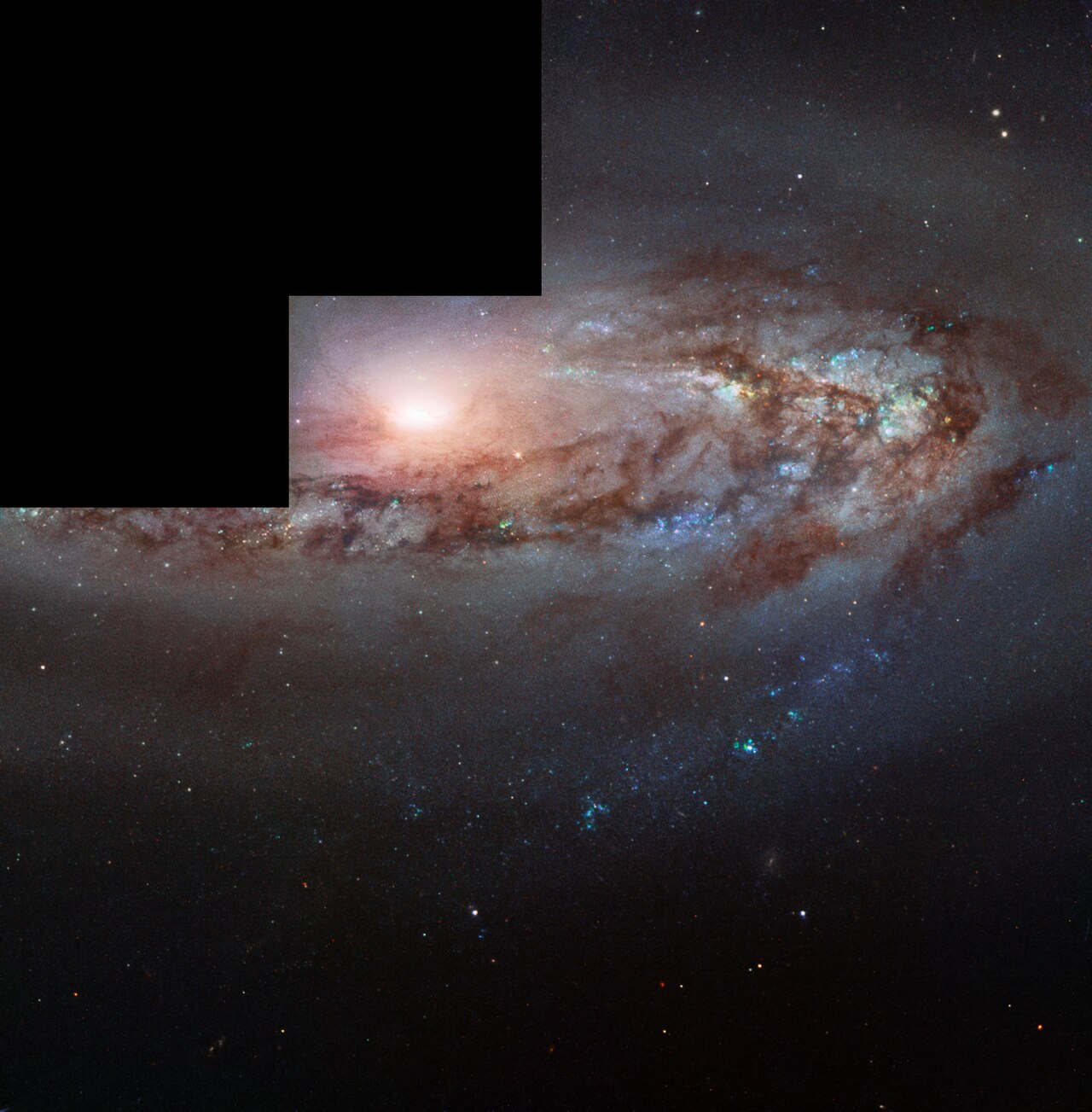
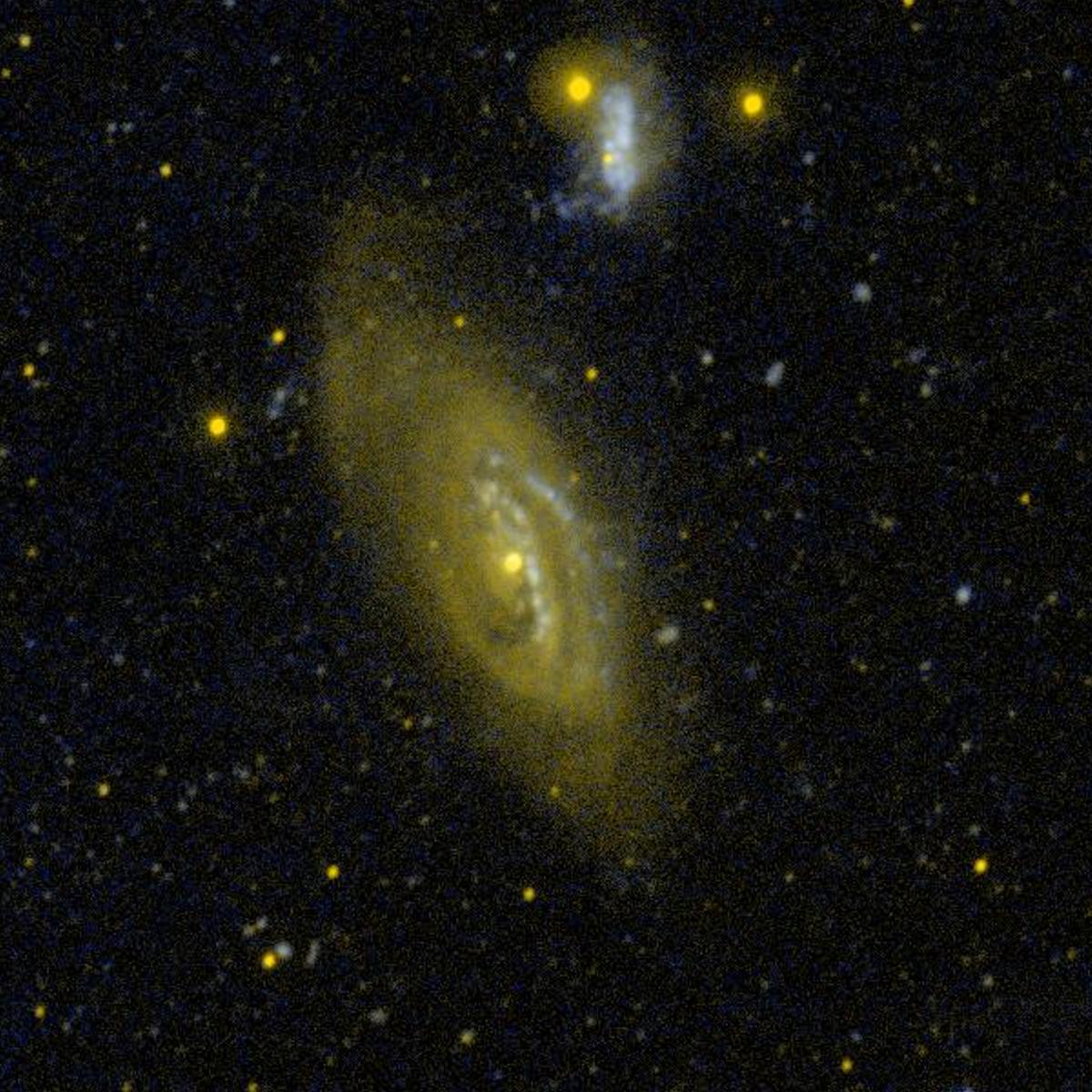
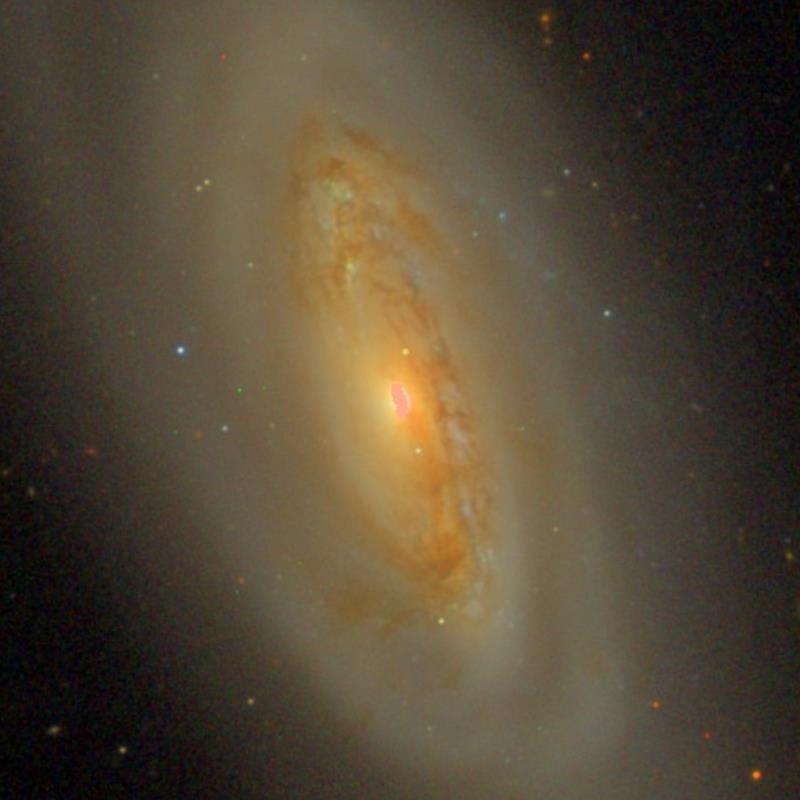
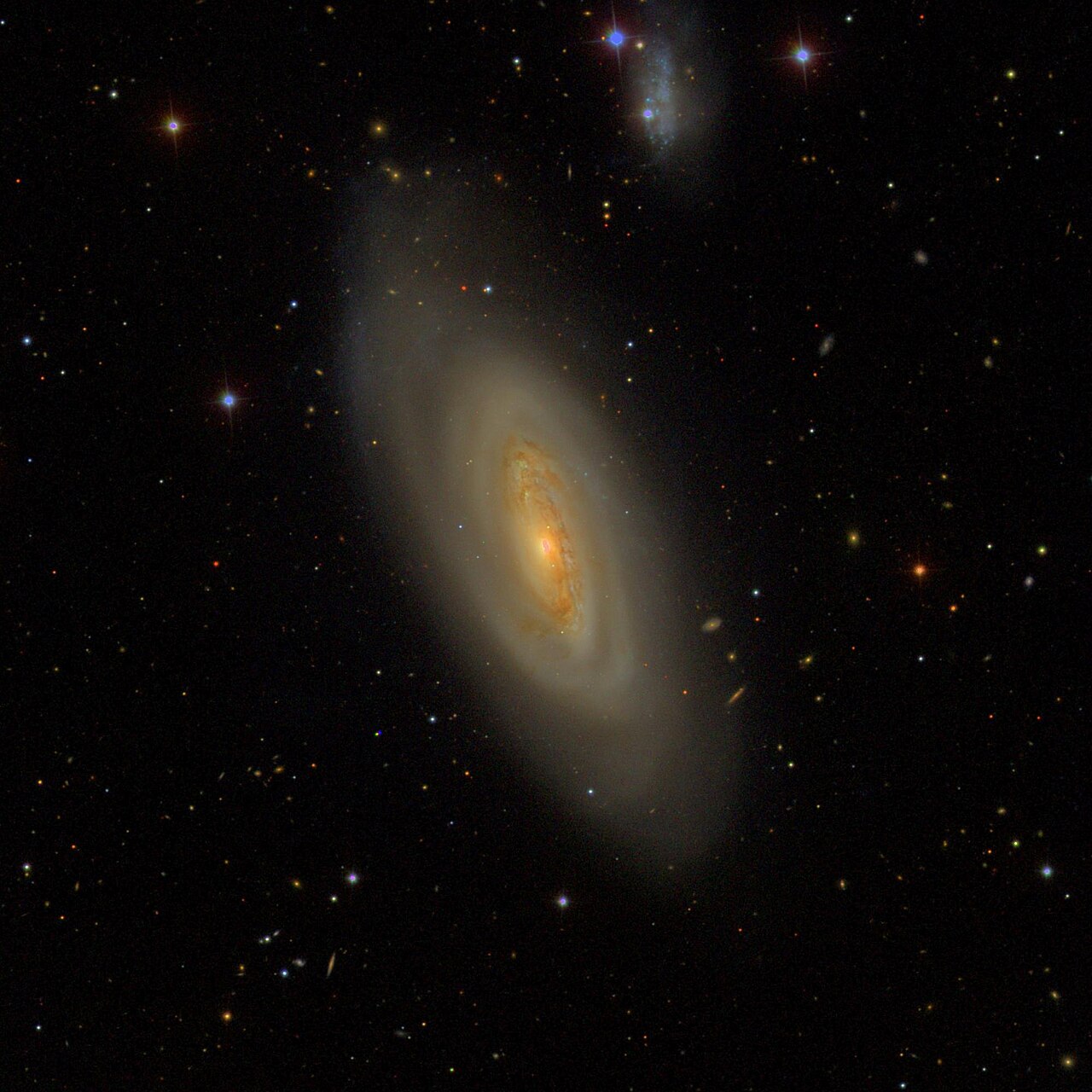
Messier 90 (also cataloged as M90, NGC 4569, or the Carabin Galaxy) is an intermediate spiral galaxy with a faint inner ring, located roughly 60 million light-years away in the constellation Virgo. Charles Messier first spotted it in 1781. It ranks among the Virgo Cluster’s largest and brightest spiral galaxies, boasting an absolute magnitude of about −22—outshining the Andromeda Galaxy.
As a member of the Virgo Cluster, M90 sits roughly 1.5° from the cluster’s central subgroup around Messier 87. Its interaction with the cluster’s intracluster medium has stripped away much of its interstellar gas through a process called ram-pressure stripping. This has severely truncated the galaxy’s star-forming regions and interstellar medium compared to similar galaxies outside the cluster. Evidence of this stripping includes H II regions lying outside the galactic plane and long tails of ionized gas—up to 80,000 parsecs (260,000 light-years)—that have been pulled away.
Because star formation is so curtailed, M90’s spiral arms appear smooth and featureless, lacking the knotty structure seen in galaxies with ongoing star formation. This has led astronomers to classify it as the prototype of an anemic galaxy, alongside NGC 4921 in the Coma Cluster. Some researchers go further, calling it a passive spiral galaxy similar to those found in high-redshift galaxy clusters. However, its center is active: it hosts significant nebulae and star formation, including roughly 50,000 O- and B-type stars that formed about 5 to 6 million years ago, mixed with many A-type supergiants born in earlier starbursts between 15 and 30 million years ago. The nucleus has also produced up to 100,000 supernovae, whose “superwinds” blow the galaxy’s interstellar medium outward into the intracluster medium. These winds are collimated into two jets; one of them is being disturbed by M90’s motion through the Virgo Cluster’s intracluster medium.
M90’s spectrum is blueshifted, meaning that—after accounting for non-aligned motion vectors—the distance between it and our galaxy is decreasing. Most galaxies show redshifted spectra. This blueshift was once taken as evidence that M90 lies in the foreground of the Virgo Cluster, but because many galaxies in that same region of sky also show blueshifts, the inference was incorrect.
Quick Facts
- Epoch
- J2000
- Constellation Name
- Virgosinnott1988
- Ra
- 12 · 36 · 49.8ned
- Dec
- +13 · 09 · 46
- Appmag V
- 9.5seds
- Z
- -0.000784 · 0.000013
- Dist Ly
- 58.7 ±
- Names
- NGC 4569, UGC 7786, PGC 42089, Arp 76
Facts from the source article.
Lore & Background
Messier 90 is a member of the Virgo Cluster, located about 1.5° from the central subgroup of Messier 87. Due to its interaction with the intracluster medium, the galaxy has lost much of its interstellar medium through ram-pressure stripping. This process has severely truncated the galaxy's medium and star formation regions compared to similar galaxies outside the cluster, producing long tails of ionized gas up to 80,000 parsecs (260,000 light-years) long and H II regions outside the galactic plane.
The galaxy's star formation appears truncated, giving its spiral arms a smooth, featureless appearance rather than the knotted look of galaxies with extended star formation. This has led to its classification, along with NGC 4921 in the Coma Cluster, as the prototype of an anemic galaxy; some authors consider it a passive spiral galaxy similar to those found in high-redshift clusters. However, its center hosts significant nebula and star formation, with about 50,000 O and B type stars formed 5 to 6 million years ago, amid many A-type supergiants from earlier starbursts 15 to 30 million years ago.
Multiple supernovae (up to 100,000) in the nucleus have produced 'superwinds' that blow the interstellar medium outward into the intracluster medium, collimated in two jets. One jet is being disturbed by interaction with Virgo's intracluster medium as the galaxy moves through it.
Reader's Guide
Messier 90's significance lies in its role as a prototype anemic galaxy, illustrating the dramatic effects of ram-pressure stripping in a dense cluster environment. Its truncated star formation and smooth spiral arms contrast with typical star-forming spirals, providing a nearby analog to passive spiral galaxies seen in high-redshift clusters. The galaxy's blueshift—unusual for most galaxies—was originally misinterpreted as evidence it lay in the foreground of the Virgo Cluster, but is now understood as part of the large range of velocities within the cluster. The presence of a central starburst region with young massive stars and supernova-driven superwinds highlights ongoing nuclear activity despite the galaxy's overall quiescence. Low levels of H I gas prevent using the Tully–Fisher relation to estimate its distance. Messier 90 is rich in globular clusters, with around 1,000 of them. The galaxy IC 3583 was once thought to be a satellite but is now considered too distant for interaction.
Did You Know?
- Messier 90 is one of the largest and brightest spiral galaxies in the Virgo Cluster, with an absolute magnitude of around −22, brighter than the Andromeda Galaxy.
- Its spectrum is blueshifted, indicating the gap between it and our galaxy is narrowing, unlike most galaxies which are redshifted.
- The galaxy has lost much of its interstellar medium due to ram-pressure stripping, creating ionized gas tails up to 260,000 light-years long.
- Its center hosts about 50,000 O and B type stars that formed 5 to 6 million years ago, along with A-type supergiants from earlier starbursts.
A Comet Hunter's Unintended Legacy
The Messier catalogue, of which M90 is a numbered member, was born from a very specific and practical frustration. Charles Messier, a French astronomer, spent his career searching for comets, but kept losing time to objects that looked like faint smudges in his telescope yet never moved like a comet should. To spare himself and fellow observers the same confusion, he began compiling a list of these non-comet deep-sky objects—nebulae, star clusters, and galaxies—that could be quickly identified and skipped. He worked alongside his assistant Pierre Méchain, and together they assembled what would become one of the most enduring references in all of astronomy. The preliminary list appeared in 1774 in the Memoirs of the French Academy of Sciences, containing forty-five unnumbered objects, eighteen of which Messier himself had discovered. What began as a personal nuisance list has since become the standard shorthand for deep-sky observing, with objects still routinely identified by their M-numbers more than two centuries later.
A Living List That Grew After Its Author
The catalogue Messier finalized in 1781 contained one hundred and three objects, published in the Connaissance des Temps for the year 1784. Yet the story of the list did not end with its creator. For a long time the total was considered to be one hundred and two because of the disputed entry Messier 102, which Méchain had observed and communicated to Messier but which Méchain later concluded was simply a re-observation of M101. Some modern sources, however, identify a different galaxy, NGC 5866, as the true M102. Beyond that controversy, other astronomers mined Messier's and Méchain's side notes to recover objects the pair had known about but never formally listed. Nicolas Camille Flammarion added M104 in 1921 after finding a marginal note in a copy of the 1781 edition. Helen Sawyer Hogg contributed M105 through M107 in 1947, Owen Gingerich added M108 and M109 in 1960, and Kenneth Glyn Jones appended M110 in 1967. Through these successive recoveries the catalogue reached its current total of one hundred and ten entries, each one a small archaeological find in the margins of an eighteenth-century notebook.
Bright Enough for a Paris Rooftop
One of the most remarkable features of the Messier catalogue—and by extension of any member like M90—is that every entry was visible through a modest instrument from the middle of a European city. Messier conducted his observations at the Hôtel de Cluny in Paris, using a refracting telescope with an aperture of roughly one hundred millimetres, about four inches. That the objects he catalogued could be resolved through such a small glass from downtown Paris tells us they are among the brightest and nearest examples of their respective classes: diffuse nebulae, planetary nebulae, open clusters, globular clusters, and galaxies. Today, professional instruments can tease out fine structural detail in these same targets, and the Concise Catalog of Deep-sky Objects compiles a summary of the astrophysics behind each one. For amateur astronomers the catalogue remains an irresistible checklist. In early spring, dedicated observers gather for Messier marathons, attempting to sweep through all one hundred and ten objects in a single night, a feat made possible precisely because the targets are bright, numerous, and spread across the northern sky.
The Northern Hemisphere's Sky, Mapped from a Single Paris Address
Messier's catalogue is not a universal inventory of deep-sky objects; it is a regional one, shaped by where and how he could point his telescope. Working from the Hôtel de Cluny in Paris, Messier covered the sky from the north celestial pole down to a celestial latitude of approximately minus thirty-five point seven degrees. Anything visible only from farther south—such as the Large and Small Magellanic Clouds—simply fell outside his field of view and was never entered into the list. This geographic constraint means the catalogue captures nearly all of the most spectacular deep-sky targets accessible from European latitudes, making it a de facto guide for northern-hemisphere observers. The final version was published in the Connaissance des Temps pour l'Année 1784, the French official yearly publication of astronomical ephemerides, giving it an institutional imprimatur that helped cement its place in the astronomical record. The catalogue's diversity spans star clusters, nebulae, and galaxies, with famous examples like the Crab Nebula at M1 and the Andromeda Galaxy at M31 anchoring the list at both ends of the deep-sky spectrum.
Gallery
Frequently Asked Questions
What is Messier 90?
M90, also known as the Carabin Galaxy or NGC 4569, is an intermediate spiral galaxy featuring a faint inner ring. It resides in the constellation Virgo and is one of the largest and brightest spiral members of the Virgo Cluster.
How far away is Messier 90?
M90 sits roughly 60 million light-years from Earth, positioned about 1.5 degrees from the Virgo Cluster's dense central subgroup near Messier 87.
Who discovered Messier 90 and when?
Charles Messier first recorded M90 in 1781 during his systematic cataloging of deep-sky objects. It has retained his catalog number ever since, alongside the NGC 4569 designation.
Why do astronomers say M90 outshines Andromeda?
With an absolute magnitude near −22, M90 is intrinsically more luminous than the Andromeda Galaxy, making it one of the most powerful spiral galaxies in the Virgo Cluster.
What happened to M90's interstellar gas?
Plunging through the hot intracluster medium of the Virgo Cluster has stripped away much of M90's interstellar gas, effectively truncating its star formation and leaving a measurable blueshift in the remaining material.
More in Messier Objects, Part 3 1-24
Spotted an error? Know more?
Reader corrections go straight into our review queue. Suggest an edit · How this site is sourced