Messier 94
A spiral galaxy with two rings and a controversial dark matter result.

RubinObs/NOIRLab/SLAC/NSF/DOE/AURA · CC BY 4.0
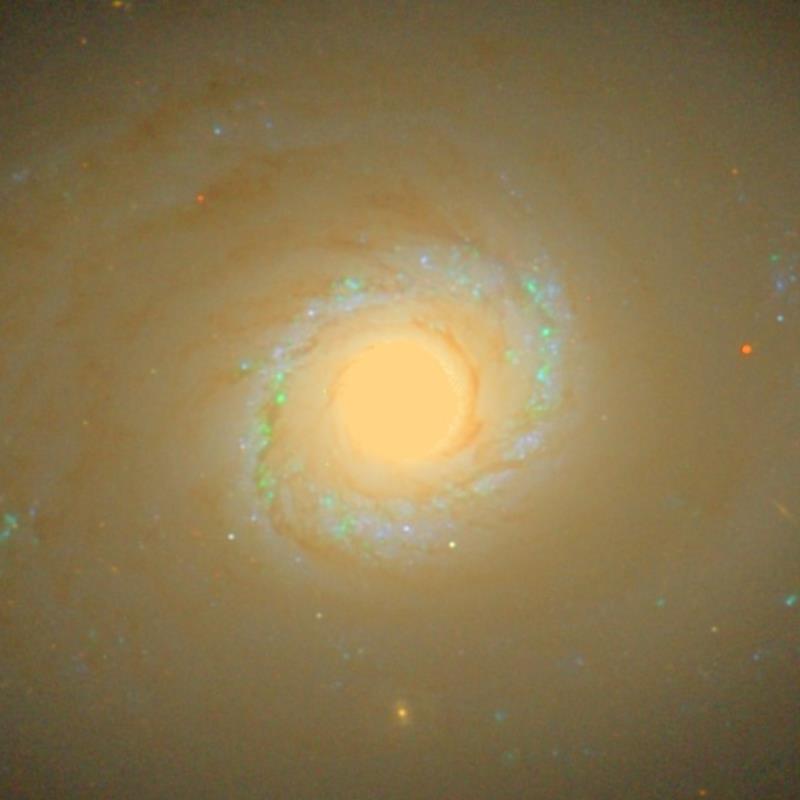
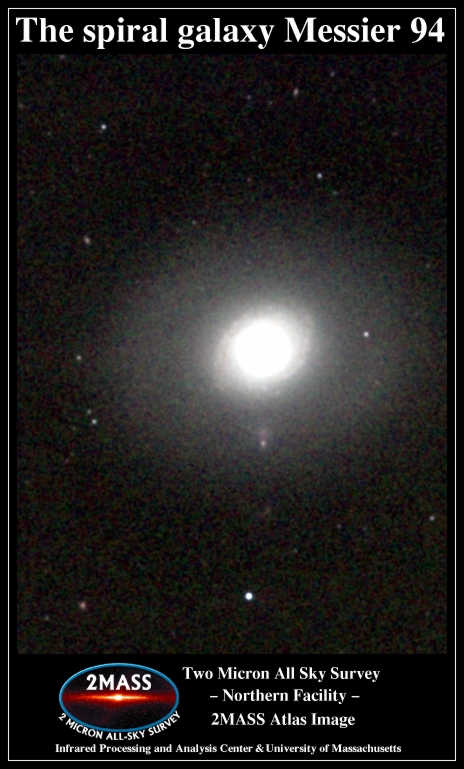
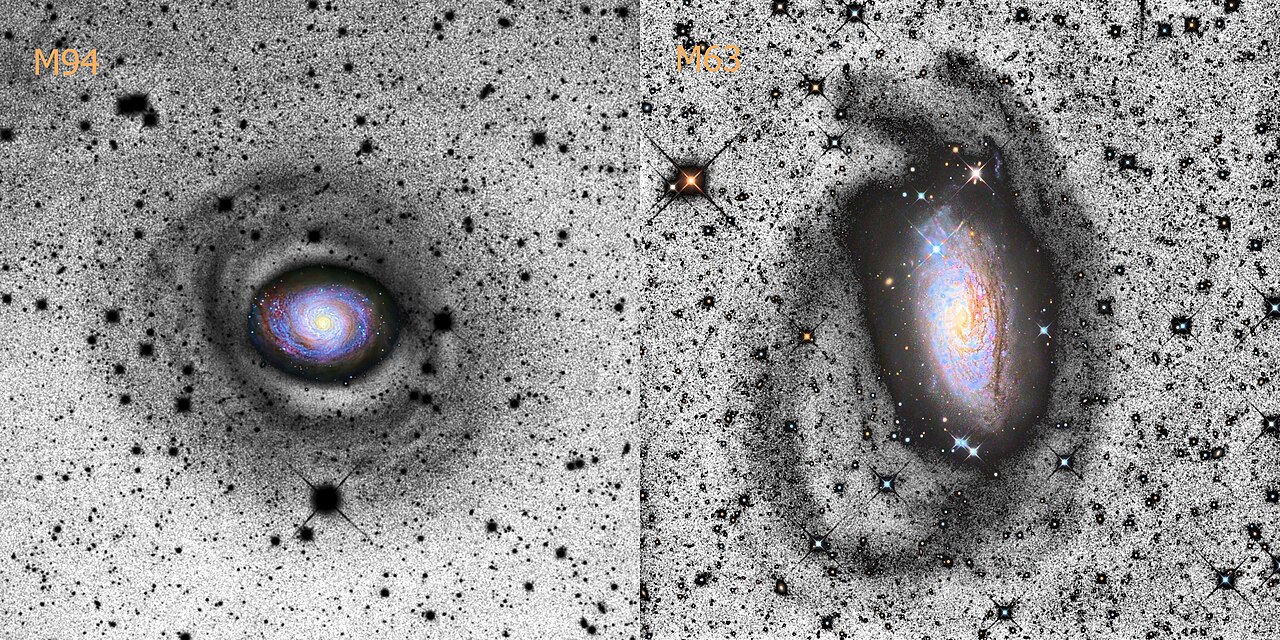
Messier 94 (also cataloged as NGC 4736 and nicknamed the Cat's Eye, Crocodile Eye, or Croc's Eye Galaxy) is a spiral galaxy located in the mid-northern constellation Canes Venatici. It was discovered by Pierre Méchain in 1781, and catalogued by Charles Messier two days later. While some sources label it a barred spiral, its central bar-like feature is actually more oval in shape. The galaxy is notable for having two distinct rings. The galaxy's nucleus is classified as a low ionization nuclear emission region (LINER), meaning its optical spectrum shows ionized gas that is only weakly ionized—the atoms have lost relatively few electrons. At its center lies a supermassive black hole with a mass of 1.60 × 10⁷ solar masses, measured using stellar kinematics from James Webb Space Telescope data, a result that aligns with established black hole–galaxy scaling relations. M94's inner ring spans 70 arcseconds (about 5,400 light-years across at its distance), while the outer ring measures 600 arcseconds (roughly 45,000 light-years). These rings likely form at resonance points in the galaxy's disk. The inner ring is a site of intense star formation—often called a starburst ring—fueled by gas driven inward by the oval-shaped bar. A 2009 study found that the outer ring is not a closed stellar ring, as previously thought, but a complex spiral structure when viewed in mid-infrared and ultraviolet light. This outer disk contains about 23% of the galaxy's total stellar mass and produces roughly 10% of its new stars. In fact, the star formation rate per unit stellar mass in the outer disk is about twice that of the inner disk. Several possible external events—such as the accretion of a satellite galaxy or gravitational interaction with a nearby system—have been proposed to explain the outer disk, but each scenario has problems. The study concluded that an oval distortion in the inner disk likely created the peripheral disk. In 2004, astronomers John Kormendy and Robert Kennicutt argued that M94 contains a prototypical pseudobulge. Unlike a classical spiral, which has a large sphere of old stars (a bulge) intersecting its disk, a pseudobulge appears as a bright, star-forming central structure that looks like a bulge when viewed face-on. In M94, this pseudobulge takes the form of a ring around a central oval region.
Quick Facts
- Epoch
- J2000
- Constellation Name
- Canes Venaticisinnott1988
- Ra
- 12 · 50 · 53.1ned
- Dec
- +41 · 07 · 14
- Appmag V
- 8.2seds
- Z
- 0.001027 · 0.000005
- Dist Ly
- 16.0 +/-
Facts from the source article.
Lore & Background
M94 is classified as having a low ionization nuclear emission region (LINER) nucleus, characterized by weakly ionized gas. It hosts a supermassive black hole with a mass of 1.60 × 10^7 M☉, measured using stellar kinematics from James Webb Space Telescope data. The galaxy has an inner ring with a diameter of 70 arcseconds (about 5,400 light-years) and an outer ring with a diameter of 600 arcseconds (about 45,000 light-years). The inner ring is a site of strong star formation, fueled by gas driven by the inner oval-shaped bar-like structure. A 2009 study revealed that the outer ring is not a closed stellar ring but a complex structure of spiral arms when viewed in mid-IR and UV. The outer disk contains about 23% of the galaxy's total stellar mass and contributes about 10% of its new stars, with a star formation rate approximately two times greater than the inner disk per unit of stellar mass. Possible external events for the outer disk's origin, such as accretion of a satellite galaxy or gravitational interaction, were found to have problems; the report concludes that an oval distortion in the inner disk led to the creation of the peripheral disk. In 2004, John Kormendy and Robert Kennicutt argued that M94 contains a prototypical pseudobulge—a bright central structure with intense star formation that looks like a bulge when viewed face-on, taking the form of a ring around a central oval-shaped region. A 2008 study showed that M94 had very little or no dark matter present, based on rotation curves and hydrogen gas density, a controversial result not yet confirmed or accepted by other research groups.
Reader's Guide
Messier 94 is significant for several reasons. Its double-ring structure, with an inner starburst ring and an outer complex of spiral arms, provides a laboratory for studying star formation and galactic dynamics. The discovery that the outer ring is not a closed ring but a spiral structure in mid-IR and UV challenged previous assumptions. The galaxy's classification as a prototypical pseudobulge by Kormendy and Kennicutt in 2004 offers insight into galaxy morphology, showing that bright central star formation can mimic a classical bulge. The measurement of its supermassive black hole mass using JWST data aligns with current relations, reinforcing those models. Most notably, the 2008 study suggesting M94 has little or no dark matter is highly controversial, as it contradicts standard galaxy formation models and alternative theories like MOND. This result remains unconfirmed and untested against standard models, making M94 a key object for debates on dark matter and galaxy formation. Its membership in the M94 Group, part of the Virgo Supercluster, places it in a broader cosmological context.
Did You Know?
- The galaxy's supermassive black hole has a mass of 1.60 × 10^7 M☉, measured using JWST data.
- A 2008 study found that M94 had very little or no dark matter, a controversial result not yet confirmed.
A Comet Hunter's Unlikely Legacy
Few astronomical lists have endured as long as the one Charles Messier assembled in the eighteenth century, yet its origins were born of frustration rather than curiosity. Messier's true passion was locating comets, and the bright, fixed objects that kept appearing in his telescope during those searches became a persistent nuisance. To spare future comet hunters the same confusion, he began recording every non-comet object that mimicked a comet's appearance. Working alongside his assistant Pierre Méchain, he compiled what would become one of the most celebrated catalogues in all of astronomy. Today, one hundred and ten objects carry their Messier designations, and M94 is among them. The catalogue remains a living reference: astronomers still speak of objects by their M-numbers, and the list stands as a testament to how a single astronomer's irritation with false positives could gift the world a permanent map of the deep sky.
From Forty-Five to One Hundred and Ten
The catalogue Messier is best known for did not arrive fully formed. A preliminary edition appeared in 1774 within the Memoirs of the French Academy of Sciences, listing forty-five unnumbered objects; eighteen of those had been spotted by Messier himself, while the remainder were credited to earlier observers. By 1780 the count had grown to seventy, and the definitive version of one hundred and three entries was published in 1781 in the Connaissance des Temps. Yet the story did not end there. Decades later, Nicolas Camille Flammarion uncovered a marginal note in a copy of the 1781 edition and added M104 in 1921. Helen Sawyer Hogg contributed M105 through M107 in 1947, Owen Gingerich appended M108 and M109 in 1960, and Kenneth Glyn Jones added M110 in 1967. The puzzling M102, originally reported by Méchain, was long suspected to be a duplicate of M101, though some researchers have linked it to the galaxy NGC 5866. M94, sitting comfortably within the original hundred and three, was never part of these later expansions.
A Night of One Hundred and Ten
Because Messier selected objects visible from European latitudes using a modest refracting telescope of roughly one hundred millimetres aperture, the resulting catalogue skews toward brightness and visual appeal. Nearly every entry represents one of the closest and most spectacular examples of its class—whether diffuse nebula, planetary nebula, open cluster, globular cluster, or galaxy. This makes the list a natural playground for modern amateur astronomers, who now employ far larger instruments and sensitive cameras to extract details that would have been invisible to an eighteenth-century observer. In early spring, dedicated observers gather for what is popularly called a Messier marathon: a single night in which all one hundred and ten objects, including M94, can be swept through in sequence as they rise and set across the sky. The event has become a rite of passage in the amateur community, a communal celebration of a list first scribbled in frustration over a century and a half ago.
The Parisian Sky and Its Limits
Charles Messier conducted his observations from the Hôtel de Cluny in Paris, a building that today houses the Musée national du Moyen Âge. His working conditions were those of an eighteenth-century city astronomer: a relatively small refracting telescope, the light of a growing metropolis, and a sky bounded by practical geography. Because he could only look northward from the north celestial pole down to a celestial latitude of approximately minus thirty-five point seven degrees, his catalogue excludes objects visible solely from more southerly regions. The Large and Small Magellanic Clouds, for instance, never made the list. This geographic constraint means the catalogue is essentially a northern-hemisphere survey, and M94 falls squarely within the band of sky accessible from Paris. The final edition was published in the Connaissance des Temps, France's official yearly almanac of astronomical ephemerides, giving the list an institutional permanence that a private notebook might never have achieved.
Gallery
Frequently Asked Questions
What does Messier 94 look like and why is it nicknamed the Cat's Eye?
M94 is a spiral galaxy whose most eye-catching feature is a pair of concentric rings encircling its bright central region, giving it a striking eye-like profile. That distinctive ringed appearance is the source of its popular nicknames, including Cat's Eye, Crocodile Eye, and Croc's Eye Galaxy.
Who discovered Messier 94 and when was it catalogued?
Pierre Méchain first observed the galaxy in 1781, and Charles Messier entered it into his catalog just two days later. It resides in the mid-northern constellation Canes Venatici at an estimated distance of about 16 million light-years.
What is special about the nucleus of M94?
Its central region is classified as a LINER, meaning the surrounding gas is only weakly ionized rather than being driven by a luminous active galactic nucleus. The galaxy also harbors a supermassive black hole with a mass estimated at roughly 16 million times that of the Sun.
What is the dark matter controversy surrounding Messier 94?
A 2018 rotation-curve analysis proposed that M94's stellar dynamics could be accounted for without invoking a dark matter halo, which generated considerable debate in the astrophysics community. While most researchers still uphold the standard dark matter framework, M94 has become a frequently cited test case in the ongoing discussion.
Is Messier 94 really a barred spiral galaxy?
Many references label it a barred spiral, but the elongated central feature is actually more oval than a true bar. It is more accurate to describe M94 as a spiral galaxy distinguished primarily by its two prominent rings.
More in Messier Objects, Part 3 1-24
Spotted an error? Know more?
Reader corrections go straight into our review queue. Suggest an edit · How this site is sourced