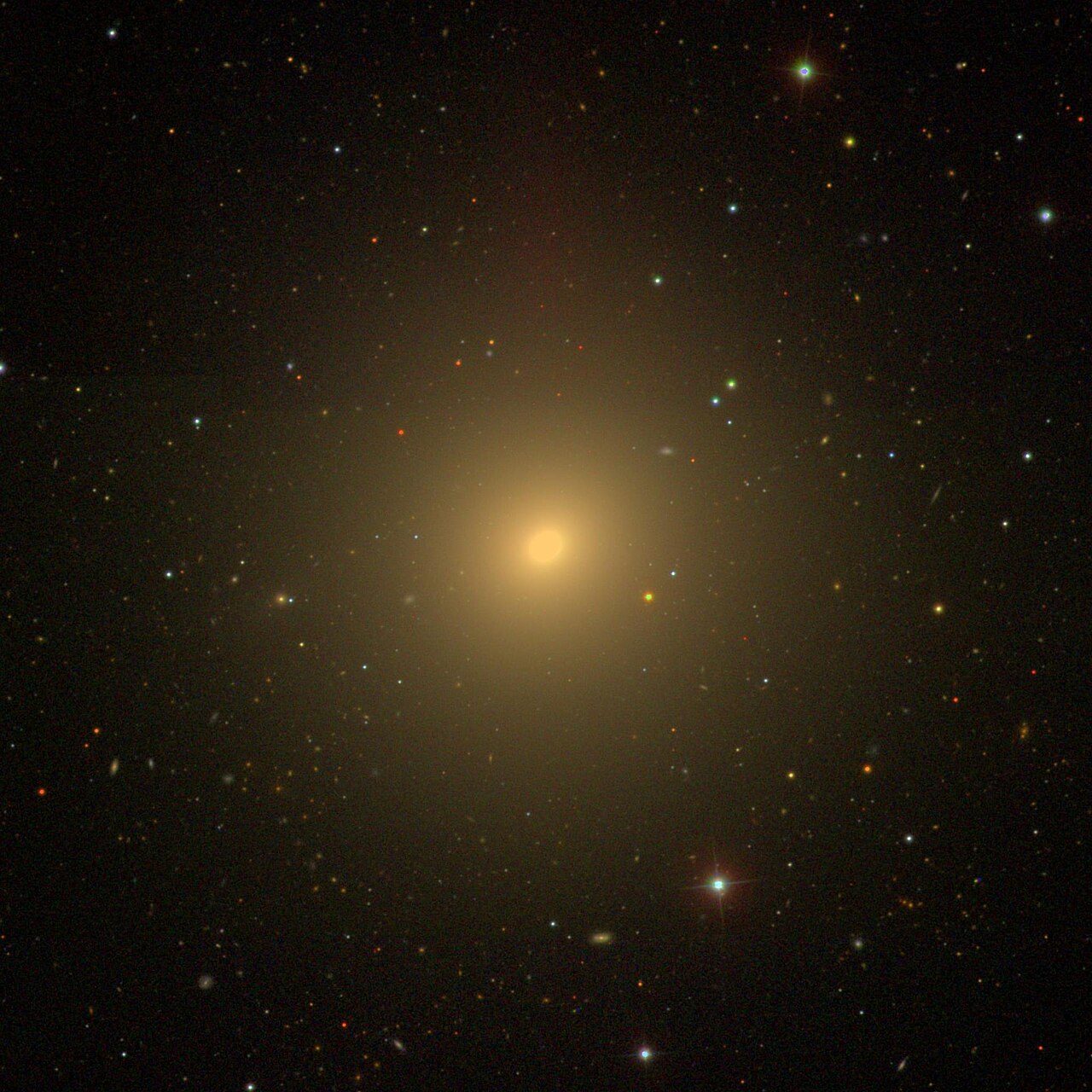
Messier 84
Giant elliptical galaxy in the Virgo Cluster core.

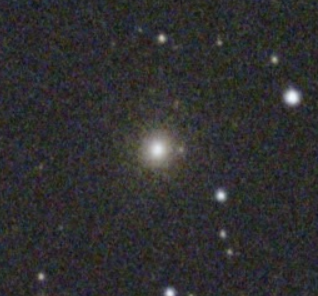
Sloan Digital Sky Survey · CC BY 4.0
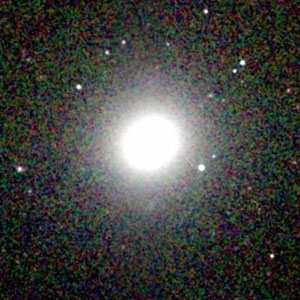
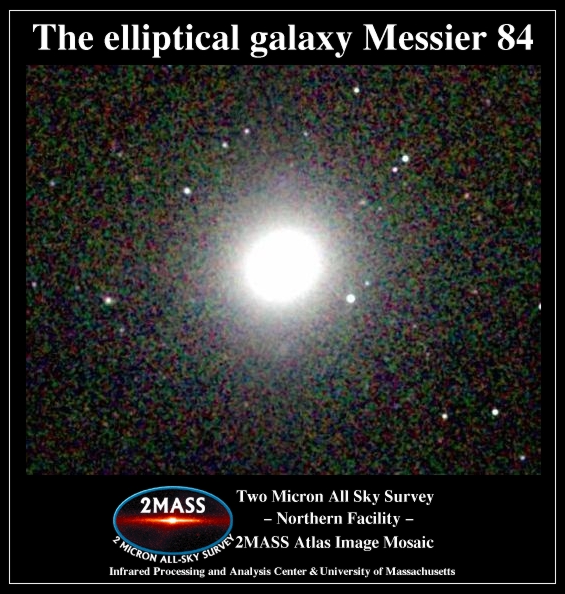
Messier 84 (M84, or NGC 4374) is a giant galaxy in the constellation Virgo, classified as either elliptical or lenticular. It sits in the dense core of the Virgo Cluster, which is part of the local supercluster. Charles Messier added it as the 84th entry in his catalog in 1781, while he was methodically scanning the sky for fuzzy, cloud-like objects.
This galaxy has a morphological type of E1, meaning it is flattened by about 10%. Its total visual brightness, after accounting for dust, is roughly 7.64 × 10¹⁰ times the Sun's luminosity. The mass-to-light ratio at the center is 6.5, and this ratio steadily climbs as you move outward from the core. The visible part of M84 is wrapped in a massive halo of dark matter.
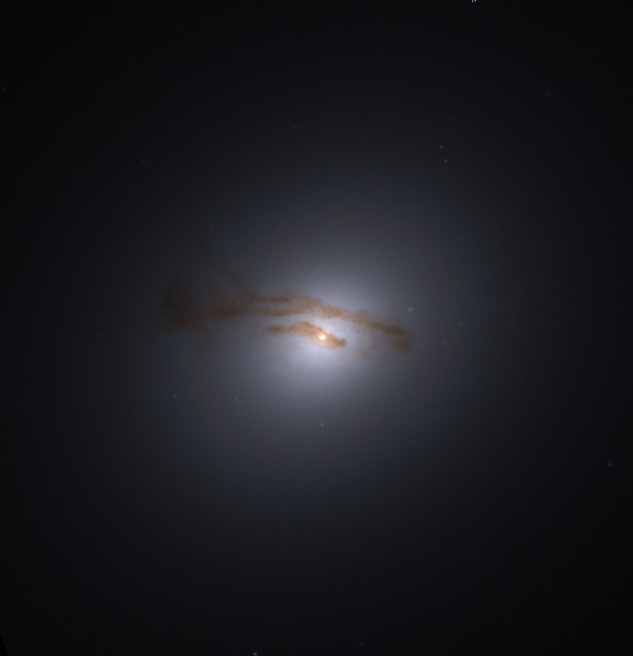
Radio observations and images from the Hubble Space Telescope show two jets of matter blasting out from the galaxy's center, along with a rotating disk of gas and stars. This disk points to a supermassive black hole with a mass of about 1.5 × 10⁹ Suns. There are also a few young stars and star clusters, indicating a very low rate of star formation. The galaxy hosts about 1,775 globular clusters (give or take 150), which is far fewer than expected for an elliptical galaxy of its size.
From Earth, the galaxy's half-light radius—the angular size containing half its total light—measures 72.5 arcseconds, just over one arcminute.
Three supernovae have been spotted in M84. SN 1957B (Type Ia, magnitude 12.5) was found by Howard S. Gates on April 28, 1957, and independently by Giuliano Romano on May 18, 1957. SN 1980I (Type Ia, magnitude 14) was discovered by M. Rosker on June 13, 1980, though it may actually belong to the neighboring galaxy NGC 4387 or M86. SN 1991bg (Type Ia-pec, magnitude 14) was visually spotted by Reiki Kushida on December 9, 1991; a precovery image showed it was already present at magnitude 14.9 on December 3. This supernova is well studied as a peculiar, underluminous Type Ia and now serves as a template for similar events, classified as Type Ia-91bg-like. Such a high supernova rate is unusual for an elliptical galaxy, hinting that M84 may contain a population of intermediate-age stars.
Quick Facts
- Epoch
- J2000
- Ra
- 12 · 25 · 03.74333
- Dec
- +12 · 53 · 13.1393
- Dist Ly
- 16.83 Mpc
- H Radial V
- 999 km/s
- Appmag V
- 9.1seds
- Absmag V
- −22.41 · 0.10
- Constellation Name
- Virgo
Facts from the source article.
Lore & Background
Messier 84 was discovered by Charles Messier in 1781. It has a morphological classification of E1, indicating a flattening of about 10%. The extinction-corrected total luminosity in the visual band is about 7.64×10¹⁰ L☉. The central mass-to-light ratio is 6.5, and this ratio steadily increases away from the core. The visible galaxy is surrounded by a massive dark matter halo.
Radio observations and Hubble Space Telescope images have revealed two jets of matter shooting out from its center, as well as a disk of rapidly rotating gas and stars, indicating the presence of a supermassive black hole with a mass of 1.5 × 10⁹ M☉. The galaxy has a few young stars and star clusters, indicating star formation at a very low rate. The number of globular clusters is 1,775 ± 150, which is much lower than expected for an elliptical galaxy.
Three supernovae have been observed in M84: SN 1957B (Type Ia, mag. 12.5, discovered by Howard S. Gates on 28 April 1957 and independently by Dr. Giuliano Romano on 18 May 1957); SN 1980I (Type Ia, mag. 14, discovered by M. Rosker on 13 June 1980, though historically catalogued as belonging to M84, it may have been in either neighboring galaxy NGC 4387 or M86); and SN 1991bg (Type Ia-pec, mag. 14, discovered visually by Reiki Kushida on 9 December 1991, with a precovery image showing it at magnitude 14.9 on 3 December 1991). This high rate of supernovae is rare for elliptical galaxies, which may indicate a population of stars of intermediate age in M84.
Reader's Guide
Messier 84 is notable as a giant elliptical or lenticular galaxy in the core of the Virgo Cluster, part of the local supercluster. Its discovery by Charles Messier in 1781 adds to the historical catalog of deep-sky objects. The galaxy's morphological classification E1 and its measured luminosity and mass-to-light ratio provide data on its structure and dark matter content. The presence of a supermassive black hole of 1.5 × 10⁹ M☉, inferred from jets and a rotating disk, is a key feature. The low number of globular clusters (1,775 ± 150) compared to expectations for an elliptical galaxy is a notable discrepancy. The observation of three supernovae, including the peculiar Type Ia-pec SN 1991bg now used as a template for 91bg-like events, is rare for elliptical galaxies and suggests an intermediate-age stellar population. The uncertainty regarding SN 1980I's host galaxy is preserved in the record.
Discovery & Place in the Cosmic Neighborhood
Charles Messier identified this object in 1781 while conducting his methodical survey of nebulous objects across the night sky, and it earned the number 84 in his now-famous catalogue. Today it also carries the designation NGC 4374, and it occupies a particularly crowded region of the universe: the dense core of the Virgo Cluster, itself a member of our local supercluster. Astronomers classify M84 as a giant elliptical or lenticular galaxy with a morphological type of E1, meaning its disk is flattened by roughly ten percent. In the visual band, after correcting for interstellar extinction, the galaxy radiates a total luminosity of approximately 7.64 × 10¹⁰ times that of our Sun, placing it firmly among the brighter members of its cluster. Its position in Virgo, a constellation visible from the northern hemisphere, has made it a long-standing target for both professional and amateur observers seeking to explore the rich galactic population of that region.
The Central Engine: Black Hole, Jets, and Dark Matter
Radio observations and imagery from the Hubble Space Telescope have revealed that M84 harbors a remarkably active nucleus. Two powerful jets of matter are seen erupting from the galaxy's center, while a disk of rapidly rotating gas and stars traces the gravitational influence of a supermassive black hole with an estimated mass of 1.5 × 10⁹ solar masses. The central mass-to-light ratio stands at 6.5, and measurements show this ratio steadily climbs as one moves outward from the core, a signature consistent with an extended dark matter distribution. Indeed, the visible galaxy is enveloped in a massive dark matter halo that dominates the gravitational potential well. Together, the jet activity, the rotating inner disk, and the rising mass-to-light profile paint a picture of a galaxy whose center is far more dynamic than a quiescent elliptical would suggest, even though the outer regions remain relatively calm.
Supernovae and a Surprising Stellar Population
Three supernovae have been recorded in M84, an unusually high tally for a galaxy of its type. SN 1957B, a Type Ia event at magnitude 12.5, was spotted in April and May 1957 by Howard S. Gates and independently by Giuliano Romano. SN 1980I, also Type Ia at magnitude 14, was found by M. Rosker in June 1980, though its true host may have been the neighboring NGC 4387 or M86. The most scientifically important of the three is SN 1991bg, a peculiar, underluminous Type Ia discovered visually by Reiki Kushida in December 1991; a precovery image placed it at magnitude 14.9 a week earlier. SN 1991bg has since become the defining template for a whole subclass of events labeled Type Ia-91bg-like. The elevated supernova rate, combined with the presence of a small population of young stars and star clusters, hints that M84 hosts an intermediate-age stellar population and undergoes star formation at a very low but nonzero pace.
Globular Clusters and Angular Structure
Despite its classification as a giant elliptical or lenticular system, M84 carries a globular cluster population of only 1,775 ± 150, a figure notably lower than what one would typically expect for a galaxy of its luminosity and morphological type. This deficit has prompted discussion about the galaxy's formation history and its interactions within the crowded Virgo Cluster core. From Earth, the galaxy's half-light radius—the angular radius within which half of its total light is emitted—measures 72.5 arcseconds, just over one arcminute of sky. That compact apparent size, combined with the dense galactic neighborhood of the Virgo Cluster, makes M84 a challenging but rewarding target for wide-field imaging. The low globular cluster count, the modest angular extent, and the E1 flattening together distinguish M84 from the more extended, cluster-rich ellipticals that dominate the Virgo core.
Gallery
Frequently Asked Questions
What is Messier 84?
Messier 84, also listed as NGC 4374, is a giant elliptical or lenticular galaxy residing in the dense central region of the Virgo Cluster. It is one of the most massive members of that cluster and belongs to the broader local supercluster.
Where in the sky can I find Messier 84?
M84 sits in the constellation Virgo, tucked among the crowded field of galaxies that make up the Virgo Cluster's core. It is not a naked-eye object, so binoculars or a small telescope are needed to pick it out from its neighbors.
What morphological type is Messier 84?
It carries an E1 classification, meaning it is flattened by roughly ten percent from a perfect sphere. Some observers and catalogs also describe it as lenticular, reflecting its smooth, featureless disk-like glow without visible spiral arms.
How luminous is Messier 84 compared to the Sun?
After correcting for interstellar dust, M84's total visual output is approximately 7.64 × 10¹⁰ solar luminosities. Its central region shows a mass-to-light ratio of about 6.5, hinting at a large reservoir of unseen mass near the core.
Who added Messier 84 to the catalog and when?
Charles Messier recorded it as entry number 84 in 1781, during his methodical sweep of the sky for faint, cloud-like nebulous objects. He was cataloging these fuzzy patches partly to help astronomers avoid mistaking them for comets.
More in Messier Objects, Part 3 1-24
Spotted an error? Know more?
Reader corrections go straight into our review queue. Suggest an edit · How this site is sourced