Messier 87
A supergiant elliptical galaxy with a relativistic jet.

Event Horizon Telescope , uploader cropped and converted TIF to JPG · CC BY 4.0
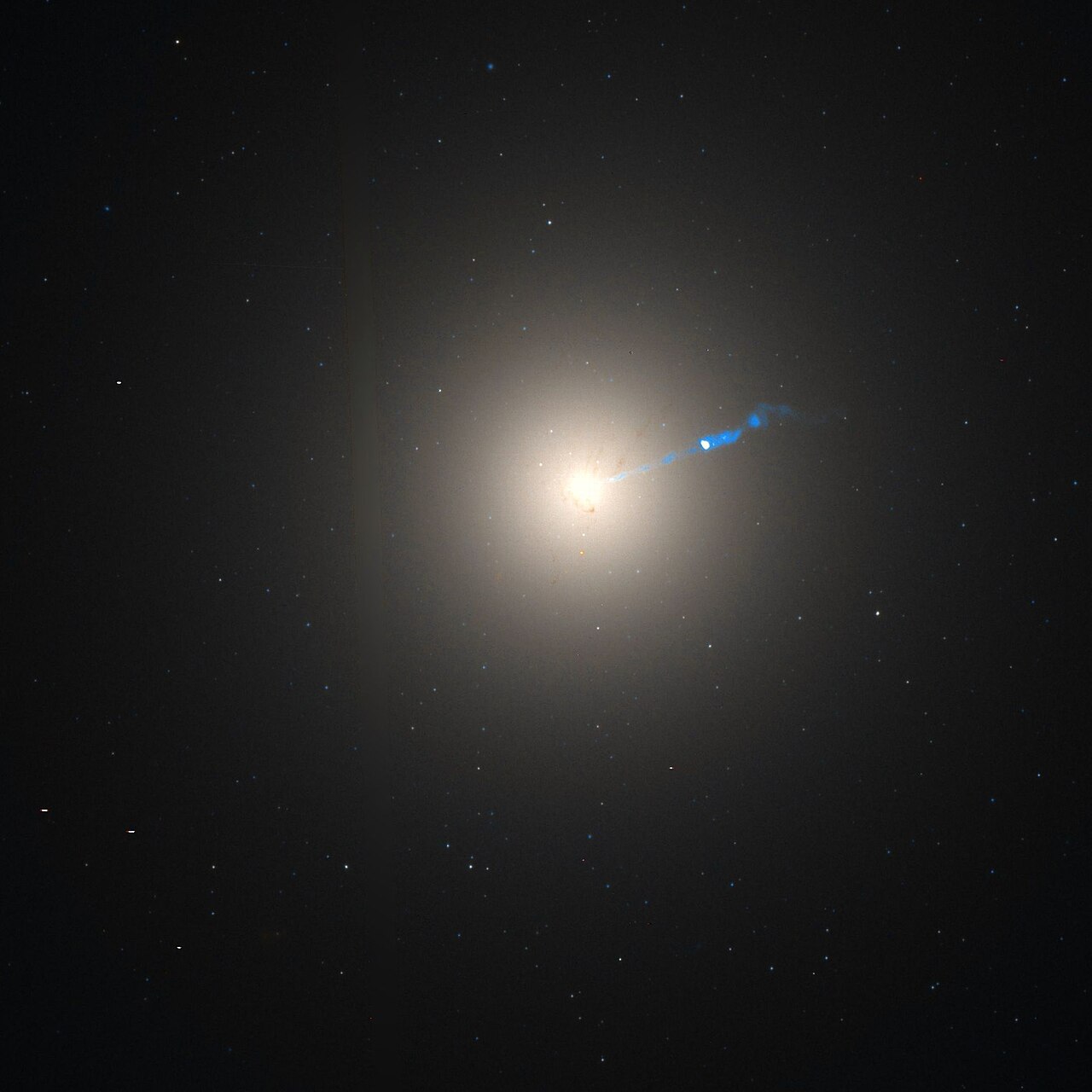
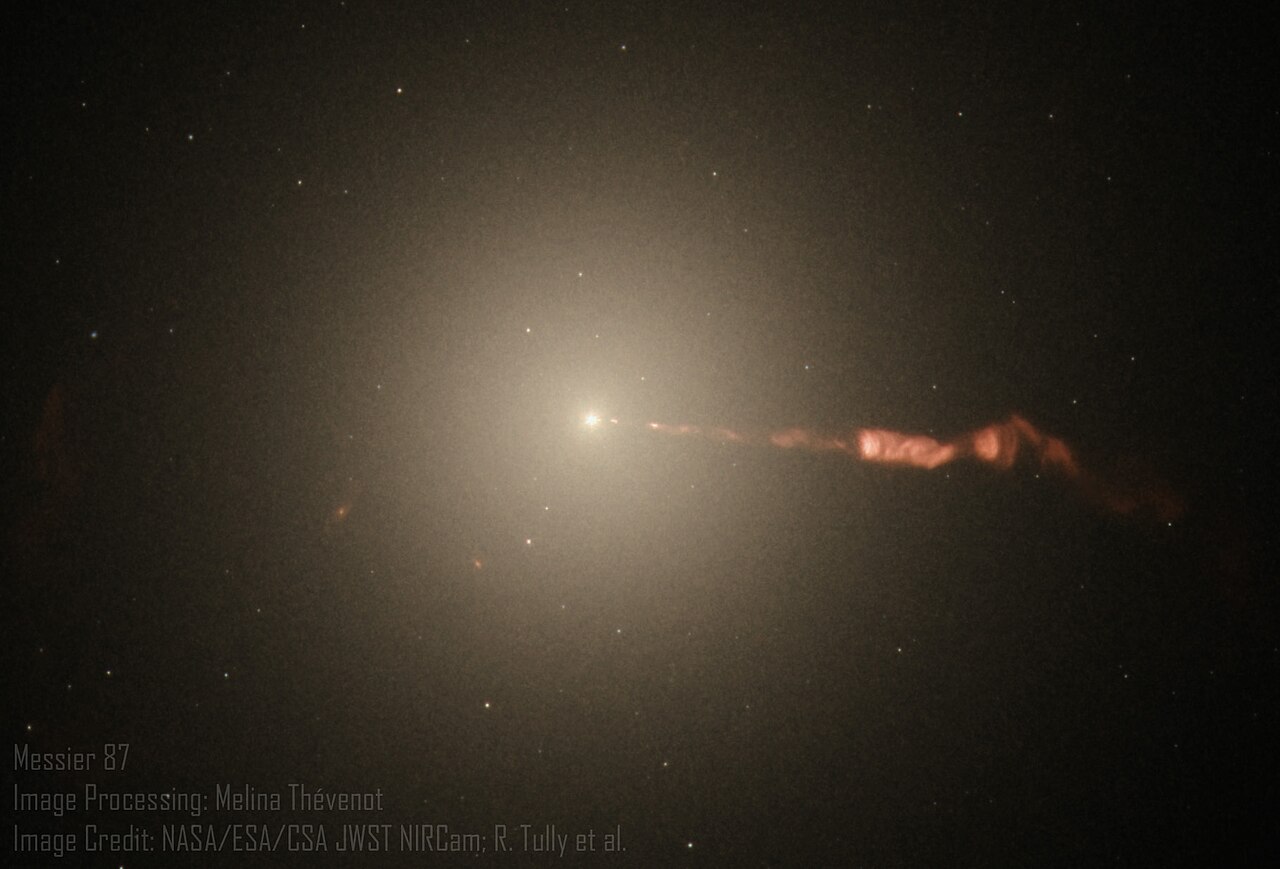
Messier 87—tagged as Virgo A or NGC 4486, and often shortened to M87—is a supergiant elliptical galaxy located in the constellation Virgo. It holds several trillion stars. Among the biggest and most massive galaxies in our cosmic neighborhood, it boasts roughly 15,000 globular clusters (the Milky Way has only 150 to 200), plus a relativistic jet of energetic plasma shooting from its core. That jet travels at near-light speed and stretches at least 1,500 parsecs (4,900 light-years). M87 ranks as one of the sky’s brightest radio sources and draws attention from both amateur skywatchers and professional researchers.
Quick Facts
- Epoch
- J2000
- Constellation Name
- Virgo
- Ra
- 12 · 30 · 49.42338
- Dec
- +12 · 23 · 28.0439
- Appmag V
- 8.6seds
- H Radial V
- 1,284 ± 5 km/s
- Z
- 0.00428 ± 0.00002
- Dist Ly
- 16.4 ± 0.5 Mpc
- Names
- Virgo A, Virgo X-1, NGC 4486, UGC 7654, PGC 41361, VCC 1316, Arp 152, 3C 274, 3U 1228+12.
Facts from the source article.
Lore & Background
The French astronomer Charles Messier discovered M87 in 1781, and cataloged it as a nebula. In 1918, the American astronomer Heber Curtis noted M87's lack of a spiral structure and observed a 'curious straight ray ... apparently connected with the nucleus by a thin line of matter.' In January 1922, Russian astronomer Innokentii A. Balanowski discovered supernova SN 1919A on a photographic plate of M87. In 1922, Edwin Hubble categorized M87 as one of the brighter globular nebulae, and by 1926 he classified it as a type of elliptical extragalactic nebula with no apparent elongation (class E0). In 1931, Hubble described M87 as a member of the Virgo Cluster.
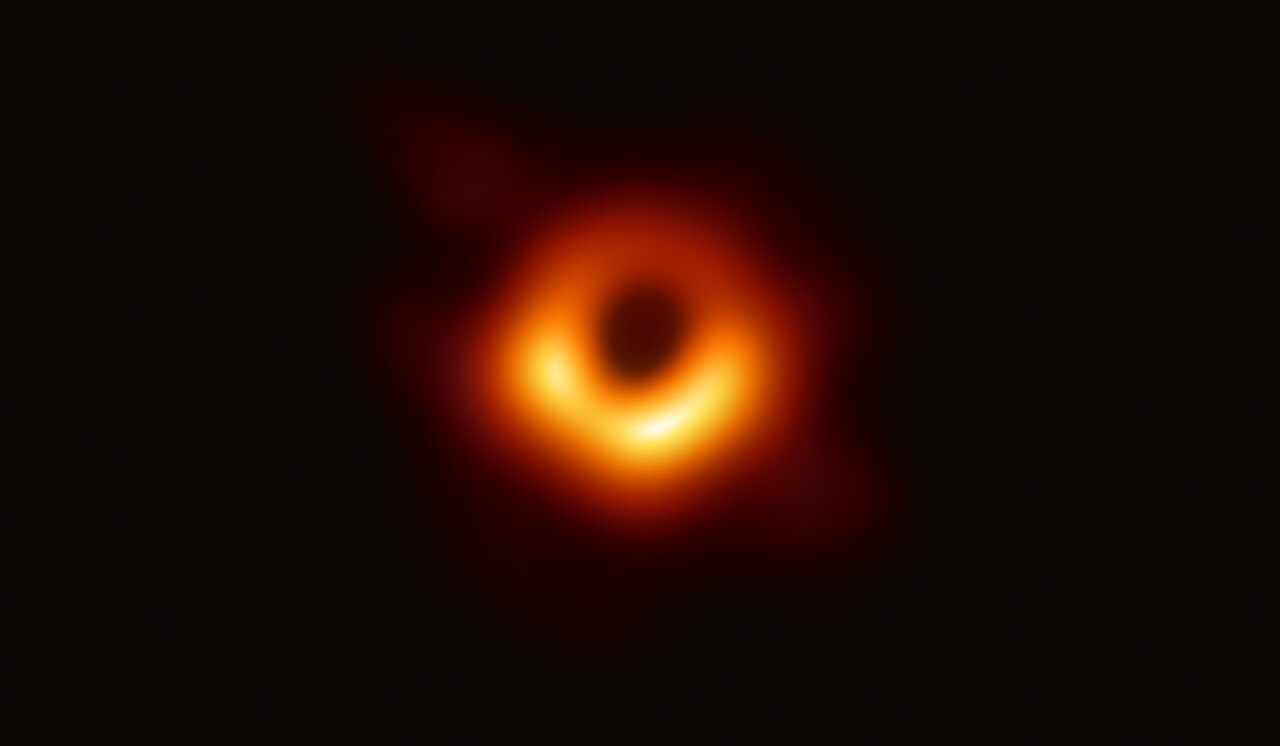
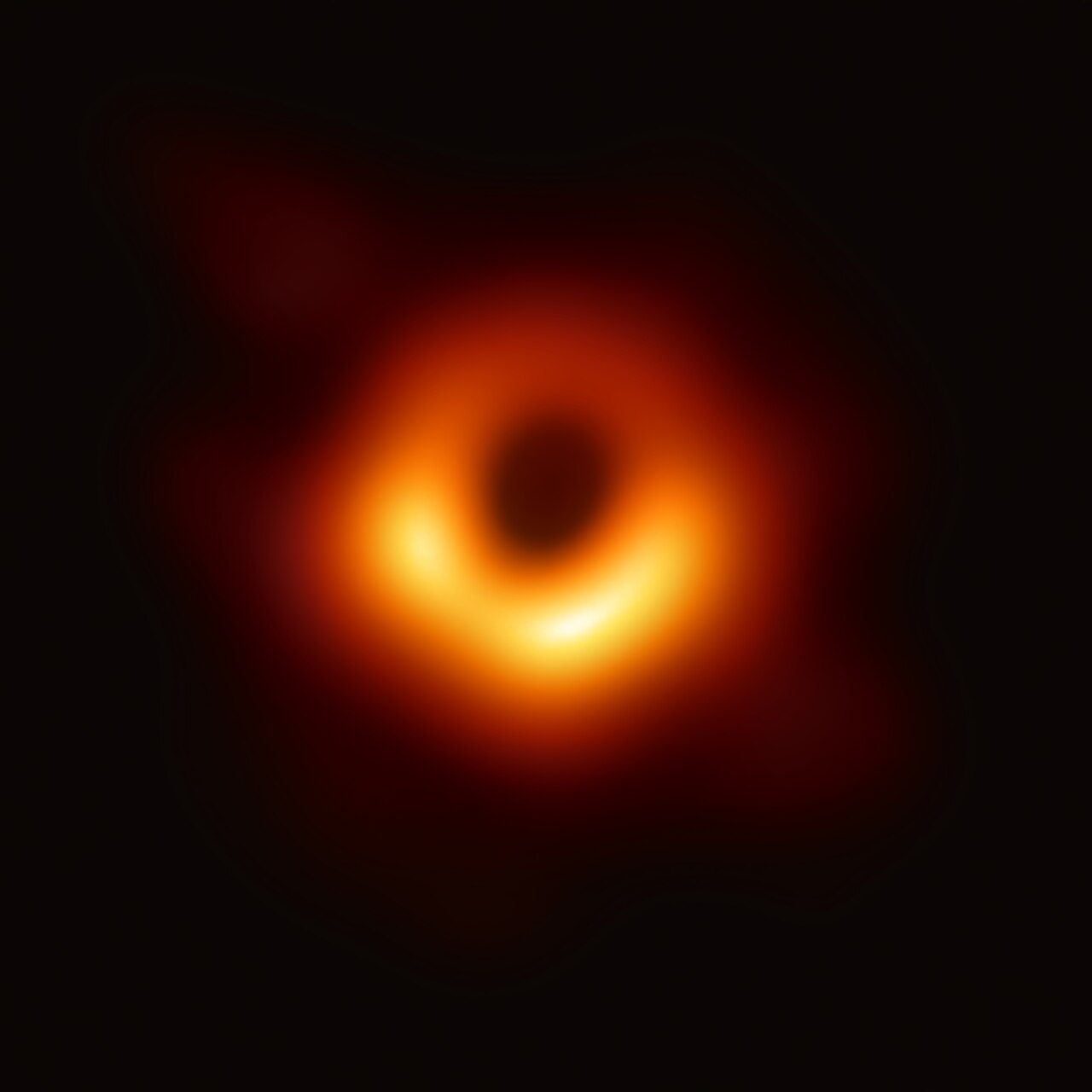
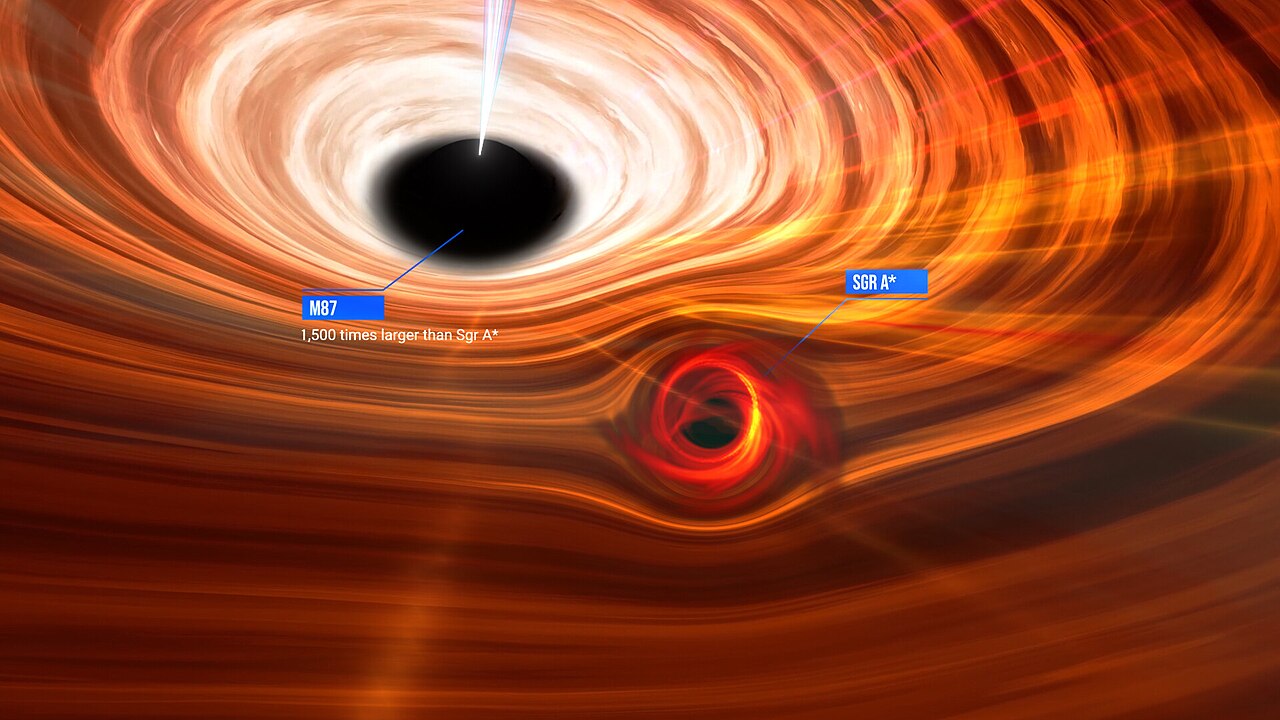
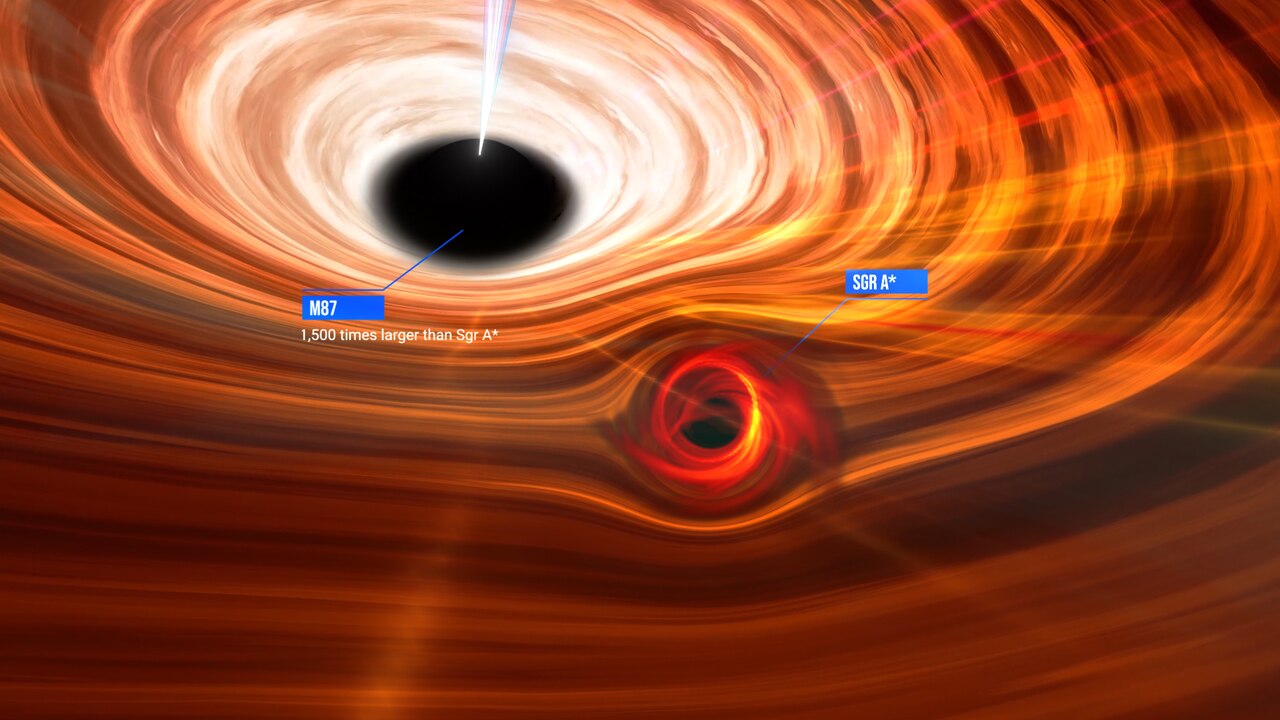
M87 has an active supermassive black hole at its core, which forms the primary component of an active galactic nucleus. The black hole was imaged using data collected in 2017 by the Event Horizon Telescope (EHT), with a final, processed image released on 10 April 2019. In March 2021, the EHT Collaboration presented, for the first time, a polarized-based image of the black hole. The galaxy is a strong source of multi-wavelength radiation, particularly radio waves. It has an isophotal diameter of 40.55 kiloparsecs (132,000 light-years), with a diffuse galactic envelope that extends to a radius of about 150 kiloparsecs (490,000 light-years), where it is truncated—possibly by an encounter with another galaxy.
Reader's Guide
M87 has been an important testing ground for techniques that measure the masses of central supermassive black holes in galaxies. In 1978, stellar-dynamical modeling gave evidence for a central mass of five billion solar masses. After the installation of the COSTAR corrective-optics module in the Hubble Space Telescope in 1993, the Hubble Faint Object Spectrograph (FOS) measured the rotation velocity of the ionized gas disk at the center of M87, indicating a central black hole mass of 2.4 billion M☉, with 30% uncertainty. Globular clusters within M87 have been used to calibrate metallicity relations. In 1947, a prominent radio source, Virgo A, was identified with errors in its measured position that overlapped the location of M87; the source was confirmed to be M87 by 1953, and the linear relativistic jet emerging from the core was suggested as the cause. In 1966, the United States Naval Research Laboratory's Aerobee 150 rocket identified Virgo X-1, the first X-ray source in Virgo, later linked to M87. The galaxy is visible with a small telescope of 6 cm aperture, though viewing the jet is a challenge without photography. M87 is classified as an E0p galaxy in the modified Hubble sequence, and as a type-cD galaxy in the Yerkes scheme.
Did You Know?
- M87 contains about 15,000 globular clusters, compared to the Milky Way's 150–200.
- The relativistic jet from M87's core extends at least 1,500 parsecs (4,900 light-years).
- The black hole at M87's center was imaged by the Event Horizon Telescope in 2017, with the image released on 10 April 2019.
- M87 is the second-brightest galaxy within the northern Virgo Cluster.
A Comet Hunter's Legacy
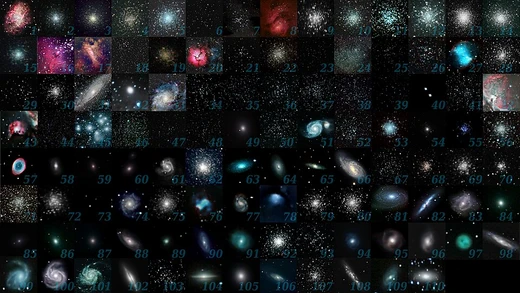
The Messier catalogue was born not from a grand ambition to map the cosmos, but from sheer frustration. Charles Messier, a French astronomer working in Paris, was primarily on the hunt for comets. The bright, fuzzy patches of nebulae, clusters, and galaxies kept derailing his search, so he began listing them to avoid confusion. Working alongside his assistant Pierre Méchain, he compiled what would become one of the most celebrated astronomical lists ever assembled. Messier 87, a galaxy among the diverse entries, found its place in this collection of non-comet objects. The preliminary version appeared in 1774 in the Memoirs of the French Academy of Sciences, containing 45 unnumbered objects. By the time Messier's final version was published in 1781 in the Connaissance des Temps for 1784, the list had grown to 103 entries. M87 sits within this body of work as one of the galaxies included alongside star clusters, nebulae, and other deep-sky phenomena.
From 45 to 110: The Growing Catalogue
The Messier list did not remain static after its initial publication. The 1774 first edition held 45 objects, growing to 70 by 1780 and reaching 103 in the 1781 publication. Yet the story continued through the notes and marginalia left in Messier's and Méchain's texts. In 1921, Nicolas Camille Flammarion discovered a note in a copy of the 1781 edition and added Messier 104. Helen Sawyer Hogg contributed M105 through M107 in 1947, Owen Gingerich added M108 and M109 in 1960, and Kenneth Glyn Jones included M110 in 1967. The contentious M102, observed by Méchain and communicated to Messier, was long thought to be a duplicate of M101, though some sources identify it as the galaxy NGC 5866. Through these successive additions, the catalogue expanded to 110 objects, with M87 remaining a stable and well-established entry throughout this long evolution.
A Target for Every Skywatcher
Messier observed the sky from the Hôtel de Cluny in Paris using a modest refracting telescope of roughly 100 millimeters aperture. The objects he and Méchain recorded, including galaxies like M87, were bright enough to be resolved through such a small instrument, making them among the most luminous and visually striking deep-sky objects available to observers on Earth. This accessibility has made them perennial favorites for amateur astronomers who today use larger-aperture equipment to reveal finer structural details. The catalogue covers the sky from the north celestial pole down to a celestial latitude of approximately minus 35.7 degrees, encompassing nearly all spectacular deep-sky objects visible from European latitudes. In early spring, dedicated observers gather for Messier marathons, attempting to view every object in the catalogue over a single night. M87, as one of the galaxies in this collection, is a natural part of that ambitious annual ritual.
Among the Nearest and Brightest
The Messier objects are not merely historical curiosities; they represent some of the most scientifically significant targets in astronomy. Nearly all of them rank among the closest examples of their respective classes to Earth, whether they are diffuse nebulae, planetary nebulae, open clusters, globular clusters, or galaxies. This proximity means they are heavily studied with professional-class instruments capable of resolving small, visually significant structural details. A galaxy like M87 benefits from this sustained attention, as its relative closeness allows astronomers to examine features that would be invisible in more distant members of its class. The Concise Catalog of Deep-sky Objects compiles astrophysical summaries for each entry, reflecting the depth of research these objects have attracted. From Messier's eighteenth-century refractor to modern professional telescopes, these targets have remained at the forefront of observational astronomy, bridging the gap between casual stargazing and rigorous scientific inquiry.
Gallery
Frequently Asked Questions
What exactly is Messier 87?
M87 is a supergiant elliptical galaxy sitting in the constellation Virgo, and it ranks among the most massive galaxies in our immediate cosmic neighborhood. It is also catalogued under the designations Virgo A and NGC 4486.
What's the deal with the jet shooting out of M87's center?
A relativistic jet of superheated plasma erupts from the galaxy's core and races outward at nearly the speed of light. The visible stream stretches at least 4,900 light-years, which makes M87 one of the brightest radio sources in the entire sky.
How big is M87 compared to the Milky Way?
M87 spans roughly 132,000 light-years in diameter and contains several trillion stars, making it vastly larger and more massive than our own galaxy. Its mass within the inner 32 kiloparsecs alone is about 2.4 trillion solar masses.
Why is M87's globular cluster population such a big deal?
The galaxy hosts around 15,000 globular clusters, roughly a hundred times more than the Milky Way's 150 to 200. That extraordinary abundance makes M87 a prime target for studying how star clusters form and evolve in massive elliptical systems.
Who first catalogued Messier 87 and when?
French astronomer Charles Messier recorded M87 in 1781 while he was assembling his famous catalogue of deep-sky objects. It has remained a favorite of both amateur skywatchers and professional researchers ever since.
More in Messier Objects, Part 3 1-24
Spotted an error? Know more?
Reader corrections go straight into our review queue. Suggest an edit · How this site is sourced