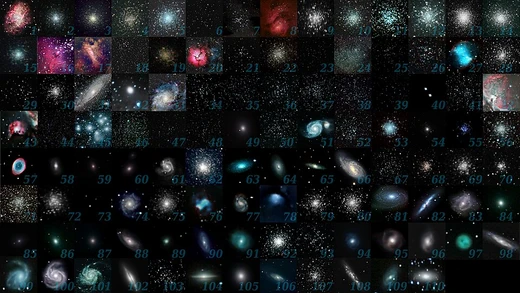
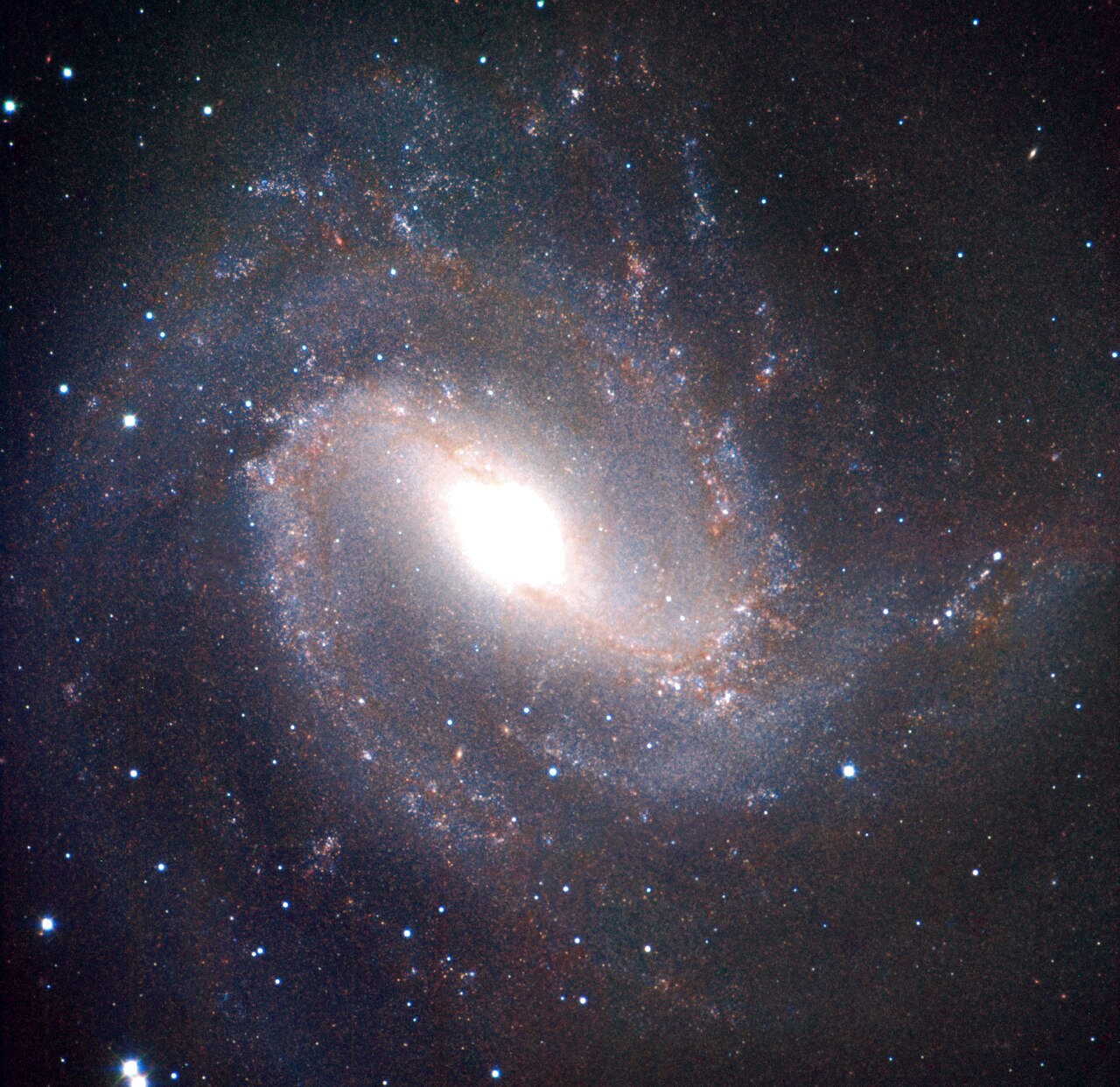
Messier 83
A bright barred spiral galaxy near Centaurus A.

ESO · CC BY 4.0
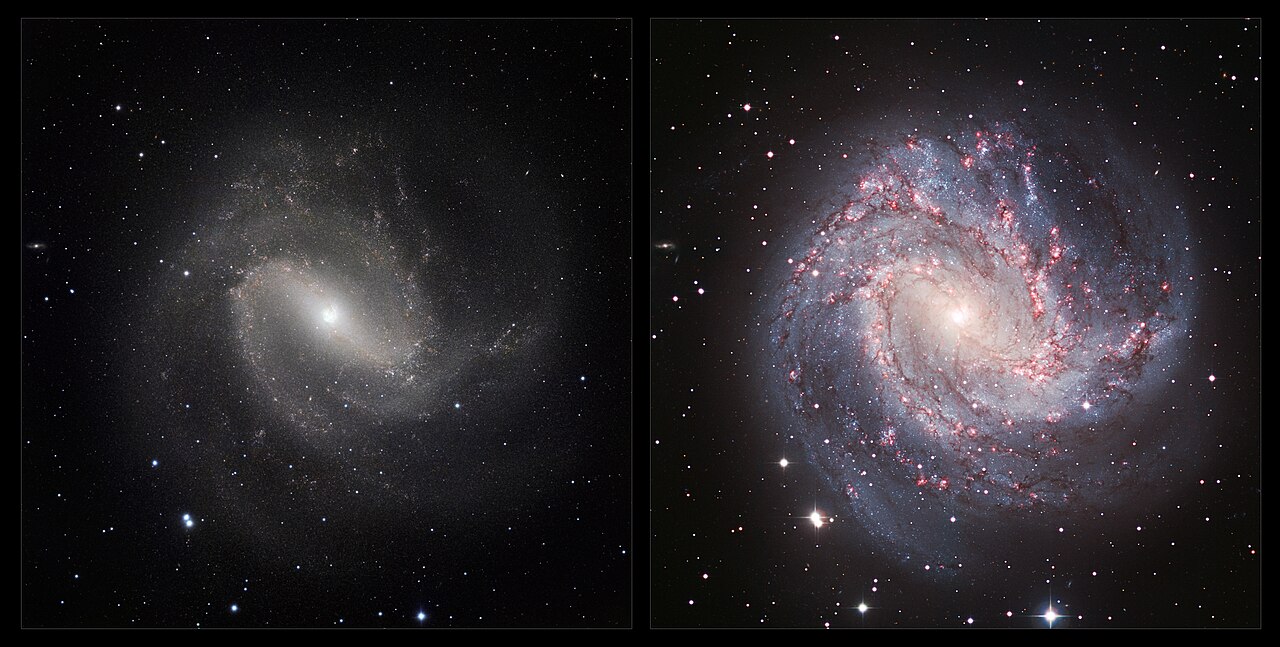
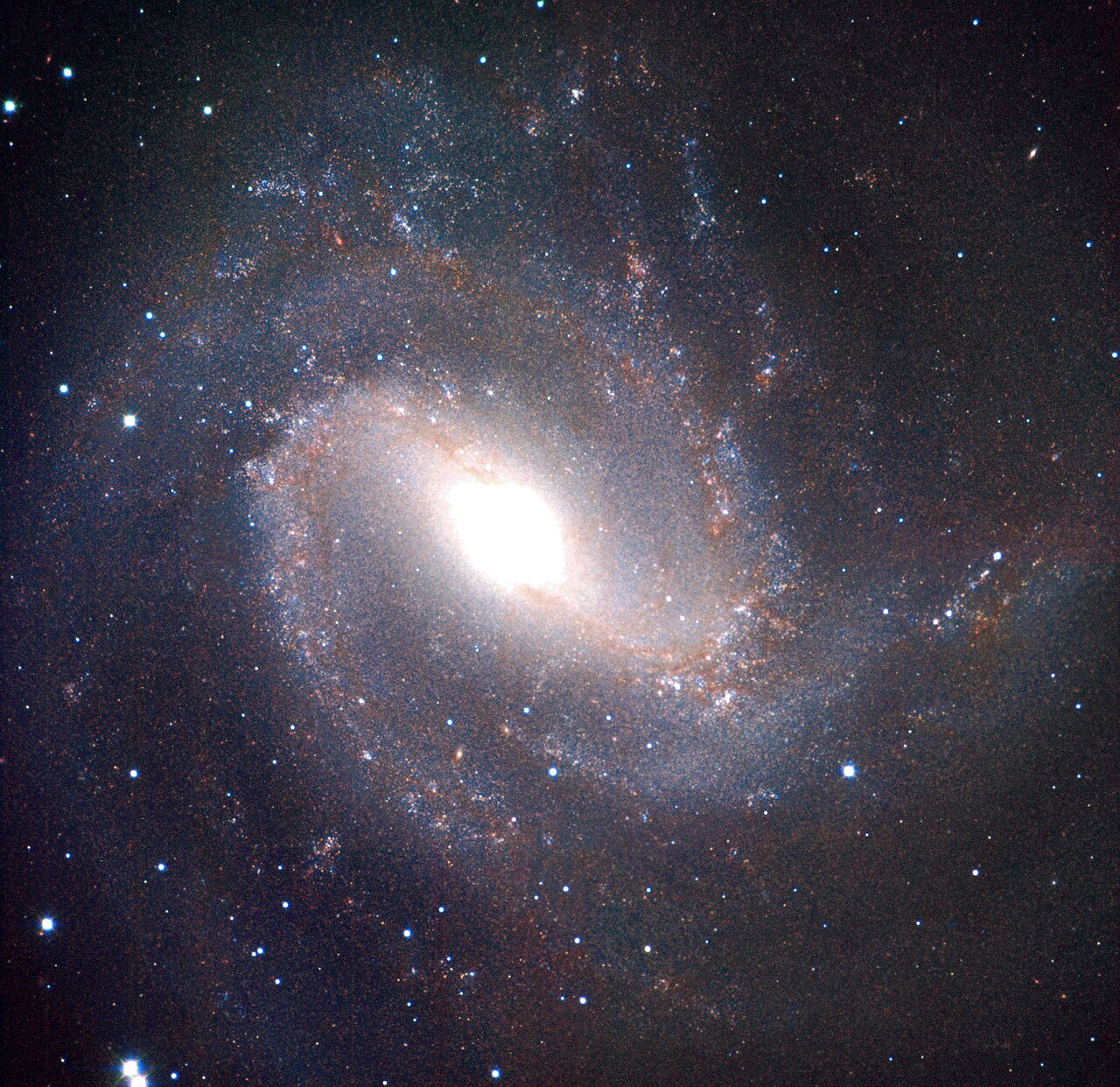
Messier 83 (M83), also cataloged as NGC 5236, is a barred spiral galaxy nicknamed the Southern Pinwheel for its visual similarity to the Pinwheel Galaxy (M101). It lies about 15 million light-years away, straddling the border between the constellations Hydra and Centaurus, and is one of the closest and brightest barred spirals in the sky—easily spotted with binoculars. The galaxy was first spotted on 17 February 1752 by Nicolas-Louis de Lacaille at the Cape of Good Hope, and Charles Messier added it to his famous catalog in March 1781. Its isophotal diameter spans roughly 118,000 light-years (36.24 kiloparsecs).
In terms of structure, M83 is a massive grand design spiral with a weak bar, classified as SAB(s)c in the De Vaucouleurs system: the "s" means it has no ring, and the "c" indicates loosely wound arms. The nearby peculiar dwarf galaxy NGC 5253 likely interacted with M83 within the last billion years, triggering starburst activity in both of their cores. Star formation in M83 is especially vigorous along the leading edges of its spiral arms, consistent with density wave theory. In April 2008, NASA's Galaxy Evolution Explorer revealed a surprising abundance of new stars in the galaxy's outer reaches, 20 kiloparsecs from the center—regions previously thought too barren for star formation. In April 2025, astronomers published the first clues pointing to a possible supermassive black hole at M83's core.
Six supernovae have been recorded in M83. The earliest, SN 1923A, was spotted by Carl Otto Lampland on 5 May 1923 (magnitude 14). SN 1945B (mag. 14.2) followed on 13 July 1945, discovered by William Liller. Guillermo Haro found SN 1950B (mag. 14.5) on 15 March 1950, and Howard S. Gates caught SN 1957D (mag. 15) on 28 December 1957. SN 1968L (Type II-P, mag. 11.9) was discovered by John C. Bennett on 17 July 1968. The most notable, SN 1983N (Type Ia, mag. 11.9), was found by Robert Evans from Australia on 3 July 1983. Three days later, the Very Large Array detected radio emissions from it—the first such detection for a Type I supernova. It peaked in brightness on 17 July at magnitude 11.54, and although classified as Type I, its spectrum was unusual. A year after the explosion, about 0.3 solar masses of iron were unambiguously found in the ejecta, a first for any supernova.
Quick Facts
- Epoch
- J2000
- Ra
- 13 · 37 · 00.919
- Dec
- -29 · 51 · 56.74
- Dist Ly
- 4.50 Mpc
- Appmag V
- 7.6seds
- Constellation Name
- Hydra
Facts from the source article.
Lore & Background
Nicolas-Louis de Lacaille discovered M83 on 17 February 1752 at the Cape of Good Hope. Charles Messier added it to his catalogue of nebulous objects in March 1781. Its morphological classification in the De Vaucouleurs system is SAB(s)c, indicating a weak-barred spiral with loosely wound arms and no ring structure. The peculiar dwarf galaxy NGC 5253 lies near M83, and the two likely interacted within the last billion years, resulting in starburst activity in their central regions.
The star formation rate in M83 is higher along the leading edge of the spiral arms, as predicted by density wave theory. On 16 April 2008, NASA's Galaxy Evolution Explorer project reported finding large numbers of new stars in the outer reaches of the galaxy—20 kpc from the center—areas previously thought to lack materials necessary for star formation. In April 2025, it was published that first clues were found for the possible existence of a supermassive black hole at the center of M83.
Six supernovae have been observed in M83, including SN 1983N, which became the modern prototype of a hydrogen-deficient Type Ib supernova, with the progenitor inferred as a Wolf–Rayet star. M83 is at the center of one of two subgroups within the Centaurus A/M83 Group, a nearby galaxy group; the two subgroups appear not to be moving relative to each other.
Reader's Guide
Messier 83 is notable as one of the closest and brightest barred spiral galaxies, making it a frequent target for amateur and professional astronomers. Its discovery by Nicolas-Louis de Lacaille in 1752 at the Cape of Good Hope and its inclusion by Charles Messier in 1781 highlight its historical significance. The galaxy's grand design spiral structure and high star formation rate, especially along the leading edges of its arms, provide a natural laboratory for testing density wave theory. The 2008 discovery of new stars in its outer reaches challenged previous assumptions about star formation environments. The possible detection of a supermassive black hole at its center, announced in April 2025, adds to its astrophysical importance. The six supernovae observed in M83, particularly SN 1983N, have contributed to the understanding of supernova types and progenitor systems, including the first unambiguous detection of a large amount of iron in supernova ejecta. As the center of one subgroup within the Centaurus A/M83 Group, M83 plays a key role in studies of galaxy interactions and group dynamics.
Did You Know?
- M83 was discovered by Nicolas-Louis de Lacaille on 17 February 1752 at the Cape of Good Hope.
- SN 1983N in M83 was the first Type I supernova to have a radio emission detected.
- The galaxy's nickname 'Southern Pinwheel' derives from its resemblance to the Pinwheel Galaxy (M101).
A Number in a Legendary List
M83 occupies a place in one of the most celebrated compilations in all of astronomy. The Messier catalogue, originally assembled by Charles Messier and his assistant Pierre Méchain, began as a practical tool: a running list of bright, non-comet objects that kept derailing Messier's obsessive search for new comets. What started as 45 unnumbered entries in a 1774 memo submitted to the French Academy of Sciences grew steadily, reaching 70 objects by 1780 and a final 103 in the 1781 edition published in the Connaissance des Temps. Later astronomers, poring over marginalia and side notes in Messier's and Méchain's manuscripts, pushed the count to 110. M83 stands among this diverse roster of galaxies, nebulae, and star clusters, and to this day it is referenced far more often by its simple Messier designation than by any other catalog number.
One of the Spectacular Few
The Messier objects are not random picks plucked from the night sky. They represent, in nearly every category of deep-sky phenomenon—diffuse nebulae, planetary nebulae, open clusters, globular clusters, and galaxies—some of the most visually striking examples visible from European latitudes. Crucially, nearly every entry sits near the top of the closeness rankings within its category, meaning they are among the nearest members of their class to Earth. This proximity means modern professional instruments can resolve fine structural details in them, and that even a modest 100-millimeter refractor, the kind Messier himself used from his Paris base, could render them visible through glass. M83, as a galaxy within this elite group, benefits from that same combination of brightness and closeness that made it a natural inclusion in a list designed to capture the sky's most impressive sights.
Compiled from the Rooftops of Paris
The entire Messier catalogue, of which M83 is a member, was born from a single vantage point: the Hôtel de Cluny in Paris, now home to the Musée national du Moyen Âge. Messier and Méchain worked from this location, and their observational window was constrained by geography. Their list encompasses objects spanning from the north celestial pole down to roughly −35.7° in celestial latitude, meaning they deliberately excluded targets visible only from much more southerly latitudes, such as the Magellanic Clouds. This geographic limitation shaped the catalogue's character, filling it with objects that a mid-northern observer could realistically track across the seasons. The final edition was published in the Connaissance des Temps pour l'Année 1784, France's official yearly ephemeris, cementing its status as a reference work for the broader astronomical community.
A Marathon for the Modern Eye
More than two centuries after Messier first jotted down his frustrating non-comet targets, the catalogue remains a living resource. Amateur astronomers worldwide still reach for Messier numbers as shorthand for some of the most rewarding visual and photographic targets available. In early spring, dedicated observers gather for so-called Messier marathons, attempting to sweep through all 110 entries in a single night as the sky rotates through the appropriate constellations. Modern equipment with apertures far exceeding Messier's modest refractor makes these objects even more accessible, revealing structural details that would have been invisible in the eighteenth century. M83, like its catalogued neighbors, continues to draw both casual backyard stargazers and serious astrophotographers, ensuring that a list born out of comet-hunting frustration endures as a gateway to the deep sky.
Gallery
Frequently Asked Questions
What kind of object is Messier 83?
M83 is a barred spiral galaxy (classified SAB(s)c) with a central bar feeding into loosely wound spiral arms. It ranks among the nearest and brightest barred spirals visible from Earth.
How far away is M83 and where in the sky can I find it?
The galaxy sits roughly 15 million light-years from us, straddling the boundary between the constellations Hydra and Centaurus. Its proximity and brightness mean even a pair of binoculars will reveal it as a soft fuzzy patch.
Who first observed M83 and when did Messier add it to his catalog?
French astronomer Nicolas-Louis de Lacaille spotted the galaxy at the Cape of Good Hope on 17 February 1752. Charles Messier later incorporated it into his famous list in March 1781.
Why is M83 nicknamed the 'Southern Pinwheel'?
The name comes from its visual resemblance to the better-known Pinwheel Galaxy (M101), with sweeping arms radiating from the center. The 'Southern' qualifier simply notes that M83 is visible from the southern hemisphere, distinguishing it from its northern namesake.
How large is Messier 83?
Its isophotal diameter spans roughly 118,000 light-years (about 36 kiloparsecs), making it a substantial barred spiral. That places it in the same general size range as the Milky Way's visible stellar disk.
More in Messier Objects, Part 3 1-24
Spotted an error? Know more?
Reader corrections go straight into our review queue. Suggest an edit · How this site is sourced