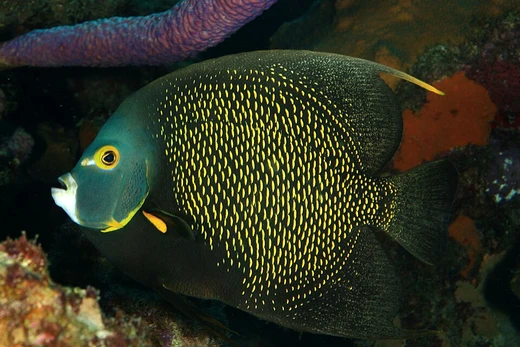
Twospined angelfish
A marine angelfish found in the Indo-Pacific.

The twospined angelfish (Centropyge bispinosa), also called the dusky angelfish or coral beauty, is a marine angelfish from the family Pomacanthidae. Its body is dark purplish-blue with irregular orange vertical bars on the sides. The dorsal, tail, and anal fins have a bright blue edge. The dorsal fin has 14 spines and 17–18 soft rays, while the anal fin has 3 spines and 17–19 soft rays. It grows up to 10 centimeters (3.9 inches) long.
This fish lives in the Indo-Pacific, from East Africa between Tanzania and South Africa east to the Tuamotu Islands, north to Japan’s Izu Islands, and south to Lord Howe Island. In Australia, it appears at the Rowley Shoals, Scott Reef, Ashmore Reef, and along the east coast from Raine Island to Bass Point, plus Christmas Island. Offshore, it occurs at Norfolk Island, Elizabeth and Middleton Reefs in the Tasman Sea, and Ashmore and Kenn Reefs in the Coral Sea.
It inhabits coral reefs at depths of 5 to 50 meters (16 to 164 feet), especially around drop-offs, lagoons, and rubble patches. The fish lives in small groups with one male and several females. It is a protogynous hermaphrodite: if the male dies, the dominant female changes sex to replace him. It eats algae and detritus.
First described in 1869 by Albert Günther, with the type location at Ambon Island, Indonesia, it is sometimes placed in the subgenus *Centropyge*. It is common in the aquarium trade.
Quick Facts
- Taxon
- Centropyge bispinosa
Facts from the source article.
Lore & Background
The twospined angelfish has a basic dark purplish-blue body marked with irregular orange vertical bars on its flanks. The dorsal, caudal and anal fins have a bright blue margin. This species attains a maximum total length of 10 centimetres (3.9 in).
It is found in the Indo-Pacific, ranging from the coast of East Africa between Tanzania and South Africa as far east as the Tuamotu Islands of French Polynesia, north to the Izu Islands of Japan and south to Lord Howe Island. In Australia, it occurs at Lord Howe Island, the Rowley Shoals and Scott Reef in Western Australia, Ashmore Reef in the Timor Sea, and along the east coast from Raine Island in Queensland to Bass Point in New South Wales, as well as Christmas Island. Offshore it is found at Norfolk Island, Elizabeth Reef and Middleton Reef in the Tasman Sea, and Ashmore Reef and Kenn Reef in the Coral Sea.
The twospined angelfish lives at depths of 5 to 50 metres in coral reefs within lagoons, rubble patches and drop offs, being commonest around drop offs. It lives in small social groups consisting of a single male and a few females. It is a protogynous hermaphrodite: the most dominant female in a group will change sex to become male if the existing male dies or disappears. This species feeds on algae and detritus.
Reader's Guide
The twospined angelfish was first formally described in 1869 by the German-born British ichthyologist and herpetologist Albert Günther, with the type locality given as Ambon Island, Indonesia. In some classifications it is placed in the subgenus Centropyge. The species is frequently found in the aquarium trade, which contributes to its significance as a commonly kept marine angelfish. Its notable coloration—dark purplish-blue with irregular orange vertical bars and bright blue fin margins—makes it visually distinctive. Its protogynous hermaphroditism and social structure, where a single male dominates a group of females, are key biological traits. The species is widespread across the Indo-Pacific, from East Africa to French Polynesia, and occurs in a variety of coral reef habitats, particularly drop offs. Its diet consists of algae and detritus.
Did You Know?
- The twospined angelfish is also known as the dusky angelfish or coral beauty.
- It is a protogynous hermaphrodite: the dominant female changes sex to male if the male dies.
More in Marine Angelfish 1-24
Spotted an error? Know more?
Reader corrections go straight into our review queue. Suggest an edit · How this site is sourced