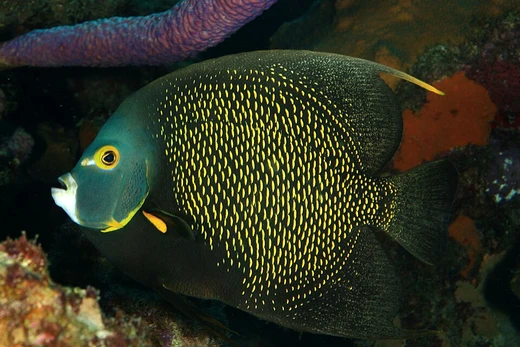
Apolemichthys xanthotis
A white-bodied angelfish with a black head and yellow tail.

The yellow-ear angelfish, also called the Red Sea angelfish, is a marine angelfish in the family Pomacanthidae. Its body is mostly white, with a black head and a yellow tail. The dorsal and anal fins are black with white edges. The black on the head is more extensive than in its close relative, covering the gill cover and the first few rows of scales on the body. This contrasts with a yellow spot on the upper preoperculum. Juveniles have a wide black band across the eye and an angled black patch on the back that fades as they mature. They reach a maximum total length of 20 centimeters. This species lives in the northwestern Indian Ocean, including the Red Sea, Gulf of Aden, Arabian Sea, and Persian Gulf. It is also found near Socotra, and a temporary population appeared off Kenya after the 1998 El Niño. It inhabits depths from 10 to 80 meters in coral-rich areas and rocky reefs, usually in pairs or small groups. It likely feeds on algae and benthic invertebrates, especially sponges. First formally described in 1950 as *Holacanthus xanthotis* by British ichthyologist Alec Fraser-Bruner, with the type locality given as Al-Mukalla on the Red Sea coast of Yemen, its specific name means “yellow ear,” referring to the spot on the upper preoperculum. Within the genus *Apolemichthys*, it appears most closely related to *A. griffisi* of the western Pacific and the allopatric *A. xanthurus* of the Indian Ocean. Though considered beautiful, hardy, and easy to keep, it is uncommon in the aquarium trade.
Quick Facts
- Taxon
- Apolemichthys xanthotis
Facts from the source article.
Lore & Background
Apolemichthys xanthotis has a largely white body with a black head and a yellow tail. Its dorsal and anal fins are black with white margins. The black on the head extends across the gill cover and over the first few scale rows on the body, contrasting with a yellow spot on the upper preoperculum. Juveniles have a wide black band over the eye and an oblique black patch on the back, which fades as the fish matures. This species is found in the northwestern Indian Ocean, including the Red Sea, Gulf of Aden, Arabian Sea, and Persian Gulf, as well as off Socotra. A transient population was discovered off Kenya following the El Niño of 1998. It lives at depths between 10 and 80 meters in areas rich in coral and on rocky reefs, typically encountered in pairs or small groups. First formally described in 1950 by British ichthyologist Alec Fraser-Bruner as Holacanthus xanthotis, with the type locality given as Al-Mukalla on the Red Sea coast of Yemen, its specific name means 'yellow ear'. Within the genus Apolemichthys, it appears most closely related to A. griffisi of the Western Pacific and the allopatric A. xanthurus of the Indian Ocean.
Reader's Guide
Apolemichthys xanthotis is uncommon in the aquarium trade, despite being considered a beautiful, hardy, and easily maintained species. Its striking coloration—white body, black head, yellow tail, and black fins with white margins—makes it visually distinctive. The species likely feeds on algae and benthic invertebrates, especially sponges, and is typically found in pairs or small groups on coral-rich or rocky reefs at depths of 10 to 80 meters. Its distribution spans the northwestern Indian Ocean, with a notable transient population appearing off Kenya after the 1998 El Niño. The yellow spot on the upper preoperculum, which gives the fish its common and scientific name, is a key identifying feature. Although not widely traded, its hardiness and ease of care suggest potential for greater popularity among aquarists. The species was first described in 1950 by Alec Fraser-Bruner, and its closest relatives within the genus are A. griffisi and A. xanthurus.
Did You Know?
- The specific name xanthotis means 'yellow ear', referring to the yellow spot on the upper preoperculum.
- A transient population of this species was discovered off Kenya following the El Niño of 1998.
- It attains a maximum total length of 20 centimeters (7.9 inches).
Appearance & Morphology
The yellow-ear angelfish presents a bold palette of contrasting colors that makes it immediately recognizable among marine angelfishes. Its body is predominantly white, set against a strikingly black head and a vivid yellow tail. The dorsal and anal fins are dark with clean white edges, adding to the graphic quality of its overall look. What sets this species apart from its close relatives is the sheer extent of the black coloration on the head: it stretches fully across the gill cover and spills over onto the first few rows of body scales. Against that dark backdrop, a small yellow spot on the upper preoperculum stands out sharply, a feature that actually gives the fish its specific name. Young specimens carry an additional wide black band sweeping over the eye along with an oblique dark patch on the back, both of which gradually fade as the individual matures. The species reaches a modest maximum total length of twenty centimetres, roughly eight inches, making it a mid-sized member of the Pomacanthidae family.
Range & Distribution
Native to the northwestern Indian Ocean, the yellow-ear angelfish occupies a range that stretches across several well-known marine basins. Its core distribution encompasses the Red Sea, the Gulf of Aden, the broader Arabian Sea, and the Persian Gulf, with additional records from the waters surrounding Socotra. What makes this species' range particularly noteworthy is a documented anomaly: following the powerful El Niño event of 1998, a transient population was observed off the coast of Kenya, well outside its typical boundaries. This brief appearance suggests that unusual oceanic conditions can temporarily push the species far beyond its normal habitat, though no permanent establishment was noted there. The concentration of its range in the warm, semi-enclosed waters of the northwestern Indian Ocean aligns with the coral-rich environments it favors. Its documented distribution remains confined to these specific basins, distinguishing it from congeners that range across the Western Pacific or the broader central Indian Ocean.
Habitat, Behavior & Diet
Within its range, the yellow-ear angelfish inhabits a depth band spanning roughly ten to eighty metres, from the shallower coral zones down to deeper reef areas. It shows a clear preference for structurally complex environments, favoring areas abundant in living coral as well as rocky reef formations. Socially, this species is not a solitary wanderer; it is most often encountered either in pairs or in small, loose groups, a pattern that suggests some degree of social structure within its population. Its diet appears to be mixed, drawing on both plant and animal matter. Algae form part of its foraging, but benthic invertebrates—particularly sponges—seem to constitute a significant component of what it consumes. This combination of habitat use and feeding strategy positions the yellow-ear angelfish as a forager within coral and rocky reef ecosystems, interacting with both the algal communities and the sponge populations that characterize the Red Sea and adjacent waters it calls home.
Taxonomy & Human Interaction
The yellow-ear angelfish was formally introduced to scientific literature in 1950, when the British ichthyologist Alec Fraser-Bruner described it under the name Holacanthus xanthotis. The type locality he recorded was Al-Mukalla, situated on the Red Sea coast of Yemen. The specific epithet xanthotis, meaning 'yellow ear,' is a direct reference to the distinctive yellow spot on the upper preoperculum that sets this fish apart from its congeners. Within the genus Apolemichthys, phylogenetic relationships indicate that this species is more closely allied to A. griffisi, a Western Pacific form, and to the allopatric A. xanthurus of the Indian Ocean, rather than to other members of the group. In terms of human interaction, the yellow-ear angelfish remains a rarity in the aquarium trade. This is a notable fact given that it is regarded as a beautiful, hardy, and straightforward species to maintain in captivity. Its relative absence from the hobbyist market, despite these favorable attributes, makes it a somewhat overlooked gem among marine angelfishes available to enthusiasts.
Frequently Asked Questions
What is Apolemichthys xanthotis?
It is a marine angelfish in the family Pomacanthidae, commonly known as the yellow-ear angelfish or the Red Sea angelfish. It is a small, strikingly patterned reef species native to the Red Sea region.
What does Apolemichthys xanthotis look like?
Adults show a predominantly white body paired with a solid black head and a bright yellow tail, while the dorsal and anal fins are black trimmed with white. A distinctive yellow patch sits on the upper preoperculum, and the black head coloration extends further back onto the body than in its closest relative.
Where does Apolemichthys xanthotis live and at what depth?
Its type locality is Al-Mukalla on the Red Sea coast of Yemen, and it is generally found in Red Sea waters. It inhabits depths ranging from about 10 to 80 meters (roughly 33 to 262 feet).
How large does Apolemichthys xanthotis grow?
It reaches a maximum total length of 20 centimeters, or about 7.9 inches. Juveniles are noticeably different, showing a broad black band across the eye and an angled black patch on the back that gradually fades as the fish matures.
Who described Apolemichthys xanthotis and when?
The species was described in 1950 by the British ichthyologist Alec Fraser-Bruner (1906–1986). He originally placed it in the genus Holacanthus under the name Holacanthus xanthotis before it was later moved to its current genus, Apolemichthys.
More in Marine Angelfish 1-24
Spotted an error? Know more?
Reader corrections go straight into our review queue. Suggest an edit · How this site is sourced