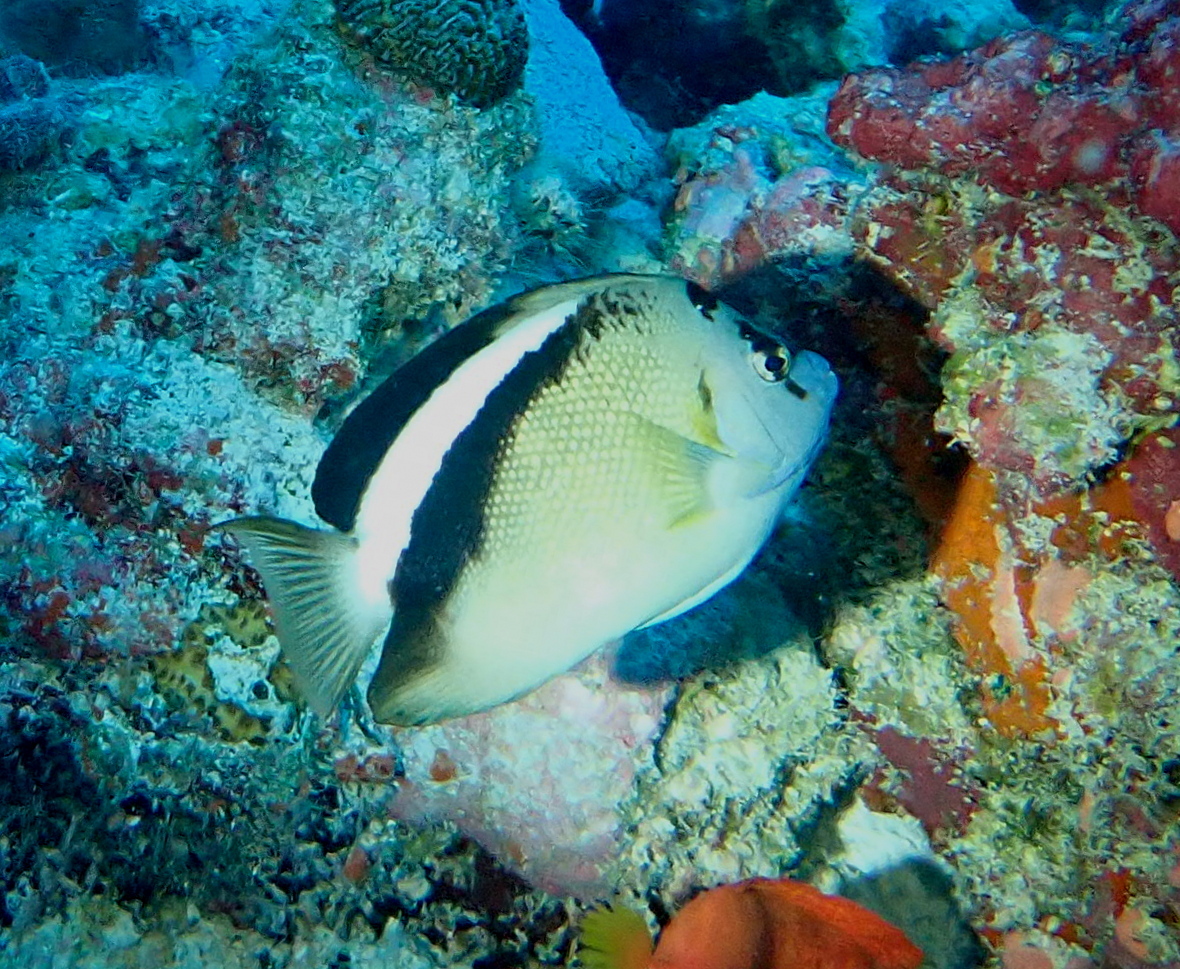
Apolemichthys griffisi
A rare Pacific angelfish with a distinctive black and white band.

Debra Baker · CC BY 4.0
The Griffis angelfish (*Apolemichthys griffisi*) is a marine ray-finned fish in the Pomacanthidae family. It lives in the Pacific Ocean and rarely enters the aquarium trade, where it ranks among the most expensive fish available.
The body is greyish white or ash-colored, marked by a wide black band that runs from the head to the lower part of the caudal peduncle. Inside this band is a contrasting white stripe, though juveniles lack this stripe. A large black spot sits on the head above the eye. The dorsal fin is mostly black, while the anal and pelvic fins are white. The dorsal fin has 14 spines and 18 soft rays; the anal fin has 3 spines and 18 soft rays. Maximum total length is 30 centimeters (12 inches).
This species ranges widely from Southeast Asia east to the Line Islands, with confirmed records from Indonesia, Kiribati, Nauru, the Solomon Islands, and Papua New Guinea. It may also occur near US islands. It inhabits outer coral reef slopes, rocky ledges, and drop-offs at depths of 10 to 100 meters (33 to 328 feet). Individuals are usually solitary, in pairs, or in small groups. It feeds on benthic invertebrates like sponges, tunicates, and crustaceans. It is a protogynous hermaphrodite with no sexual dimorphism.
First formally described in 1981 as *Holacanthus griffisi* by Bruce Carlson and Leighton R. Taylor, the type locality is Canton Island in the northern Phoenix Islands. The specific name honors Nixon Griffis (1917–1993), a conservationist and trustee of the New York Zoological Society who supported the collecting trip where the species was discovered. Within the genus *Apolemichthys*, it appears most closely related to *A. xanthotis* and *A. xanthurus* of the Indian Ocean.
Most aquarium-trade specimens are collected from Kiritimati, Kiribati.
Quick Facts
- Taxon
- Apolemichthys griffisi
Facts from the source article.
Lore & Background
Apolemichthys griffisi has a greyish white or ash colored body with a wide black band extending from the head to the ventral part of the caudal peduncle, containing a contrasting white band. A large black spot is present on the head above the eye. The dorsal fin is largely black, while the anal and pelvic fins are white. Juveniles lack the white stripe within the black band. The species attains a maximum total length of 30 centimeters.
It was first formally described in 1981 as Holacanthus griffisi by Bruce Carlson and Leighton R. Taylor, with the type locality given as Canton Island in the northern Phoenix Islands. Its specific name honors Nixon Griffis, a conservationist and trustee of the New York Zoological Society who supported the collecting trip on which the species was discovered. Within the genus Apolemichthys, it appears most closely related to A. xanthotis and A. xanthurus of the Indian Ocean.
This species inhabits outer coral reef slopes, rocky ledges, and drop-offs at depths of 10 to 100 meters. It is normally recorded as solitary individuals, pairs, or in small aggregations. It feeds on benthic invertebrates such as sponges, tunicates, and crustaceans. It is a protogynous hermaphrodite with no sexual dimorphism.
Reader's Guide
Apolemichthys griffisi is rarely exported through the aquarium trade, with most specimens collected from Kiritimati, Kiribati. It is reported to be one of the most expensive fishes in the trade. Its wide distribution extends from Southeast Asia east to the Line Islands, with confirmed records from Indonesia, Kiribati, Nauru, the Solomon Islands, and Papua New Guinea; it may also occur in the US Islands, though this is uncertain. The species was first described in 1981, and its specific name honors Nixon Griffis, a conservationist and patron of the New York Aquarium. Within its genus, it is closely related to two Indian Ocean species. Its biology includes protogynous hermaphroditism and a diet of benthic invertebrates. The species is notable for its rarity in the aquarium trade and its high price, making it a sought-after but infrequently available fish for collectors.
Did You Know?
- Apolemichthys griffisi was first described in 1981 as Holacanthus griffisi.
- Most aquarium specimens are collected from Kiritimati, Kiribati.
Striking Coloration and Growth
The Griffis angelfish presents a visually arresting profile against the muted tones of deep reef environments. Its body carries a greyish-white or ash-toned base, overlaid by a broad black band that stretches from the head region all the way to the lower portion of the caudal peduncle. Nestled inside this dark stripe runs a bold white band, creating a sharp contrast that makes the fish instantly recognizable. A prominent black spot sits above the eye on the head, adding another focal point to the pattern. The dorsal fin is predominantly black, while the anal and pelvic fins stand out in clean white. Fin structure is precise: the dorsal fin bears fourteen spines and eighteen soft rays, and the anal fin carries three spines alongside eighteen soft rays. One notable developmental difference exists between life stages—juvenile individuals do not yet display the white stripe embedded within the black band, meaning younger fish present a simpler, less contrasting appearance. Adults reach a maximum total length of thirty centimetres, roughly twelve inches, placing them among the mid-sized members of their family.
Reef Dweller of the Deep Pacific
Native to the Pacific Ocean, the Griffis angelfish occupies a broad swath of waters stretching from Southeast Asian coastlines eastward to the Line Islands. Confirmed records place it in Indonesian waters, Kiribati, Nauru, the Solomon Islands, and Papua New Guinea, with possible but less certain sightings in US-held islands. Rather than shallow lagoons, this species favours the outer slopes of coral reefs, rocky ledges, and steep drop-offs, typically encountered between ten and one hundred metres below the surface. In terms of social behaviour, it is most often observed as a lone individual, in a pair, or within small groups, suggesting a relatively low-density population in its preferred habitats. Its diet consists of benthic invertebrates—sponges, tunicates, and various crustaceans—that cling to the reef substrate at those depths. Biologically, the species is a protogynous hermaphrodite, meaning individuals begin life as females and may later transition to males, yet no visible differences in size or colouring distinguish the sexes from one another.
Discovery and the Man Behind the Name
The species received its formal scientific description in 1981, when Bruce Carlson and Leigthon R. Taylor published it under the name Holacanthus griffisi. The type locality was Canton Island, situated among the northern Phoenix Islands in the South Pacific. The specific epithet was chosen to honour Nixon Griffis, a conservationist who lived from 1917 to 1993. Griffis served as a trustee of the New York Zoological Society and was a patron of the New York Aquarium. Crucially, he provided financial backing for the very collecting expedition to Canton Island during which Carlson and Taylor encountered this previously unknown angelfish. Without his support, the discovery might never have been documented. Taxonomically, the species has since been placed within the genus Apolemichthys. Interestingly, phylogenetic evidence suggests it is more closely allied to two Indian Ocean relatives—A. xanthotis and A. xanthurus—than to other Pacific members of the same genus, hinting at a complex biogeographic history that spans multiple ocean basins.
A Rare and Costly Aquarium Specimen
Despite belonging to a family that includes many popular marine aquarium fish, the Griffis angelfish is an uncommon sight in the trade. It is reported to be rarely exported, making encounters with this species in commercial aquaria a genuine novelty. When specimens do appear, the overwhelming majority are sourced from Kiritimati, an atoll in Kiribati, suggesting that local collectors there have a particular relationship with this fish. The scarcity of supply, combined with the difficulty of sourcing individuals from their deep-reef habitat, has driven the Griffis angelfish to a position among the most expensive fishes available to hobbyists and public aquaria. Its rarity in the trade stands in stark contrast to the wider distribution the species enjoys in the wild, where it ranges across multiple Pacific nations. This disconnect between its natural presence across a broad geographic area and its extreme scarcity in the commercial market underscores how habitat depth, collection difficulty, and limited trade channels can all conspire to make a species feel vanishingly rare to those who encounter it only through a shop window.
Gallery
Frequently Asked Questions
What is Apolemichthys griffisi?
It is a ray-finned marine angelfish in the Pomacanthidae family, commonly known as the Griffis angelfish. It is a Pacific Ocean species and one of the least frequently encountered members of its genus.
What does Apolemichthys griffisi look like?
Adults show a greyish-white body crossed by a broad black band that hides a thin white stripe, with a large black spot above the eye. The dorsal fin is mostly black while the anal and pelvic fins are white, and young fish lack the inner white stripe entirely.
Where does Apolemichthys griffisi live and at what depth?
This species ranges across the Pacific Ocean, typically found between roughly 10 and 100 meters (33 to 328 feet) below the surface. That span covers shallow reef habitats as well as deeper open-water zones.
How large does Apolemichthys griffisi get?
The Griffis angelfish reaches a maximum total length of about 30 centimeters (12 inches). Its dorsal fin is supported by 14 spines and 18 soft rays, while the anal fin has 3 spines and 18 soft rays.
Why is Apolemichthys griffisi so rare and expensive in the aquarium trade?
It very seldom enters the hobby, and when specimens do appear they rank among the priciest marine fish available. Its limited wild availability and infrequent capture keep the supply extremely low, driving prices up.
More in Marine Angelfish 1-24
Spotted an error? Know more?
Reader corrections go straight into our review queue. Suggest an edit · How this site is sourced