Paracentropyge multifasciata
A cryptic Indo-Pacific angelfish with eight black vertical bars.

desertnaturalist · CC BY 4.0
Paracentropyge multifasciata, also called the barred angelfish, banded pygmy-angelfish, many-banded angelfish, multi-banded angelfish, or multibarred angelfish, is a marine ray-finned fish in the family Pomacanthidae. It lives in the Indo-Pacific.
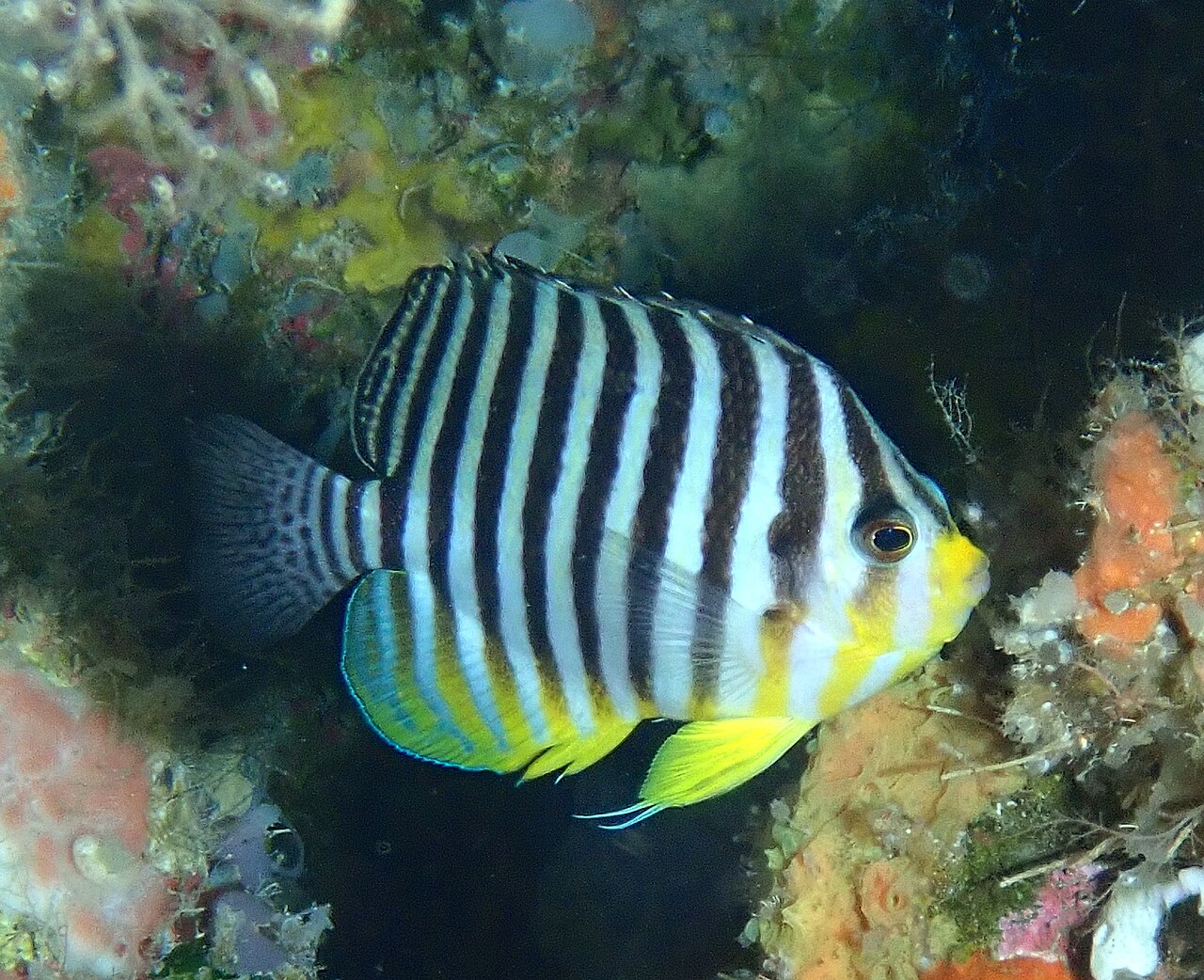
The body is white with eight black vertical bars that shift to yellowish near the belly. A black spot sits on the rear part of the dorsal fin but fades with age. The mouth, pelvic fin, and anal fin are yellow. Each spine on the dorsal fin has a thin thread at its tip, and the pelvic fins have two threads each. The caudal fin is clear with a line of black spots. Juveniles have less distinct bands. The dorsal fin has 13 spines and 17–19 soft rays; the anal fin has 3 spines and 17–18 soft rays. Maximum total length is 12 cm (4.7 in).
This species ranges from the Cocos (Keeling) Islands (Australian territory) east to the Society Islands in French Polynesia, north to the southern Ryukyu Islands of Japan, and south to the Great Barrier Reef in Queensland.
It lives at depths of 7 to 70 meters (23–230 ft), under overhangs, in caves, and in crevices on steep outer reef slopes, and sometimes in clear lagoon reefs. It is cryptic and rarely strays far from cover. Usually found in pairs or small groups. It likely eats algae, sponges, tunicates, and various crustaceans. It lives in harems with one dominant male and several females. Like all angelfish, it is protogynous: all start as females, and the dominant ones become male. It is a broadcast spawner, releasing eggs and sperm into the water after a long mating ritual. Eggs are 0.7 mm across and hatch in 16–18 hours. Larvae have a pelagic phase lasting up to 50 days, then settle and metamorphose into juveniles.
The species was first formally described as *Holocanthus multifasciatus* in 1911 by Hugh McCormick Smith and Lewis Radcliffe, with the type locality Puerto Galera on Mindoro, Philippines. When Warren E. Burgess created the genus *Paracentropyge*, he made *H. multifasciatus* the type species. Many authorities consider *Paracentropyge* a subgenus of *Centropyge*, adding *C. venusta* and *C. boylei* to it, so the species is sometimes called *Centropyge multifasciata*.
In the aquarium trade, it is a medium-priced dwarf angelfish, typically selling for $50 to $100 per specimen (2010). Availability varies, but it is not rare.
Quick Facts
- Taxon
- Paracentropyge multifasciata
Facts from the source article.
Lore & Background
Paracentropyge multifasciata has a white body with eight black vertical bars that turn yellowish near the ventral part. An obvious black spot on the posterior portion of the dorsal fin fades as the fish ages. The mouth, pelvic, and anal fins are yellow. Each spine in the dorsal fin is tipped with a single thin thread, with a pair of threads on the tips of the pelvic fins. The caudal fin is hyaline with a line of black spots. Juveniles have less distinct bands.
This species was first formally described as Holocanthus multifasciatus in 1911 by American ichthyologists Hugh McCormick Smith and Lewis Radcliffe, with the type locality given as Puerto Galera on Mindoro in the Philippines. When Warren E. Burgess created the genus Paracentropyge, he named H. multifasciatus as its type species. Paracentropyge is considered a subgenus of Centropyge by many authorities, and accordingly this species is sometimes listed as Centropyge multifasciata.
It is found at depths between 7 and 70 metres, under overhangs and in caves and crevices on steep outer slopes of reefs, and occasionally in clear lagoon reefs. It is a cryptic species that rarely moves far from a hiding place, typically encountered in pairs or small groups. It is thought to feed on algae, sponges, tunicates, and a variety of crustaceans. It lives in harems with one dominant male and multiple females, and like all angelfish is a protogynous hermaphrodite. It is a broadcast spawner; eggs are 0.7 mm in diameter and hatch after 16–18 hours, with larvae having a pelagic phase lasting up to 50 days.
Reader's Guide
In the aquarium trade, Paracentropyge multifasciata is one of the medium-priced dwarf angelfish, with sales prices usually ranging from $50 to $100 per specimen as of the source article's 2010 context. Availability may vary, but it cannot be considered rare in the trade. Specimens usually arrive in fish stores in good health, though problems can arise when keeping them in sterile quarantine settings without live rock, as they often do not accept artificial or frozen foods initially. Aquarists must weigh the risks of skipping quarantine; applying freshwater dips before placing them in tanks is usually sufficient to prevent the introduction of protozoans.
Barred angelfish are social and should be kept in pairs or larger groups in large reef tank settings. Keeping more than one specimen facilitates weaning onto frozen or prepared foods. After introduction, they can be shy and reclusive, but when they establish territory this almost always improves. Outgoing but not too aggressive tank mates, such as surgeonfish or butterflyfish, can help overcome timidness. When keeping them with other angelfish species, the different levels of aggressiveness must be considered, as P. multifasciata is one of the less aggressive members of the genus.
Appearance and Taxonomic History
The barred angelfish presents a striking visual profile: a predominantly white body crossed by eight bold vertical bars that gradually shift toward a yellowish hue as they descend toward the belly. The mouth, pelvic fins, and anal fin all carry a vivid yellow tone, while the caudal fin remains largely transparent, punctuated by a neat row of small black spots. Each spine along the dorsal fin terminates in a delicate thread, and the pelvic fins bear a pair of similar filaments at their tips. A prominent black blotch sits on the rear portion of the dorsal fin, though this marking visibly fades as the individual matures. Juveniles display noticeably fainter banding. The species reaches a maximum of twelve centimetres in total length. Taxonomically, the fish was originally named Holocanthus multifasciatus in 1911 by American ichthyologists Hugh McCormick Smith and Lewis Radcliffe, based on a specimen from Puerto Galera on Mindoro in the Philippines. When Warren E. Burgess later established the genus Paracentropyge, he designated this species as its type. Many modern authorities, however, treat Paracentropyge as merely a subgenus within Centropyge, which would render the correct name Centropyge multifasciata.
Indo-Pacific Range and Reef Microhabitat
The barred angelfish inhabits a broad swath of the tropical Indo-Pacific. Its western boundary reaches the Cocos (Keeling) Islands, an Australian territory, while its eastern limit extends to the Society Islands in French Polynesia. To the north, populations occur around the southern Ryukyu Islands of Japan, and to the south the range touches the Great Barrier Reef off Queensland. Vertically, the species occupies depths from roughly seven to seventy metres, favouring the steep outer slopes of coral reefs where it shelters beneath overhangs, within caves, and inside narrow crevices. It is occasionally recorded in the clearer waters of lagoon reefs as well. Behaviourally, the fish is notably cryptic; an individual will rarely travel more than a short distance away from its chosen hiding spot. Observers typically encounter them in pairs or in small, loose groups rather than as solitary specimens. Their diet appears to be varied, encompassing algae, sponges, tunicates, and a range of small crustaceans, all of which can be gleaned from the complex reef structures they inhabit.
Harem Life and the Hermaphroditic Lifecycle
One of the most fascinating aspects of the barred angelfish is its social and reproductive biology. The species lives in harems consisting of a single dominant male surrounded by several females. Crucially, every individual begins life as a female, a condition known as protogynous hermaphroditism that is shared across the angelfish family. The most dominant female in a group will eventually transition into the male role, ensuring that each harem always has a leader. When the time comes to reproduce, the pair engages in an extended courtship ritual before releasing their gametes directly into the surrounding water, making them broadcast spawners. The resulting eggs are tiny, measuring only about 0.7 millimetres in diameter, and they hatch within sixteen to eighteen hours. The newly hatched larvae then enter a pelagic phase that can last as long as fifty days, drifting in the open water column before settling onto the seafloor. Upon reaching the benthic stage, they undergo metamorphosis and begin developing into recognisable juvenile barred angelfish.
Keeping Barred Angelfish in the Reef Aquarium
In the marine aquarist trade, the barred angelfish occupies a middle price tier among dwarf angelfish, with retail prices historically falling between fifty and one hundred dollars per specimen. It is not considered rare, and fish typically arrive at stores in sound health. However, a practical challenge arises during quarantine: in sterile, live-rock-free tanks, the species often refuses artificial or frozen foods, making it difficult to establish them on a reliable diet. Many keepers therefore opt to skip formal quarantine and instead rely on a simple freshwater dip to guard against protozoan parasites. In the display tank, barred angelfish are at their best when housed in pairs or small groups within a sufficiently large reef setup. Keeping multiple individuals together also helps with weaning them onto prepared foods such as pellets, flakes, Artemia, Mysis, mussels, and fresh oysters. Newly introduced specimens tend to be shy and reclusive, but their confidence grows once they claim a territory. Outgoing but non-aggressive companions like surgeonfish or butterflyfish can help draw them out. Among their angelfish relatives, the barred angelfish ranks as one of the least aggressive, though compatibility with other species still requires careful consideration of each one's temperament.
Gallery
Frequently Asked Questions
What is Paracentropyge multifasciata?
It is a small marine ray-finned fish in the angelfish family Pomacanthidae, native to the Indo-Pacific. You will also see it referred to as the barred angelfish, banded pygmy-angelfish, or multibarred angelfish.
What does Paracentropyge multifasciata look like?
Its body is mostly white marked with eight bold black vertical bars that shift to a yellowish hue near the belly, while the mouth, pelvic fins, and anal fin are yellow. A black spot on the rear portion of the dorsal fin gradually fades as the fish matures.
Where and at what depth does Paracentropyge multifasciata live?
This species is found throughout the Indo-Pacific, occupying a depth range of roughly 7 to 70 metres (23 to 230 ft).
How big does Paracentropyge multifasciata get?
It tops out at about 12 centimetres (4.7 inches) in total length, making it one of the smaller members of the angelfish family.
What features make Paracentropyge multifasciata easy to identify?
In addition to its eight-barred pattern, every dorsal-fin spine ends in a thin thread and each pelvic fin bears two filamentous threads. These delicate extensions, paired with its cryptic white-and-black coloration, distinguish it from most other Pomacanthids.
More in Marine Angelfish 1-24
Spotted an error? Know more?
Reader corrections go straight into our review queue. Suggest an edit · How this site is sourced