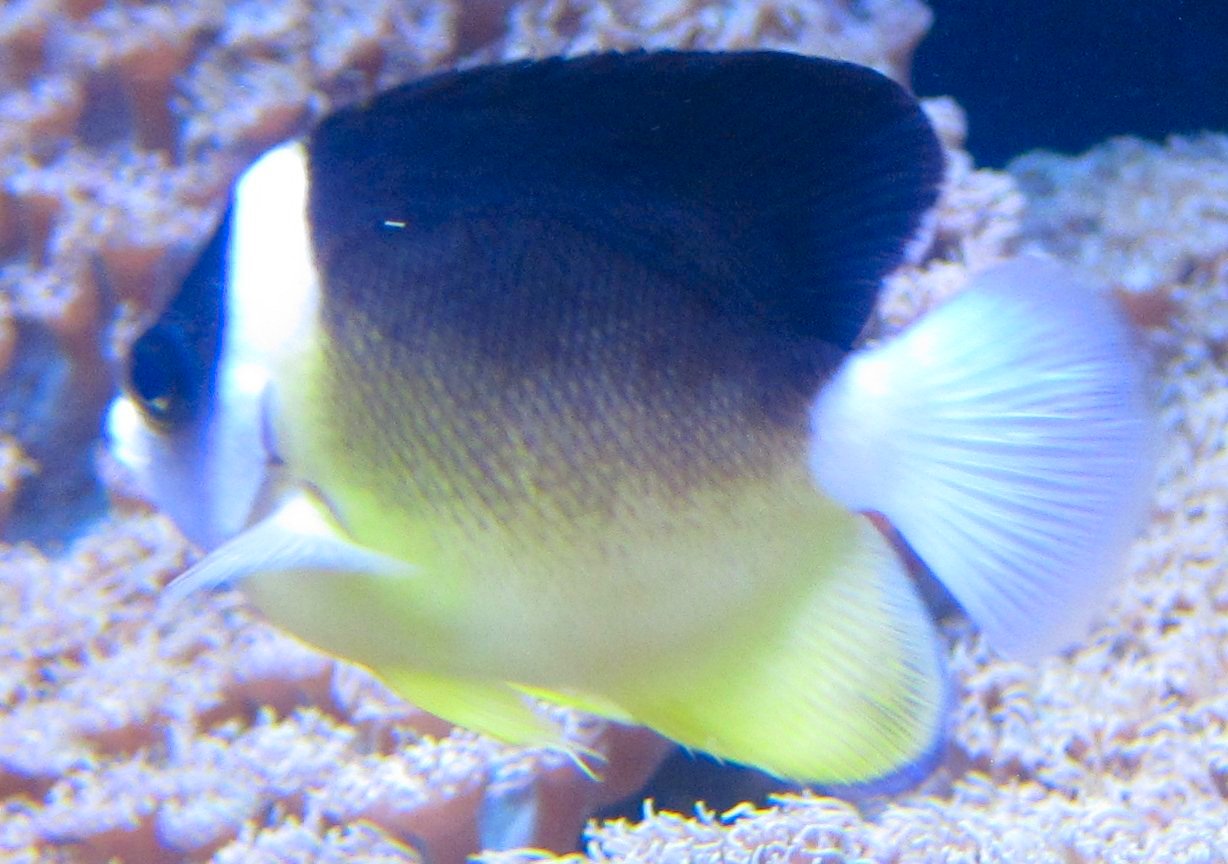
Centropyge abei
A deep-water pygmy angelfish with a yellow body and black upper back.

Wmpearl · CC0
Centropyge abei, commonly known as Abe's angelfish, is a species of marine ray-finned fish belonging to the family Pomacanthidae. It is a small marine angelfish found in the western Pacific Ocean. The species is notable for its distinctive coloration and its association with relatively deep-water habitats, sharing several characteristics with the closely related Centropyge colini.
Quick Facts
- Taxon
- Centropyge abei
Facts from the source article.
Lore & Background
Centropyge abei was first formally described in 2006 by Gerald Allen, Forrest Young and Patrick L. Colin, with the type locality given as the southeast side of Manado Tua, on Sulawesi. The specific name honors Yoshitaka Abe, director of the Japanese public aquarium Aquamarine Fukushima, which funded the expedition on which the type was collected. Within the genus Centropyge, it appears to be closest to C. colini, both species sharing adaptations for life on deeper reefs than their congeners. Some authorities treat this species as incertae sedis within the genus, reflecting uncertainty about its exact phylogenetic placement.
Reader's Guide
Centropyge abei is a relatively recently described species, first formally named in 2006. Its discovery and description were made possible by funding from the Aquamarine Fukushima public aquarium in Japan, and the species was named in honor of its director, Yoshitaka Abe. The fish is found in the western Pacific Ocean, with recorded locations including northern Sulawesi, Palau, southern Japan, and Holmes Reef in the Coral Sea off Queensland. It inhabits depths ranging from 5 to 155 metres, typically over rubble substrates and on outer reef slopes, drop-offs, and in caves, at temperatures of 20–21 °C. The species is notable for its morphological similarities to Centropyge colini, including a small face with large eyes set far forward, and a high, flattened dorsal fin that is longer and less arched than in other pygmy angelfish. These features are considered adaptations for life in deeper waters. The body is predominantly yellow, with the upper third of the back, the dorsal fin, and the upper part of the head being black. A wide white bar appears immediately in front of the dorsal fin origin, extending at least to the upper edge of the gill cover. The caudal fin and caudal peduncle are white. Juveniles are less distinctly marked and may have a white tail stripe. The species reaches a maximum total length of 9.1 centimetres. Its taxonomic placement remains somewhat uncertain, with some authorities listing it as incertae sedis within the genus Centropyge.
Did You Know?
- Centropyge abei attains a maximum total length of 9.1 centimetres (3.6 in).
- It is found at depths of 5 to 155 metres over rubble substrates.
- The species was named after Yoshitaka Abe, director of the Aquamarine Fukushima aquarium.
- It shares a small face and large forward-set eyes with Centropyge colini.
Taxonomy & Classification
The genus Centropyge presents a fascinating taxonomic puzzle. Rather than forming a clean, single evolutionary branch, it is actually paraphyletic, meaning that other genera such as Genicanthus and the polyphyletic Apolemichthys are nested within its lineage. The genus is organized into three subgenera. Xiphypops groups together the C. acanthops complex, which includes C. acanthops, C. argi, C. aurantonota, and C. resplendens, while Paracentropyge encompasses C. boylei, C. multifasciata, and C. venusta. Both of these subgenera are monophyletic, and researchers have suggested they could be elevated to full genus status. The remaining species fall under the nominate subgenus Centropyge, which unfortunately is not monophyletic. Adding further complexity, different studies have proposed different species complexes within the genus, depending on how each researcher defines the term species complex. Currently, 35 species are recognized across the genus.
Biology & Sex Change
One of the most remarkable biological traits of Centropyge species is their protogynous hermaphroditism. Every individual in the genus begins its adult life as a female, and the dominant member of a social group can transition to male within a matter of days. This rapid sex change is a hallmark of marine angelfish and many reef fish. What makes Centropyge particularly noteworthy is that, uniquely among protogynous fish, males of at least one species, C. ferrugata, can reverse the process and change back into females. However, this reverse transition is far slower than the initial female-to-male shift. Distinguishing the sexes externally is challenging, though females tend to be slightly shorter in body and possess more rounded fins. These sex-change dynamics are tightly linked to the social hierarchy of the group, making reproductive biology and social structure inseparable in this genus.
Social Structure & Harem Dynamics
Centropyge species live in haremic social arrangements, a structure in which a single dominant male presides over a group of multiple females. This social organization is central to understanding their biology, as it directly drives the sex-change mechanisms described in their reproductive biology. The dominant individual in any given group holds the male role, and if that individual is removed or dies, another female in the group can assume the male position within days. This fluidity in social roles means that the hierarchy is not fixed but responsive to changes in group composition. These small fish, none exceeding 15 cm in length, maintain these social structures across their range in the Atlantic, Indian, and Pacific Oceans. The harem system also influences their territorial behavior, as males defend their groups while females occupy subordinate positions within the social unit.
Aquarium Keeping
In the aquarium hobby, Centropyge species are best suited to matured reef tanks, where high water quality and the presence of well-cured live rock replicate conditions closer to their natural environment. In the wild, most species in this genus feed on algae, sponges, and small benthic invertebrates, and a generous supply of live rock in captivity helps supplement this diet. This dietary consideration is not merely a matter of nutrition; underfed dwarf angels are known to nip at corals and sessile invertebrates, which can be devastating in a reef setup. Behaviorally, these fish tend to be quite shy when first introduced to a new environment, often hiding among corals, caves, and crevices. Over time, however, they become more outgoing and territorial, particularly when housed with appropriate tank mates in tanks of adequate size. Their small stature, capping out at 15 cm, makes them manageable for reef enthusiasts, but their social and dietary needs demand careful planning.
Gallery
Frequently Asked Questions
What is Centropyge abei?
Centropyge abei, commonly called Abe's angelfish, is a small pygmy angelfish in the family Pomacanthidae. It is a ray-finned marine species native to the western Pacific Ocean.
How big does Centropyge abei grow?
Abe's angelfish is quite small, reaching a maximum total length of about 9.1 cm (roughly 3.6 in). Its dorsal fin carries 13 spines and 17 soft rays, while the anal fin has 3 spines and 18 soft rays.
Where does Centropyge abei live?
This species inhabits relatively deep waters in the western Pacific, ranging from about 5 metres down to 155 metres (16 to 509 ft). It is considered a deep-water pygmy angelfish rather than a shallow-reef dweller.
What does Centropyge abei look like?
Abe's angelfish has a striking two-tone pattern: a bright yellow body contrasted by a solid black upper back. This bold coloration is one of the features that sets it apart from many other small angelfish.
How is Centropyge abei related to other angelfish?
It is closely allied to Centropyge colini, sharing several morphological and ecological traits with that species. Both are small, deep-water members of the genus Centropyge found in the western Pacific.
More in Marine Angelfish 1-24
Spotted an error? Know more?
Reader corrections go straight into our review queue. Suggest an edit · How this site is sourced