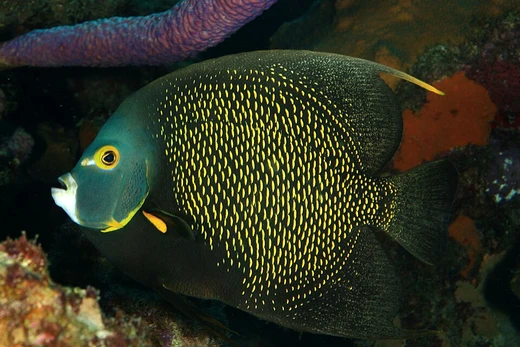
Cherubfish
A small, deep blue marine angelfish from the western Atlantic.

The cherubfish, or pygmy angelfish (Centropyge argi), is a small marine angelfish from the family Pomacanthidae. Its body is oval, deep, and flattened from side to side, with a short, blunt snout and a tiny mouth. A long, sturdy spine sits at the angle of the preoperculum, whose vertical edge is serrated. The fish is a deep blue overall, with an orange-yellow head and chest, a thin blue ring around the eye, and a small dark blue patch behind the mouth. The pectoral fins are pale yellow, while the other fins are dark blue edged with light blue. The dorsal fin has 14–15 spines and 15–16 soft rays, and the anal fin has 3 spines and 17 soft rays. Maximum total length is 8 cm (3.1 in).
This species lives in the western Atlantic Ocean, from Bermuda and North Carolina through the Caribbean Sea and Gulf of Mexico, reaching the Caribbean coast of South America as far east as French Guiana. It is found at depths between 5 and 18 m (16–59 ft), though typically below 30 m (98 ft). Its usual habitat is coral rubble, where it eats algae and small bottom-dwelling invertebrates. When alarmed, it retreats into cavities. Cherubfish live in small groups of about ten individuals, usually one male with several females and juveniles.
The cherubfish was first formally described in 1951 by Loren Paul Woods and Robert H. Kanazawa, with the type locality given as the Argus Bank near Bermuda. Some classifications place it in the subgenus Xiphipops. Its specific name, *argi*, refers to the type locality. It is one of the most popular marine angelfish for home aquariums.
Quick Facts
- Taxon
- Centropyge argi
Facts from the source article.
Lore & Background
The cherubfish has an oval, deep and laterally compressed body with a short, blunt snout and a small mouth. There is a long, robust spine at the angle of the preoperculum, which has its vertical edge being serrated. The body is deep blue in colour with the head and chest being orange-yellow with a thin blue eye ring and a small dark blue blotch to the rear of the mouth. The pectoral fins are pale yellowish while the other fins are dark blue with light blue margins. The dorsal fin contains 14–15 spines and 15–16 soft rays while the anal fin has 3 spines and 17 soft rays. This species attains a maximum total length of 8 centimetres (3.1 in).
The cherubfish is found in the western Atlantic Ocean. It occurs off Bermuda, and from North Carolina through the Caribbean Sea and Gulf of Mexico to the Caribbean coast of South America, as far east as French Guiana. It occurs at depths between 5 and 18 metres (16 and 59 ft), typically below 30 metres (98 ft). Its usual habitat is coral rubble where it feeds on algae and small benthic invertebrates. It retreats into cavities when alarmed. It lives in small groups of around 10 fish, usually a single male and a few females and juveniles.
The cherubfish was first formally described in 1951 by Loren Paul Woods and Robert H. Kanazawa with the type locality given as the Argus Bank near Bermuda. In some classifications it is placed in the subgenus Xiphipops. The specific name refers to the type locality.
Reader's Guide
The cherubfish is one of the most popular species of marine angelfish in aquaria, according to the source article. Its small size, reaching a maximum total length of 8 centimetres, and its striking coloration—deep blue body with an orange-yellow head and chest—make it a sought-after species for home aquariums. The article notes that it is found in the western Atlantic Ocean, from Bermuda and North Carolina through the Caribbean Sea and Gulf of Mexico to the Caribbean coast of South America, as far east as French Guiana. Its typical habitat is coral rubble at depths between 5 and 18 metres, though it is often found below 30 metres. The cherubfish feeds on algae and small benthic invertebrates and retreats into cavities when alarmed. It lives in small groups of around 10 fish, usually a single male with a few females and juveniles. The species was first formally described in 1951 by Loren Paul Woods and Robert H. Kanazawa, with the type locality given as the Argus Bank near Bermuda. Its specific name refers to this type locality. In some classifications, it is placed in the subgenus Xiphipops.
Physical Form & Coloration
The cherubfish presents a compact, oval silhouette that is notably deep and compressed from side to side, lending it a disc-like profile. Its face is defined by a brief, rounded snout paired with a diminutive mouth. At the angle of the preoperculum, a prominent, sturdy spine guards the fish, its vertical edge bearing a serrated texture. The coloration scheme is bold: the body carries a rich deep blue, while the head and chest transition to a warm orange-yellow. A slender blue ring encircles the eye, and a small dark blue blotch sits just behind the mouth. The pectoral fins display a pale yellowish tint, contrasting with the remaining fins, which are dark blue edged in a lighter shade. The dorsal fin bears between fourteen and fifteen spines alongside fifteen to sixteen soft rays, while the anal fin carries three spines and seventeen soft rays. No individual exceeds eight centimetres in total length, making it a genuinely diminutive member of the angelfish family.
Geographic Range & Ecological Niche
The cherubfish is a resident of the western Atlantic, with its distribution stretching from the waters off Bermuda southward along the North Carolina coast, through the Caribbean Sea and the Gulf of Mexico, and continuing along the Caribbean shoreline of South America as far east as French Guiana. In terms of depth, this species occupies a band between five and eighteen metres, though it is most commonly encountered below the thirty-metre mark. Its preferred microhabitat is coral rubble, where it forages on algae and small benthic invertebrates. When startled, the fish instinctively slips into nearby cavities for shelter. Socially, the cherubfish does not travel alone; it assembles in small groups of roughly ten individuals, typically structured around a single male accompanied by a handful of females and juveniles. This modest group size and the fish's ready tendency to hide make it a relatively discreet inhabitant of its reef environment.
Taxonomic History & Classification
The cherubfish entered the formal scientific record in 1951, when Loren Paul Woods and Robert H. Kanazawa published its original description. The type locality they designated was the Argus Bank, situated near Bermuda, and the species' specific name is a direct reference to that geographic point. As a member of the family Pomacanthidae, it is classified as a marine ray-finned angelfish. Its exact placement within the broader angelfish taxonomy has not been entirely settled: in some classification schemes, the cherubfish is assigned to the subgenus Xiphipops, while other frameworks may treat it differently. This taxonomic ambiguity reflects the ongoing refinement of how pygmy angelfishes are grouped and distinguished from one another. The 1951 description by Woods and Kanazawa remains the foundational reference for the species, anchoring its identity to a precise location in the western Atlantic and establishing the morphological baseline against which all subsequent identifications are measured.
Presence in the Aquarium Trade
Among the many marine angelfish species available to hobbyists, the cherubfish stands out as one of the most popular choices for aquaria. Its appeal is readily apparent when one considers its attributes: a maximum length of just eight centimetres makes it manageable even in moderate-sized tanks, while its bold deep-blue and orange-yellow coloration provides a vivid focal point. The small, rounded snout and compact oval body give it a distinctive silhouette that sets it apart from larger, more elongated angelfish. In the wild, its habit of gathering in small groups of around ten and its tendency to shelter in cavities when startled suggest a temperament that may translate well to a community tank, where it can retreat to rockwork when it feels exposed. As a western Atlantic species found from Bermuda through the Caribbean to French Guiana, it is geographically accessible to collectors in the Americas. Its standing as a top pick among marine angelfish for display purposes underscores the intersection of its striking appearance, manageable size, and group behavior.
Frequently Asked Questions
What is a Cherubfish?
The Cherubfish, also known as the pygmy angelfish (Centropyge argi), is a tiny marine angelfish in the family Pomacanthidae. It is native to the western Atlantic Ocean.
How big does a Cherubfish get?
Cherubfish are remarkably small, topping out at roughly 8 centimetres (3.1 inches) in total length. Their compact, deep, oval body and short blunt snout give them a distinctly stubby profile compared to larger angelfish.
What does a Cherubfish look like?
The body is a rich deep blue overall, contrasted by an orange-yellow head and chest, a thin blue ring encircling the eye, and a small dark blue smudge just behind the mouth. The pectoral fins are pale yellow, while the dorsal, anal, and caudal fins are dark blue trimmed with a lighter blue edge.
Where do Cherubfish live and at what depth?
They are found in the western Atlantic, generally ranging from 5 to 18 metres (16 to 59 feet) below the surface. In practice, most Cherubfish are encountered below 30 metres (98 feet), where they patrol reef structures.
What are the Cherubfish's fin counts and key anatomical features?
The dorsal fin bears 14–15 spines followed by 15–16 soft rays, and the anal fin has 3 spines with 17 soft rays. A notably long, sturdy spine projects from the angle of the preoperculum, whose vertical edge is serrated.
More in Marine Angelfish 1-24
Spotted an error? Know more?
Reader corrections go straight into our review queue. Suggest an edit · How this site is sourced