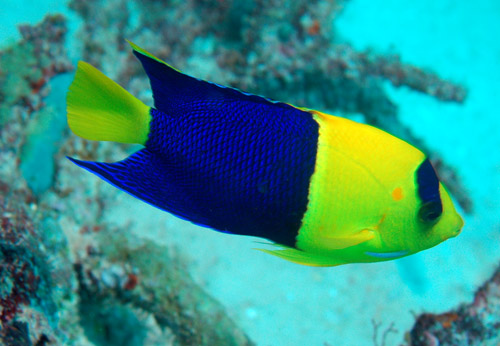
Bicolor angelfish
A small, protogynous hermaphrodite with striking yellow and blue coloration.

Rickard Zerpe · CC BY 2.0
The bicolor angelfish (Centropyge bicolor) goes by many common names, including the Pacific rock beauty, oriole angelfish, oriole dwarf angel, blue and gold angel, and two-colored angel. It belongs to the marine ray-finned fish family Pomacanthidae.
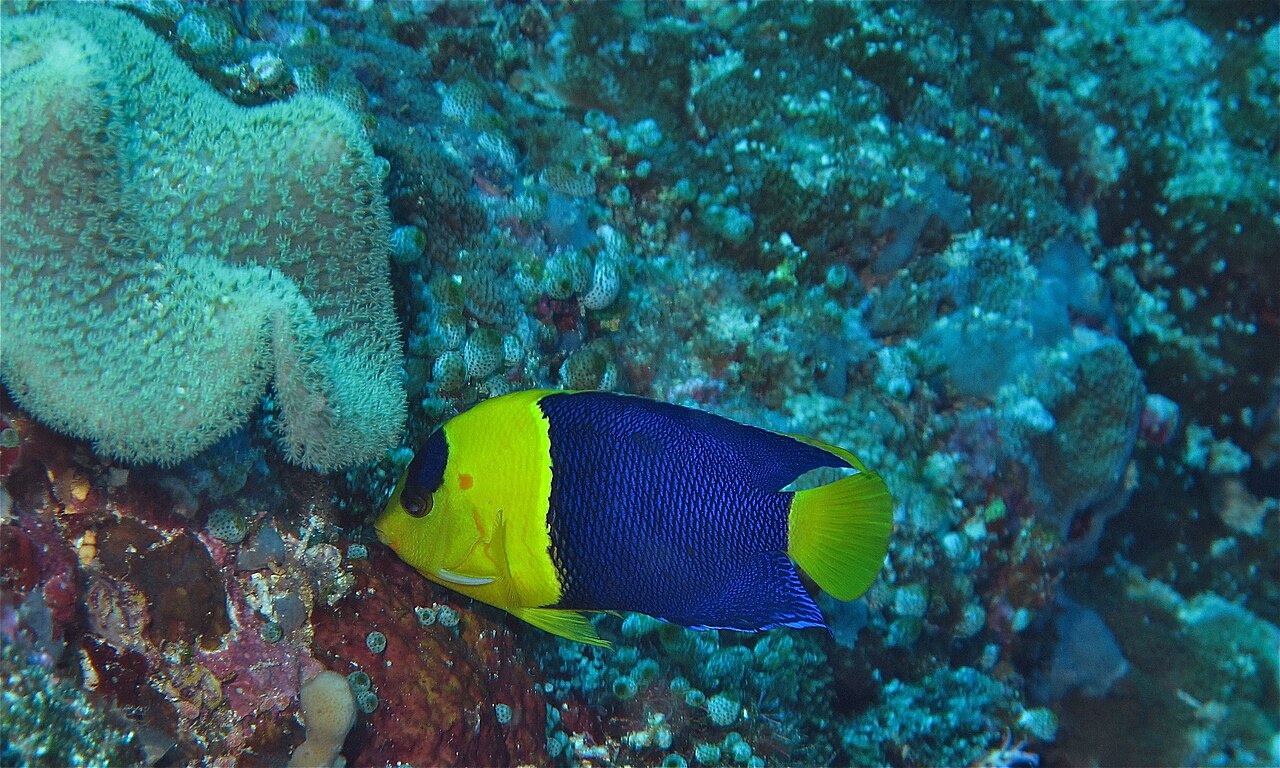
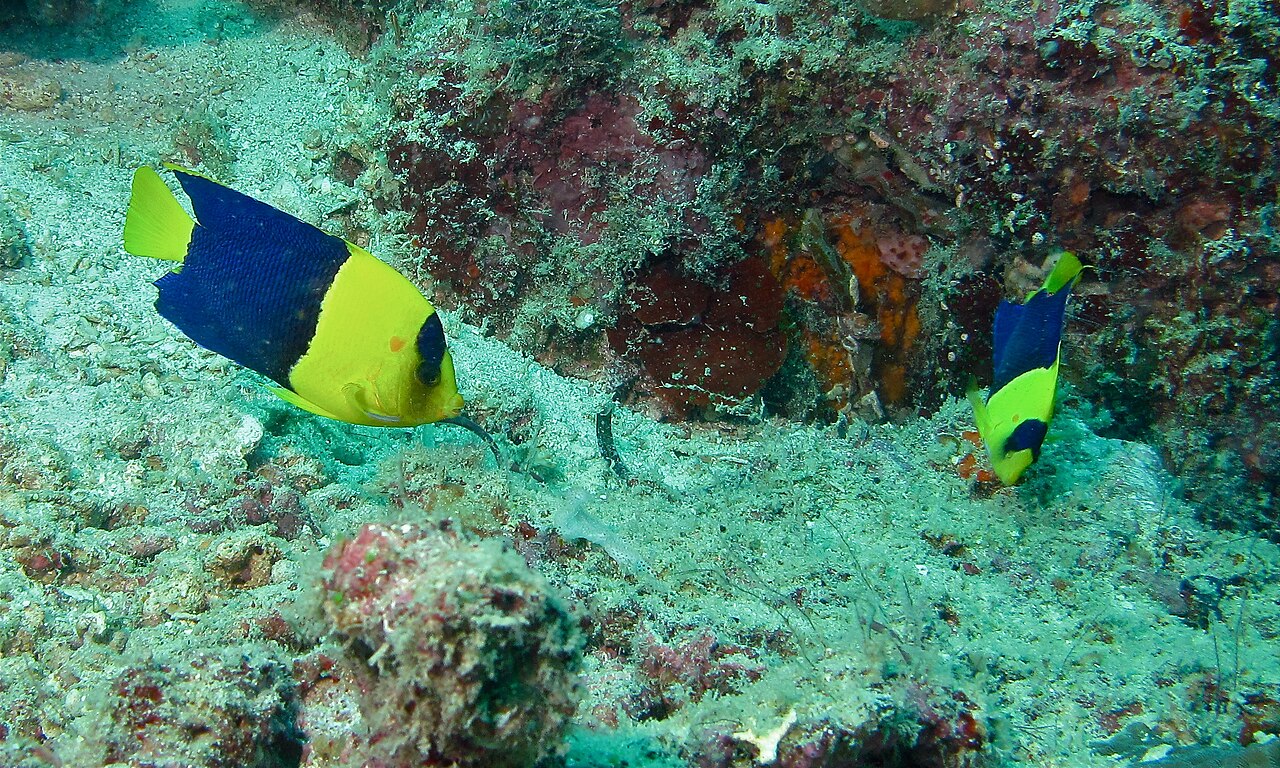
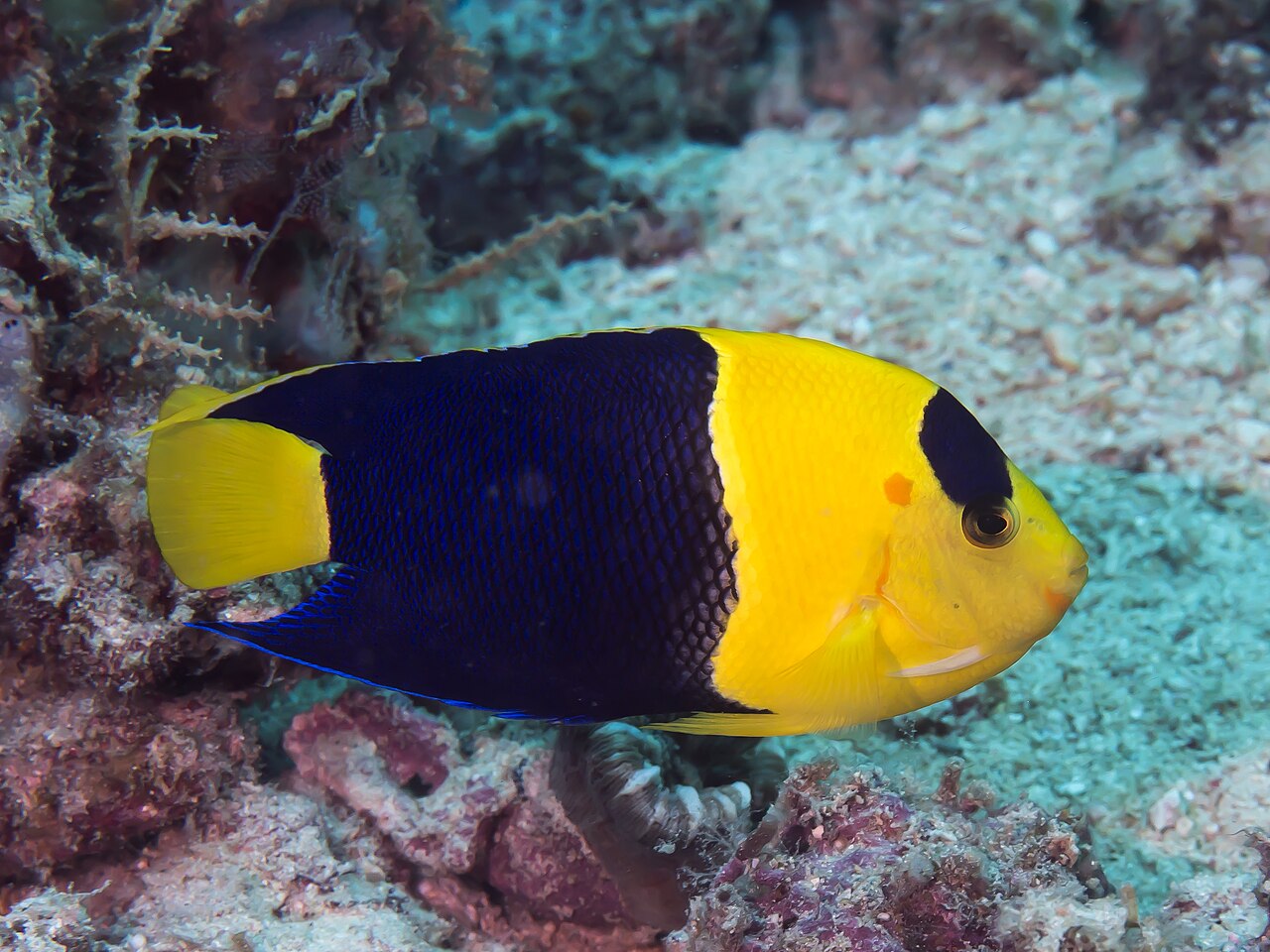
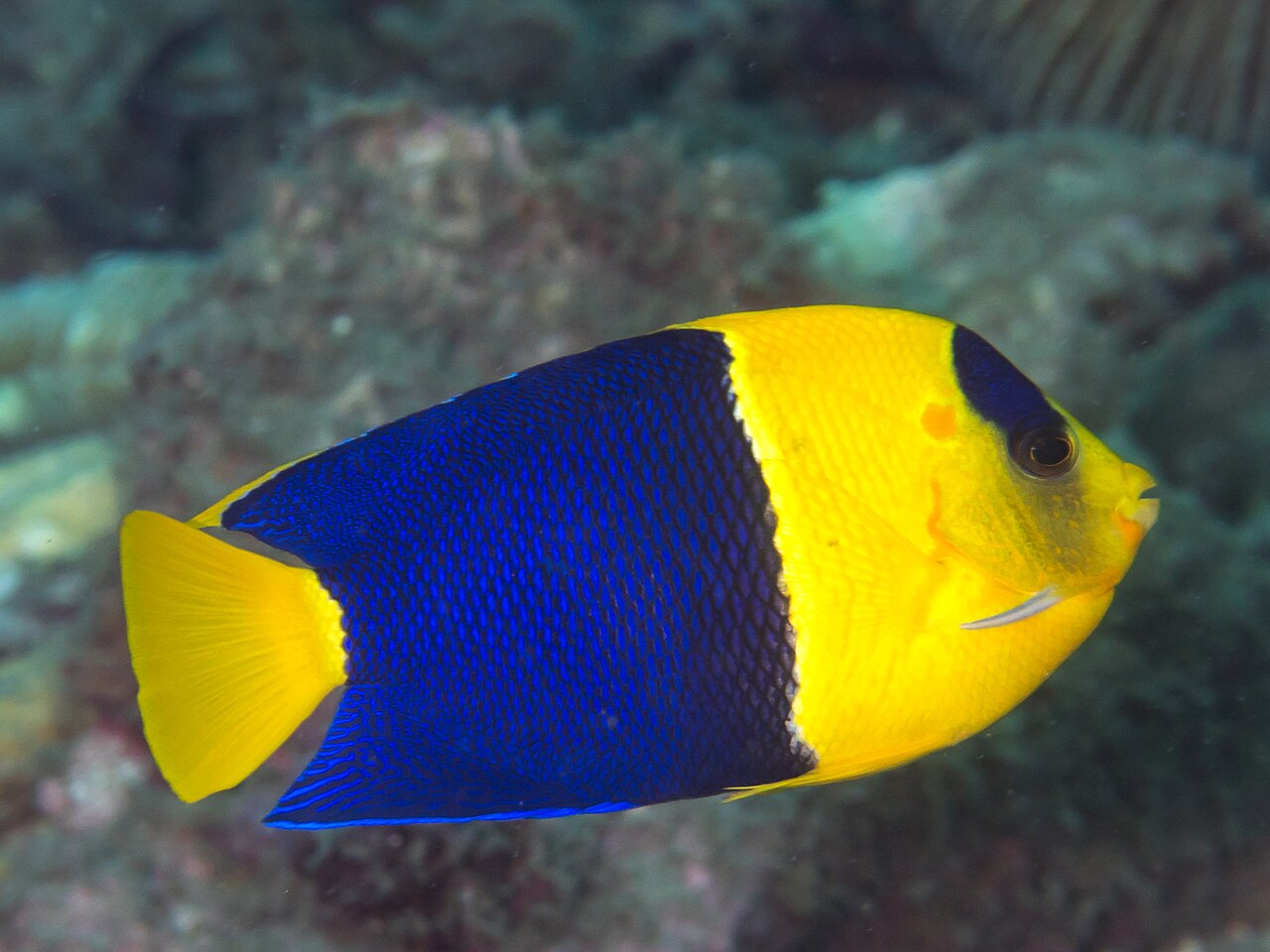
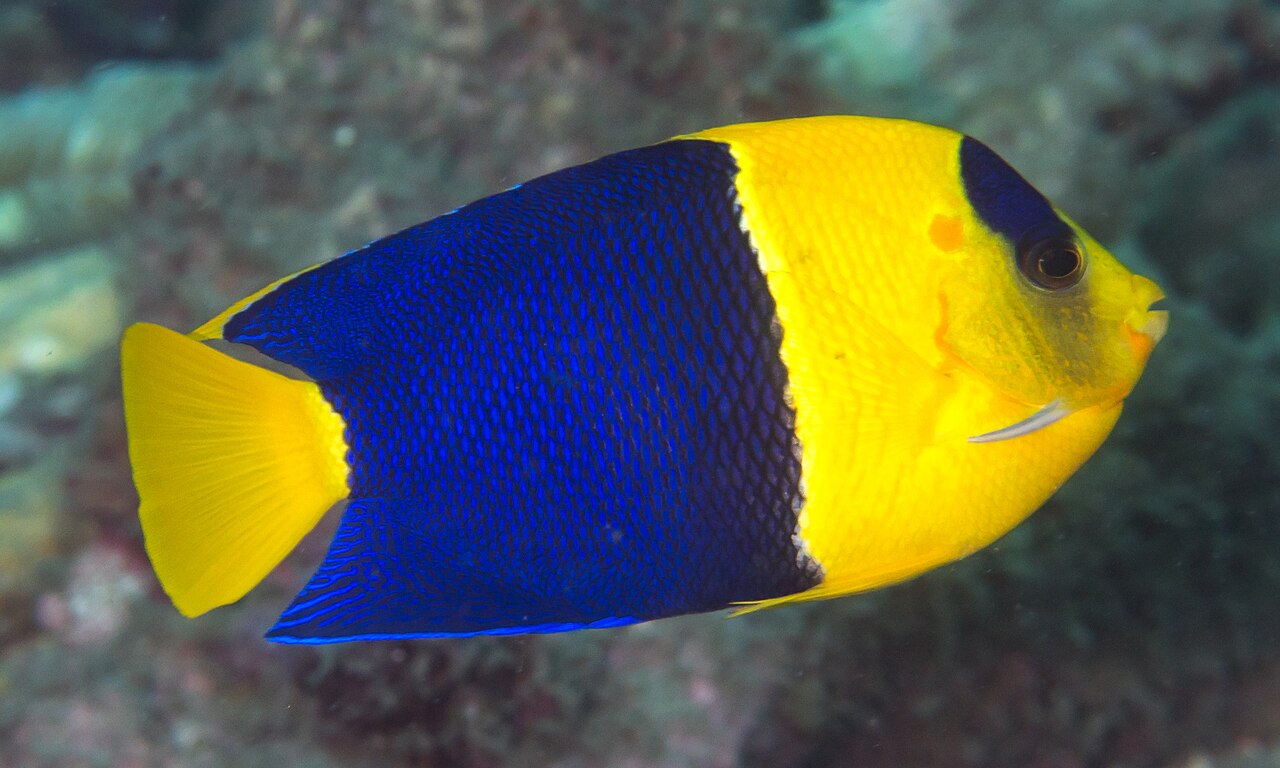
This small fish is easy to identify. Its head (except for the areas around and above the eyes), the front of the body, and the pelvic and caudal fins are bright yellow. The pectoral fins are nearly transparent, while all other parts are dark blue.
It lives in the Indo-Pacific, from East Africa to southern Japan, Australia, the Philippines, and Fiji. Its depth range is 1 to 25 meters (3.3 to 82 feet), and it favors reef slopes, coral-rich areas, lagoons, and spots near drop-offs.
The bicolor angelfish eats small crustaceans like brine and mysis shrimp, along with tunicates, corals, sponges, worms, algae, and sometimes clams.
Its larval stage lasts about 32 days. All larvae are female, as this species is a protogynous hermaphrodite. Sex change only happens in adulthood under special circumstances. Lifespan in the wild varies by location, ranging from 5 to 13 years.
Adults live in harems. One male dominates, with several females (seven on average) ranked linearly by size. These females mate exclusively with that male. If the male is removed or dies, the highest-ranking female changes sex to replace him, a process that takes 18 to 20 days.
When it’s time to reproduce, the male visits females in the harem, usually at dusk. He may mate with one or more females per night, but each female spawns at most once per night. The female scatters her eggs, and the male releases sperm to fertilize them. Higher-ranking females spawn more often than lower-ranking ones.
The bicolor angelfish is moderately aggressive toward both other species and its own kind. The male spends most of his time guarding his territory—which rarely exceeds 200 square meters (2,200 square feet) and covers all the females’ home ranges—from predators, intruding species, and especially other harems. Females are aggressive only toward lower-ranking harem members, as they try to maintain their rank. In captivity, this fish has been seen acting as a facultative cleaner fish, though this behavior is unlikely in the wild.
Quick Facts
- Taxon
- Centropyge bicolor
Facts from the source article.
Lore & Background
The bicolor angelfish is a small, easily recognizable fish. The head (excluding the areas around and above the eyes), the front of the body and the pelvic and caudal fins are bright yellow, the pectoral fins are essentially transparent, and all other parts are dark blue. It is found in the Indo-Pacific region, including East Africa, southern Japan, Australia, the Philippines and Fiji, living at a depth range of 1–25 m (3.3–82.0 ft) and associated with reef slopes, coral-rich areas, lagoons, and near drop-off areas.
The diet of a typical bicolor angelfish consists of small crustaceans (such as brine and mysis shrimp), as well as tunicates, corals, sponges, worms, algae, and sometimes clams. The larval stages last for approximately 32 days. All larvae are female, as this species is a protogynous hermaphrodite, and sex change only happens in adulthood and in special circumstances. The life expectancy in the wild varies greatly depending on location, ranging between 5 and 13 years.
As an adult, the bicolor angelfish lives in harems, with one male dominating and several females (7 on average) ranked linearly based on size; these females exclusively mate with that one male. If the male is removed or dies, the highest ranking female will undergo sex change to replace the male, taking between 18 and 20 days. The bicolor angelfish is moderately aggressive, both to members of other species and their own species. The male spends most of his time guarding his territory from predators, intruding members of other species, but mostly against other harems. Females are only aggressive towards lower-ranking members of the harem.
Reader's Guide
The bicolor angelfish is on the larger end of dwarf angels and requires a large tank of at least 75 gallons with ample grazing opportunities. This fish will often nip at and consume stony corals and ornamental bivalves, though not every individual will exhibit this behavior. Tanks with a lot of hiding spaces are best, as this species likes to move from one hiding place to another. It can be one of the more sensitive angelfish when adjusting to a new aquarium, so it is ideal to add it early on before other aggressive fish like Tangs have established territories. The water temperature should be kept around 23–26 °C (73–79 °F), and the pH level between 8.1 and 8.4. The level of care required is moderate, and it takes a range of foods, including algae, shrimps, worms, and spirulina flakes. No other bicolor angels should be in the tank unless attempting to pair them or create a harem, in which case the group should include one larger fish and one or more smaller ones to maximize chances of getting a male. In captivity, the bicolor angelfish has been observed to act as a facultative cleaner fish, though it seems unlikely that it would show this behavior in the wild.
Did You Know?
- All bicolor angelfish larvae are female; sex change to male occurs only in adulthood under special circumstances.
- The sex change from female to male takes between 18 and 20 days.
- The male bicolor angelfish guards a territory not exceeding 200 m² (2,200 sq ft).
- In captivity, the bicolor angelfish has been observed acting as a facultative cleaner fish, though this behavior seems unlikely in the wild.
Identity & Striking Coloration
The bicolor angelfish, scientifically classified as Centropyge bicolor within the Pomacanthidae family, is a small marine ray-finned fish that has accumulated a remarkable collection of common names over the years. Aquarists and marine biologists alike may refer to it as the Pacific rock beauty, the oriole angelfish, the oriole dwarf angel, the blue and gold angel, or simply the two-colored angel. Despite the variety of names, the fish itself is instantly identifiable thanks to its bold two-tone color scheme. The head—though the regions immediately surrounding and above the eyes are excluded—the forward portion of the body, and both the pelvic and caudal fins blaze in a vivid yellow. In contrast, the pectoral fins are nearly transparent, and every remaining part of the body takes on a deep, saturated blue. This dramatic split between warm gold and cool navy makes the species one of the most visually striking small reef fish in the Indo-Pacific, and it is precisely this contrast that inspired most of its popular names.
Harem Life & the Path to Masculinity
One of the most fascinating aspects of Centropyge bicolor is its reproductive biology. Every larva that hatches is female, and the species is a protogynous hermaphrodite, meaning that sex change is possible but occurs only in adulthood under specific social triggers. In the wild, adult fish organize themselves into harems consisting of a single dominant male surrounded by an average of seven females. These females are arranged in a strict linear hierarchy based on body size, and each one mates exclusively with the harem's male. Should that male die or be removed from the group, the largest and highest-ranking female will transform into a male over a period of roughly eighteen to twenty days, seamlessly filling the vacant leadership role. The larval phase itself lasts about thirty-two days before the fish enters its juvenile stage. Wild life expectancy varies considerably by geographic location, spanning anywhere from five to thirteen years.
Mating Rituals & Territorial Defense
Reproduction in the bicolor angelfish follows a predictable evening routine. When conditions are ripe for spawning, the male moves among his harem's females, typically at dusk, and may visit one or several of them in a single night. Each female, however, limits herself to a single spawning event per evening. During the act, the female scatters her eggs into the water column while the male simultaneously releases sperm to fertilize them. Not all females contribute equally: those occupying higher positions in the size-based ranking have been documented spawning more frequently than their lower-ranked counterparts. Beyond reproduction, the male devotes most of his energy to territorial defense. His domain rarely exceeds two hundred square meters and encompasses the home ranges of every female in his group. He guards this space against predators, foreign species, and—most persistently—against rival harems. The females, meanwhile, direct their aggression downward, targeting only lower-ranking members to protect their own standing. In captivity, this species has occasionally been observed performing cleaner-fish behavior, though such activity is considered unlikely in natural reef settings.
Keeping Bicolor Angels in Captivity
For aquarists, the bicolor angelfish sits at the larger end of the dwarf angel spectrum and demands a tank of at least seventy-five gallons with plenty of grazing surface area. The species is known to nip at and occasionally consume stony corals and ornamental bivalves, though not every individual will exhibit this habit. Because the fish naturally likes to dart from one sheltered spot to another, a well-structured tank with numerous hiding places is strongly recommended. Bicolor angels can be quite sensitive during the initial acclimation period, so experienced keepers advise introducing them to the system early, before more aggressive species such as tangs have staked out their territories. Water parameters should be maintained between twenty-three and twenty-six degrees Celsius, with a pH of 8.1 to 8.4. Their diet is broad, accepting algae, small shrimps, worms, and spirulina-based flakes. Housing more than one bicolor angel is only advisable when deliberately attempting to form a pair or harem, and the group should include one noticeably larger individual alongside one or more smaller ones to increase the likelihood of obtaining a male.
Gallery
Frequently Asked Questions
Who is Bicolor angelfish?
The bicolor angelfish (Centropyge bicolor) is a small marine fish in the Pomacanthidae family, instantly recognizable by its bold split of vivid yellow on the head and front body against deep blue on the rear. It is also called the Pacific rock beauty, oriole dwarf angel, and blue and gold angel among hobbyists.
What are Bicolor angelfish's powers/role?
As a protogynous hermaphrodite, this species starts life as a female and can shift to male over roughly 18 to 20 days, after which it typically oversees a harem averaging seven females. Its home territory never exceeds about 200 square meters, making it a small-scale but fiercely territorial reef dweller.
Why is Bicolor angelfish important?
Its harem-based social structure and rapid sex-change cycle make it a valuable model for studying reproductive flexibility in marine fish. As a small forager on coral reefs, it also helps keep algae and tiny invertebrates in check across its wide Indo-Pacific range.
Where does Bicolor angelfish live?
This species is found throughout the Indo-Pacific, stretching from East African reefs through the Philippines and southern Japan to Australian waters. It typically occupies depths between 1 and 25 meters, favoring rocky outcrops and reef edges.
More in Marine Angelfish 1-24
Spotted an error? Know more?
Reader corrections go straight into our review queue. Suggest an edit · How this site is sourced