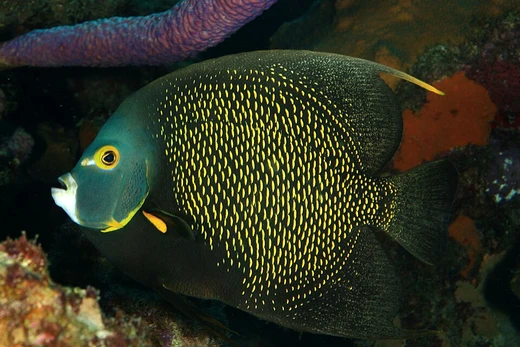
Pomacanthus
A genus of marine angelfish with prominent opercular spines.

NasserHalaweh · CC BY-SA 4.0
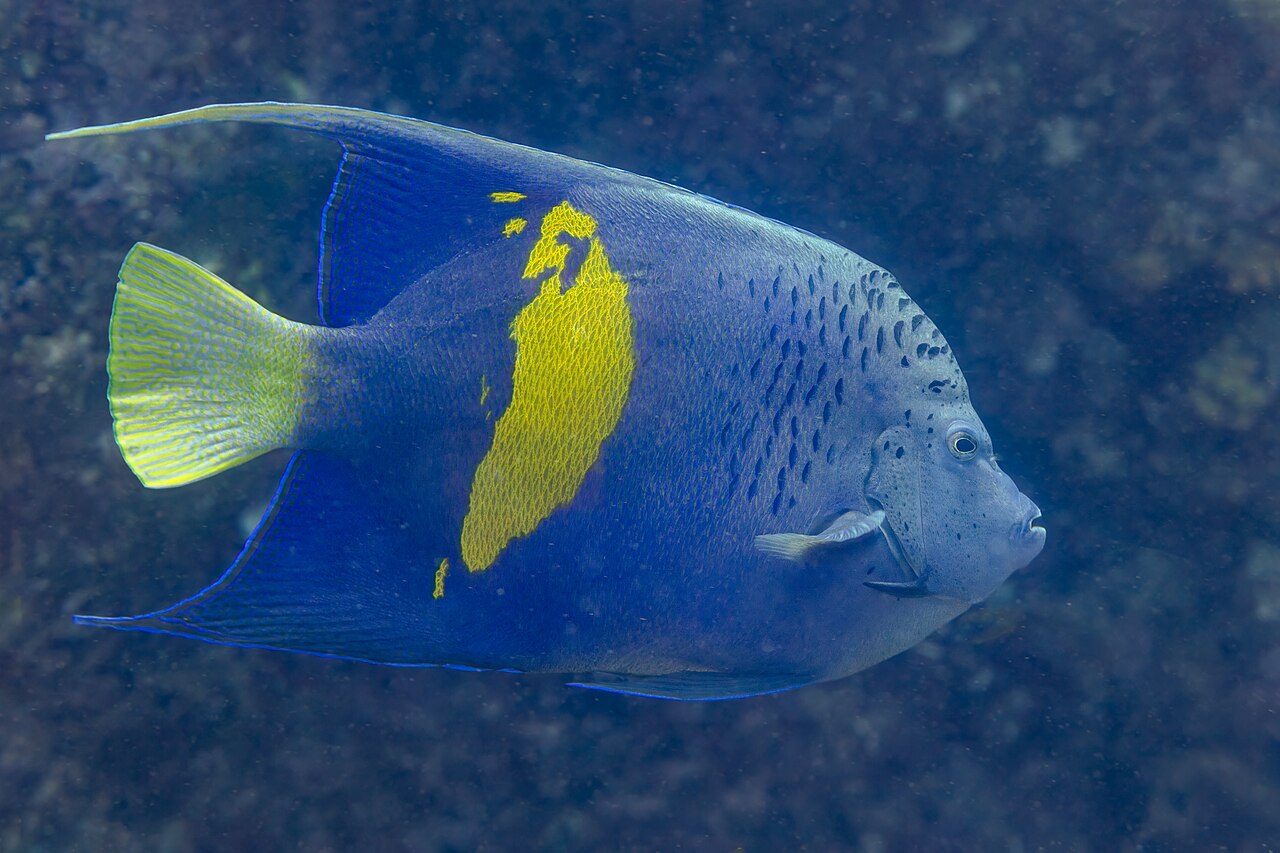
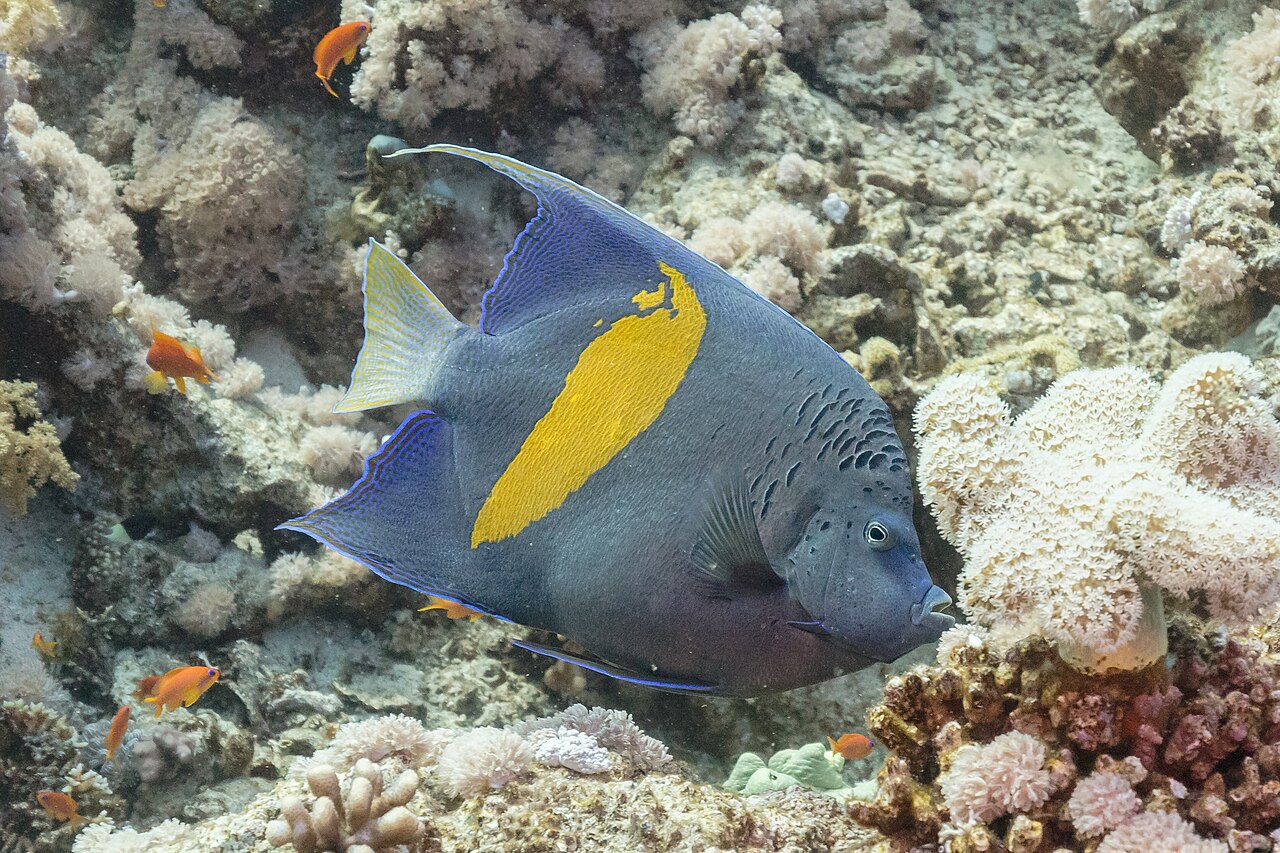
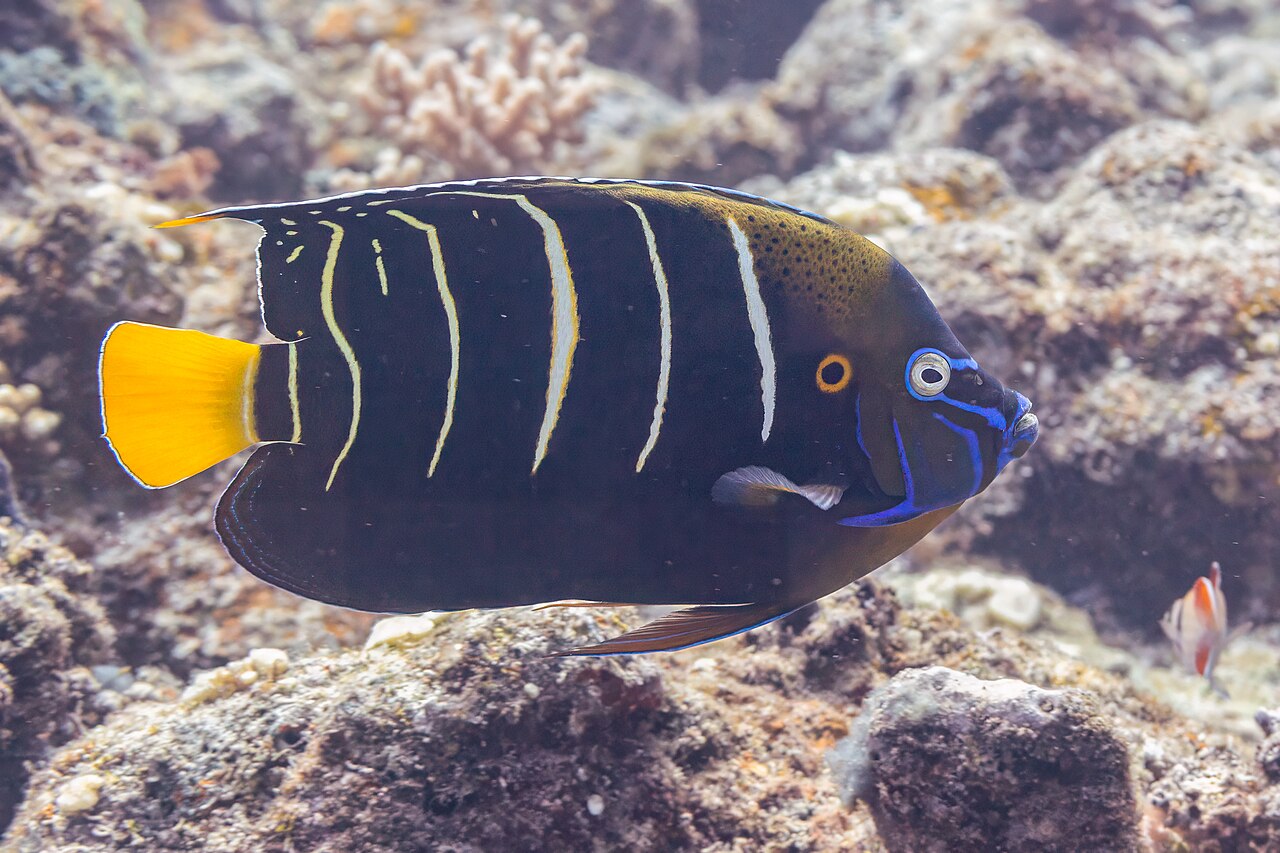
Pomacanthus is a genus of marine angelfish, the name deriving from Ancient Greek *poma* meaning 'cover' and *ákantha* meaning 'spine'. These vari-coloured fish are usually found around reefs and coral, with notable locations including the Maldives, Sri Lanka, and Sipidan off the southern coast of Sabah, Malaysia. Their patterns and colors undergo a major transformation from juvenile to adult forms, with juveniles sometimes appearing to be a different species.
Quick Facts
- Taxon
- Pomacanthus
- Type Species
- Chaetodon arcuatus
- Type Species Authority
- (Linnaeus, 1758)
Facts from the source article.
Lore & Background
The genus Pomacanthus was created in 1802 by the French naturalist Bernard Germain de Lacépède, with the type species designated as *Chaetodon arcuatus*. The name is a compound of *poma* meaning 'lid' and *acanthus* meaning 'thorn', referencing the prominent spine on the rear margin of the operculum, a feature shared by all marine angelfishes. Some authorities divide the genus into subgenera: *Pomacanthus*, *Acanthochaetodon*, *Arusetta*, and *Euxiphipops*.
Reader's Guide
The genus Pomacanthus is notable for its distinctive opercular spine, a feature that gives the group its name and is shared by all marine angelfishes. The fish are typically found around reefs and coral in locations such as the Maldives, Sri Lanka, and Sipidan off Sabah, Malaysia. A key characteristic is the major transformation in patterns and colors from juvenile to adult forms, with juveniles sometimes appearing to be a different species. The genus was established in 1802 by Bernard Germain de Lacépède, and authorities recognize 13 species divided among four subgenera: *Pomacanthus*, *Acanthochaetodon*, *Arusetta*, and *Euxiphipops*. This taxonomic structure reflects ongoing scholarly discussion about the relationships within the group.
Did You Know?
- The name Pomacanthus comes from Ancient Greek poma (cover) and ákantha (spine).
- The genus was created in 1802 by French naturalist Bernard Germain de Lacépède.
- Juveniles may appear to be a different species from the adults due to major color and pattern changes.
- The type species for the genus is Chaetodon arcuatus.
Origins of a Name
The emperor angelfish's scientific identity traces back to 1787, when the German physician and naturalist Marcus Elieser Bloch formally described the species under the name Chaetodon imperator, designating Japan as the type locality. Bloch, who lived from 1723 to 1799, contributed to a broader European effort to catalogue the natural world during the eighteenth century. The specific epithet imperator, meaning emperor, carries a story that predates Bloch's description by nearly seven decades. In 1719, the Dutch publisher Louis Renard bestowed upon the fish the colloquial name Keyser van Iapan, translating to Emperor of Japan, a title that likely captured the species' regal and striking appearance. Taxonomists continue to debate the precise placement of this fish within its family, with some authorities assigning it to the subgenus Acanthochaetodon rather than leaving it directly under Pomacanthus. Regardless of these classificatory nuances, the emperor angelfish has remained one of the most visually celebrated marine species, drawing admiration from photographers, artists, and aquarium enthusiasts alike for its brilliant and distinctive coloration patterns.
A Vast Indo-Pacific Realm
The emperor angelfish commands one of the broadest ranges of any reef-associated marine fish. Its core territory stretches from the Red Sea southward along the East African coastline to Mozambique and Madagascar, then sweeps eastward across the Indian and Pacific Oceans to reach the Tuamotu and Line Islands. To the north, populations are documented in the Kansai region and southern Japan, while to the south the range extends to Australia's Great Barrier Reef, New Caledonia, and the Austral Islands in French Polynesia. Beyond these established waters, the species has made notable forays into new regions. Vagrant individuals have turned up off Hawaii, and records exist from the coasts of Florida and Puerto Rico. Perhaps most striking is its arrival as a Lessepsian migrant in the eastern Mediterranean basin, where it has been present since 2009 and now persists in low numbers across several localities. Despite this extraordinary geographic spread, the species is generally regarded as maintaining stable populations and facing no significant extinction threats.
Two Faces of One Fish
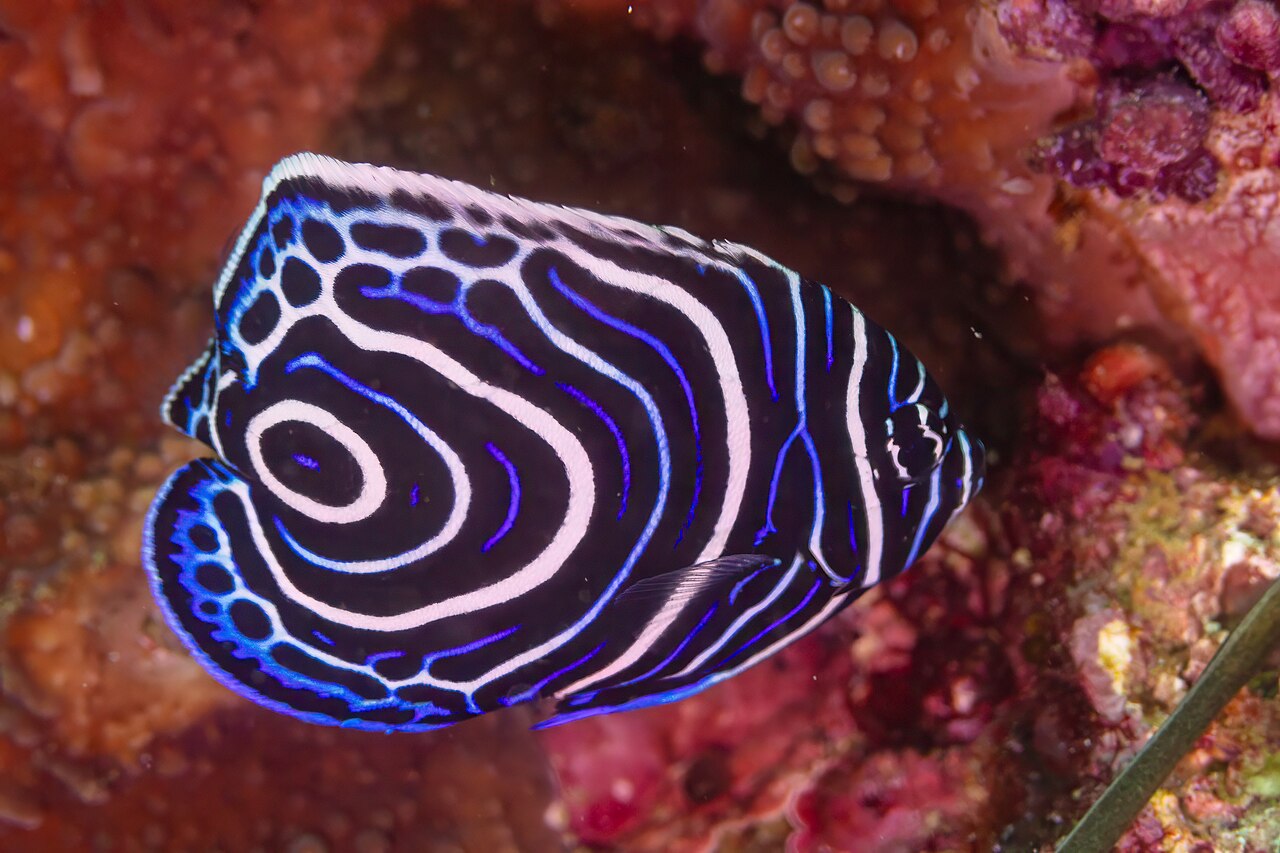
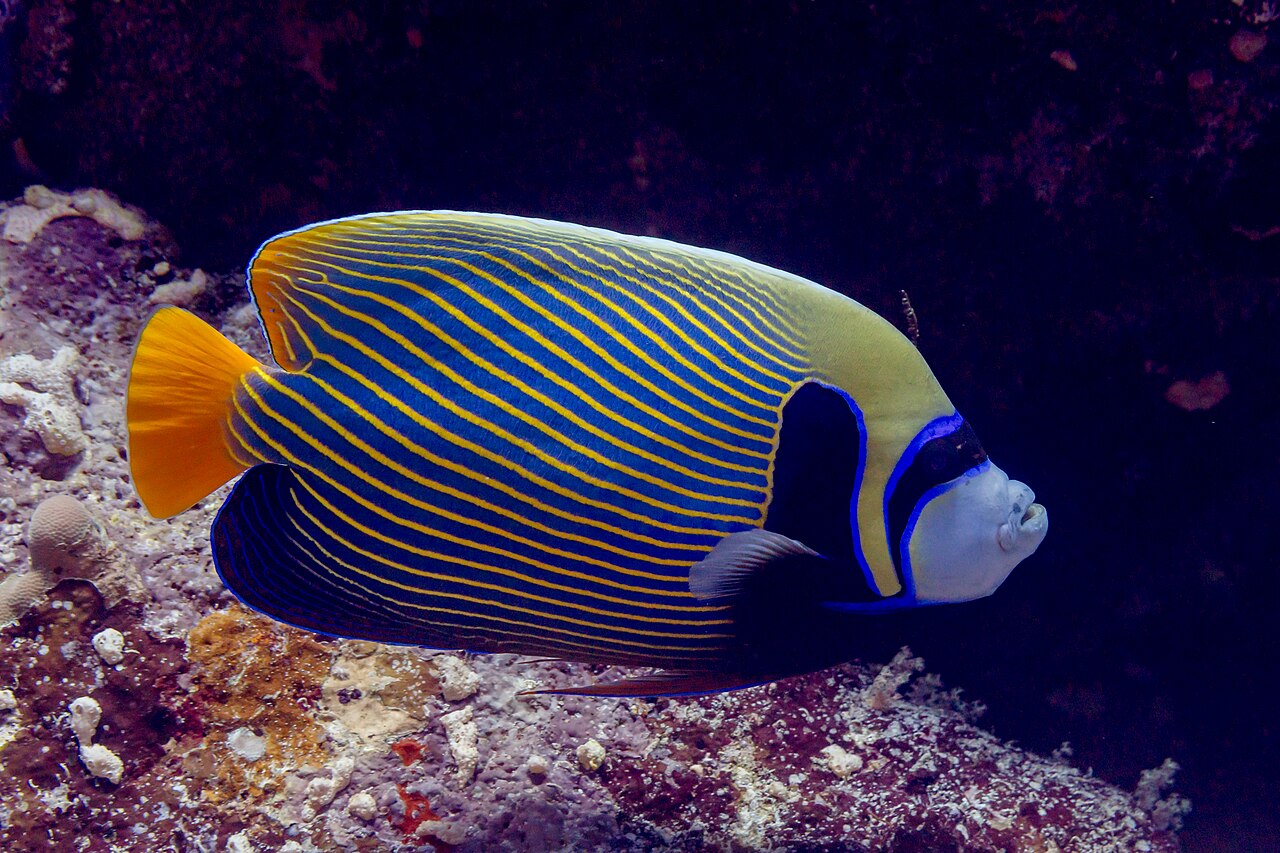
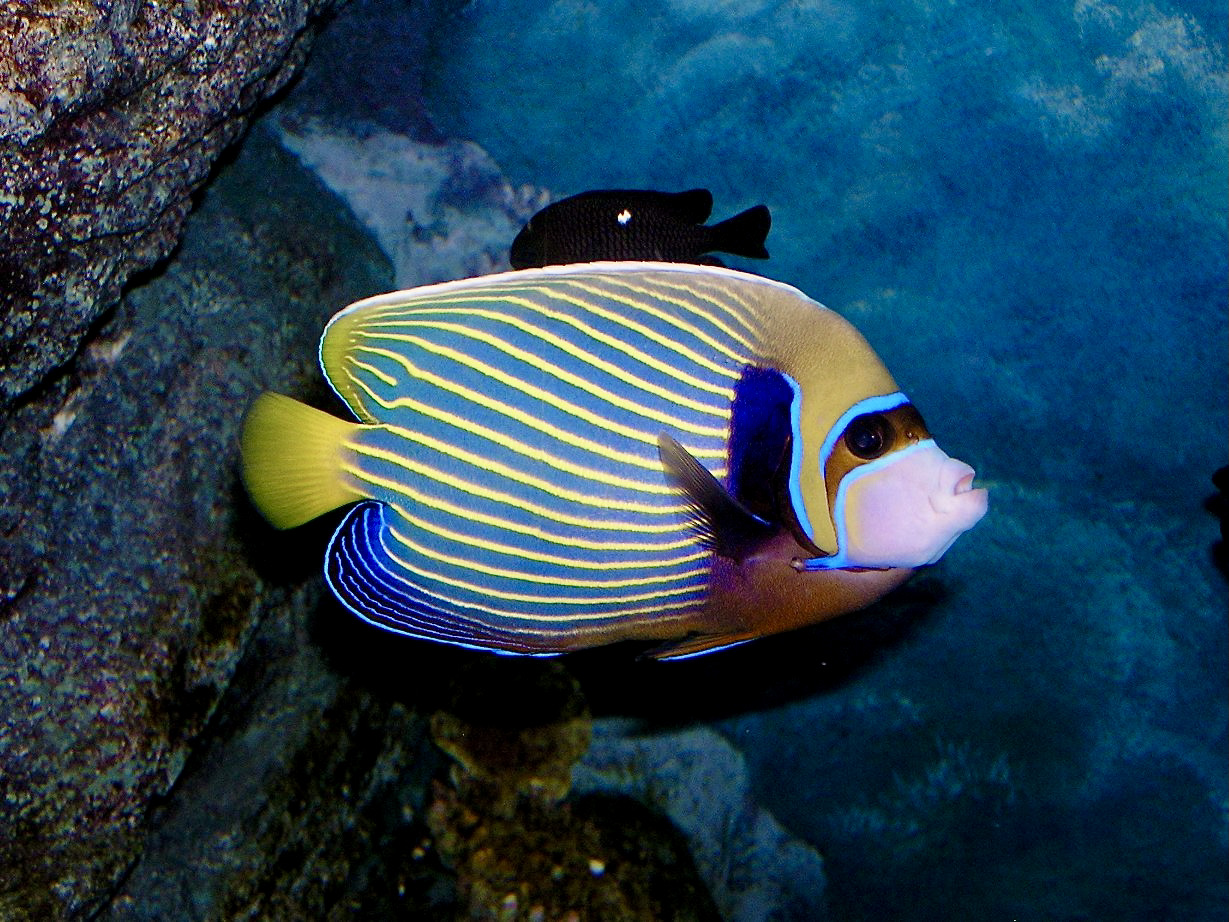
Few reef fish undergo a more dramatic visual transformation between life stages than the emperor angelfish. Juveniles present as a deep blue canvas overlaid with concentric, curving bands alternating between pale blue and white, the smallest rings nested within larger ones toward the rear. These lines shift to a vertical orientation at the front, the dorsal fin carries a white edge, and the tail remains transparent. Adults, by contrast, display bold horizontal stripes of blue and yellow, a pale blue face framed by a dark blue mask over the eyes, and a vivid yellow caudal fin. A blackish band sits above the pectoral fins, its upper edge aligned with the top of the eye, bordered in front by bright blue and behind by a thin yellow line. The anal fin shows a dark blue ground with lighter blue striping. Fin architecture includes thirteen to fourteen dorsal spines with seventeen to twenty-one soft rays, and three anal spines with eighteen to twenty-one soft rays. The species reaches a maximum total length of forty centimeters. A regional distinction exists: Pacific Ocean adults bear a trailing filament from the rear of the dorsal fin, a feature absent in their Indian Ocean counterparts.
Life Among the Corals
The emperor angelfish inhabits a depth range from just one metre to a hundred metres, occupying clear lagoons, channels, and seaward reefs where coral growth is abundant. Adults typically shelter beneath ledges and within caves, while subadults favor cavities in the reef structure and surge channels on outer reefs. Juveniles seek out the most protected microhabitats, tucking beneath ledges, into reef cavities, and into sheltered pockets along channels and outer reef flats. Their diet centers on sponges, other encrusting organisms, and tunicates. Socially, the species forms pairs, and both juveniles and adults can serve as cleaner fish, removing ectoparasites from the bodies of larger species. In moments of alarm, the fish are capable of producing a distinctive knocking sound. The emperor angelfish is a common presence in the aquarium trade, and its stable population status means it faces no major extinction threats. Its brilliant, unique coloration has made it a perennial favorite among underwater photographers, artists, and aquarists worldwide.
Gallery
Frequently Asked Questions
What is Pomacanthus?
Pomacanthus is a genus of vari-coloured marine angelfish distinguished by prominent spines on their operculum (gill cover). The name is a Greek compound: poma meaning 'cover' and ákantha meaning 'spine.'
Where can I see Pomacanthus in the wild?
These reef-dwelling fish are most commonly encountered around coral formations in tropical waters, with the Maldives, Sri Lanka, and Sipidan off Sabah, Malaysia, being well-known spots.
Why do juvenile Pomacanthus look like a completely different fish?
As these angelfish mature, they undergo a striking transformation in both color and pattern. The shift is so dramatic that a juvenile can easily be mistaken for an unrelated species.
Who established the genus Pomacanthus and when?
French naturalist Bernard Germain de Lacépède formally described the genus in 1802, designating Chaetodon arcuatus as the type species.
How many species belong to Pomacanthus?
The genus currently encompasses 13 species organized into four subgenera, making it one of the more diverse lineages among marine angelfish.
More in Marine Angelfish 1-24
Spotted an error? Know more?
Reader corrections go straight into our review queue. Suggest an edit · How this site is sourced