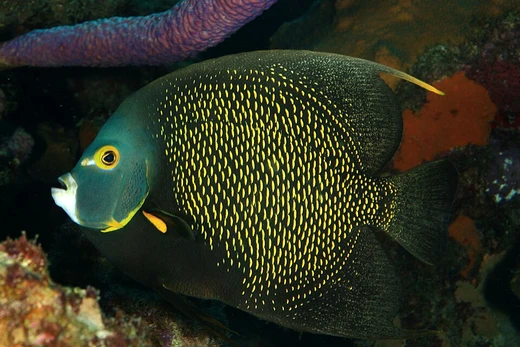
Blue velvet angelfish
A shy, bluish-black angelfish known only from Fiji.

The blue velvet angelfish (Centropyge deborae), sometimes called the Fiji blue twilight angelfish, belongs to the marine angelfish family Pomacanthidae. This small fish is found only in Fiji, where it was once thought to be a variant or subspecies of the midnight pygmy angelfish.
In appearance, the blue velvet angelfish has a bluish-black body that can look plain black in dim light. Its tail fin features a white rear edge, while the pectoral fin rays are black and separated by clear membrane. The dorsal fin contains 13 to 14 spines and 16 to 17 soft rays, and the anal fin has 3 spines and 17 to 18 soft rays. It reaches a maximum total length of 7 centimeters (2.8 inches).
This species is extremely timid and tends to hide among rubble and rocks, especially when startled, and is found on seamounts. Its known range is limited to Fiji.
The blue velvet angelfish was first formally described in 2012 by Kang-Ning Shen, Hsuan-Ching Ho, and Chih-Wei Chang, with the type locality given as Bligh Water, east of Yasawa Island in Fiji. Its specific name honors Deborah Smith, wife of Walt Smith, a collector and trader in the aquarium trade who gathered the type series. Within the genus Centropyge, its classification is considered uncertain (incertae sedis). It was initially identified as C. nox, but its blue tint and later genetic analysis at National Taiwan University confirmed it as a separate species.
The fish appears occasionally in the aquarium trade.
Quick Facts
- Taxon
- Centropyge deborae
Facts from the source article.
Lore & Background
The blue velvet angelfish has an overall bluish-black colour, although in poor light it appears black. Its caudal fin has a white rear margin, and the rays of the pectoral fin are black separated by a transparent membrane. This species attains a maximum total length of 7 centimetres. It is an extremely shy fish which often hides among rubble and rocks, particularly when alarmed, on seamounts. The species was first formally described in 2012 by Kang-Ning Shen, Hsuan-Ching Ho, and Chih-Wei Chang, with the type locality given as Bligh Water, east of Yasawa Island in Fiji. The specific name honours Deborah Smith, wife of Walt Smith, a collector and trader in the aquarium trade who collected the type series. Within the genus Centropyge this species is considered to be incertae sedis. It was initially identified as C. nox, but the blue tint and subsequent genetic analysis at the National Taiwan University confirmed it was a new species.
Reader's Guide
The blue velvet angelfish is notable for its restricted distribution, being known only from Fiji, and for its initial misidentification as a subspecies or variety of the midnight pygmy angelfish. Its description in 2012 relied on genetic analysis at the National Taiwan University, which distinguished it from C. nox based on its blue tint. The species makes an occasional appearance in the aquarium trade, though its extreme shyness and tendency to hide among rubble and rocks on seamounts likely limit its collection. Its placement within the genus Centropyge remains unresolved, listed as incertae sedis, reflecting ongoing taxonomic uncertainty. The specific name honors Deborah Smith, whose husband collected the type series, linking the species to the aquarium trade network.
Did You Know?
- The blue velvet angelfish is only known from Fiji.
- It was initially considered a variety or subspecies of the midnight pygmy angelfish.
- Its specific name honours Deborah Smith, wife of aquarium trade collector Walt Smith.
Taxonomic Journey & Naming
The blue velvet angelfish, scientifically named Centropyge deborae and sometimes called the Fiji blue twilight angelfish, belongs to the marine angelfish family Pomacanthidae. For years, specimens of this small fish were lumped together with the midnight pygmy angelfish, treated merely as a variety or subspecies of that species. The turning point came when researchers noticed a distinct blue tint in the fish's coloration and pursued genetic analysis at the National Taiwan University. Those molecular results confirmed what the eye had hinted at: this was indeed a separate species. In 2012, Kang-Ning Shen, Hsuan-Ching Ho, and Chih-Wei Chang formally described it, designating Bligh Water east of Yasawa Island in Fiji as the type locality. The specific epithet deborae pays tribute to Deborah Smith, whose husband Walt Smith, a well-known figure in the aquarium collecting and trading world, had gathered the very specimens used to establish the species. Despite its formal description, the blue velvet angelfish remains classified as incertae sedis within the genus Centropyge, meaning its precise evolutionary placement among its pygmy angelfish relatives is still unresolved.
Morphology & Coloration
The blue velvet angelfish is a compact marine fish, reaching a maximum total length of just seven centimetres, roughly 2.8 inches. Its body presents an overall bluish-black hue, though under dim or poor lighting conditions the fish can appear almost entirely black, losing that subtle blue cast that gives it its common name. The caudal fin carries a distinctive white rear margin that stands out against the darker body. The pectoral fins are particularly striking in their structure: the rays are black, separated by a transparent membrane, giving them a lacy, see-through quality. In terms of fin architecture, the dorsal fin bears between thirteen and fourteen spines followed by sixteen to seventeen soft rays, while the anal fin features three spines paired with seventeen to eighteen soft rays. These precise counts in spine and ray numbers are key diagnostic characters that help ichthyologists distinguish this species from its close relatives within the pygmy angelfish group.
Range & Behavioral Ecology
The blue velvet angelfish is one of the most geographically restricted species in the genus Centropyge. Every confirmed record of this fish comes from Fiji, making the island nation the sole known home of the species. Within that range, the fish favors seamounts, underwater volcanic peaks rising from the ocean floor, where it spends much of its time concealed among rubble and rocky outcrops. It is described as an extremely shy animal, and when startled or alarmed it will retreat into the crevices and debris of its rocky habitat rather than flee into open water. This cryptic, reclusive behavior, combined with its small size and dark coloration, makes it a challenging fish to observe in the wild. The combination of a single-country distribution, a preference for specific seamount topography, and a deeply hidden lifestyle means that much about the full ecological niche of this angelfish likely remains undocumented. Its restricted range also heightens the importance of any conservation considerations, as the entire known population exists within one nation's waters.
The Aquarium Trade Connection
Although the blue velvet angelfish is not a common sight in the commercial aquarium trade, it does make an occasional appearance among the marine species offered to hobbyists. The connection between this fish and the aquarium industry runs deeper than mere trade, however, because the very specimens that anchored its scientific description were collected by Walt Smith, a well-known collector and trader operating in Fiji's waters. His wife, Deborah Smith, is the person honored in the species' specific name, deborae, linking the fish's identity in the scientific literature directly to the family behind the aquarium trade. This intertwining of commerce and taxonomy is not unusual in marine biology, where collectors in the trade often bring in specimens that prompt new species descriptions. The fact that the blue velvet angelfish was initially mistaken for a variant of the midnight pygmy angelfish before genetic work at the National Taiwan University proved otherwise illustrates how the trade's specimens can carry hidden biological surprises. For the small number of aquarists who do encounter this species, it represents a rare, Fiji-endemic pygmy angelfish with a striking bluish-black palette and delicate transparent pectoral membranes.
Frequently Asked Questions
What is the Blue Velvet Angelfish?
The Blue Velvet Angelfish (Centropyge deborae), also called the Fiji blue twilight angelfish, is a small member of the marine angelfish family Pomacanthidae. It was long mistaken for a color variant of the midnight pygmy angelfish before being recognized as a separate species.
Where does the Blue Velvet Angelfish live?
This species is endemic to Fiji, with no confirmed records from any other region. Its limited geographic range is part of why it was initially overlooked as a distinct fish rather than a local variant of a more widespread angelfish.
How big does the Blue Velvet Angelfish get?
It tops out at roughly 7 centimetres (about 2.8 inches) in total length, placing it firmly in the pygmy angelfish size class. That compact build is typical for the genus Centropyge.
What does the Blue Velvet Angelfish look like?
Its body is a deep bluish-black that can read as plain black in dim lighting, and the tail fin is bordered by a clean white rear edge. The pectoral fins show black rays divided by clear membrane, while the dorsal fin carries 13 to 14 spines and 16 to 17 soft rays.
When was the Blue Velvet Angelfish first formally described?
The species was given its formal scientific description in 2012, once researchers confirmed it was genuinely distinct from the midnight pygmy angelfish. Prior to that, it had been catalogued as a subspecies or color morph of that other angelfish.
More in Marine Angelfish 1-24
Spotted an error? Know more?
Reader corrections go straight into our review queue. Suggest an edit · How this site is sourced