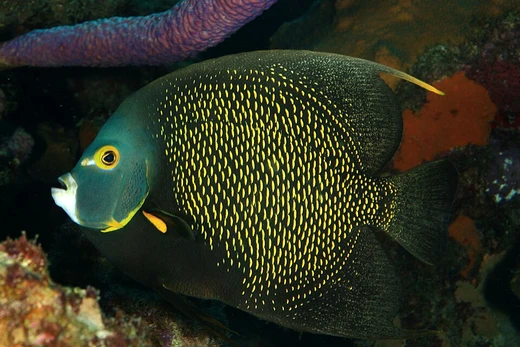
Royal angelfish
A tropical Indo-Pacific angelfish with distinctive blue-white and orange stripes.

The royal angelfish (Pygoplites diacanthus), also called the regal angelfish, is a marine fish from the Pomacanthidae family. It is the only species in its genus, Pygoplites. This fish lives in the tropical Indo-Pacific and reaches a maximum length of 25 cm (9.8 in).
Its range spans the Red Sea, the Indian Ocean near East Africa and the Maldives, and extends east to the Tuamoto Islands, New Caledonia, and the Great Barrier Reef. The northernmost parts of its territory include the southern East China Sea near Taiwan, as well as the Ryukyu and Ogasawara Islands of Japan.
The body of the royal angelfish is moderately long and very flattened. The bone in front of the eye is rounded and lacks strong spines. There is one prominent spine at the angle of the gill cover, and the lower edge of the gill plate is smooth. The eyes and mouth are moderately small, with the mouth positioned at the front and able to extend outward. It has 14 dorsal spines, 17–19 soft dorsal rays, 3 anal spines, 17–19 anal soft rays, and 16–17 pectoral fin rays. The tail fin is rounded. Coloration varies by region, especially between the Indian Ocean, Red Sea, and South Pacific. Common features include narrow, backward-angled blue-white and orange stripes along the body. The rear part of the dorsal fin is black or blue with small blue dots, and the rear of the anal fin has alternating yellow and blue bands that follow the body’s curve. The tail fin is yellow. Juveniles have a large dark spot at the base of the soft dorsal fin. They can live up to 15 years. Recent research suggests that Pygoplites includes two distinct forms, which may hybridize at Christmas Island.
This species is found at depths from 0 to 80 m (0 to 262 ft), in coral-rich areas of lagoons and reefs, often near caves. It is carnivorous, feeding on sponges and tunicates. It is non-migratory and can be seen alone, in pairs, or in groups. Juveniles hide in cracks and crevices.
The royal angelfish was first formally described in 1772 by Dutch naturalist Pieter Boddaert and has appeared in 18th- and 19th-century zoological art.
It is harmless to humans and has minor commercial use in the aquarium trade. Hobbyists value it as one of the few “reef safe” angelfish because its diet consists mainly of sponges, not corals.
Keeping this fish in captivity can be challenging.
Quick Facts
- Genus
- Pygoplites
- Species
- diacanthus
Facts from the source article.
Lore & Background
The royal angelfish was first formally described in 1772 by the Dutch naturalist Pieter Boddaert, and it has been the subject of 18th and 19th century zoological art. Its body is moderately elongate and very compressed, with a convex preorbital bone lacking strong spines, one prominent spine at the preopercle angle, and a smooth ventral edge of the interopercle. The eyes and mouth are moderately small, the mouth being terminal and protractile. Coloration varies regionally, especially among Indian Ocean, Red Sea, and South Pacific populations, but a common pattern includes narrow blue-white and orange stripes that angle backward, a black or blue posterior dorsal fin with close-set blue dots, and a yellow caudal fin. Juveniles have a large dark spot on the basal portion of the soft dorsal fin. Recent research indicates that Pygoplites comprises two morphs, with variants potentially hybridizing at Christmas Island.
Reader's Guide
The royal angelfish is widely distributed throughout the Indo-Pacific, from the Red Sea and Indian Ocean around East Africa and the Maldives to the Tuamoto Islands, New Caledonia, and Great Barrier Reef, with its northernmost range ending in the southern East China Sea around Taiwan, the Ryukyu Islands, and the Ogasawara Islands of Japan. It occurs at depths from 0 to 80 m in coral-rich areas of lagoons and reefs, often near caves. A carnivorous species, it feeds on sponges and tunicates. It is non-migratory and can be found solitary, in pairs, or groups; juveniles shelter in cracks and crevices. The species is considered harmless to humans and has minor commercial use in the aquarium industry, valued as one of the few 'reef safe' angelfish because its diet consists primarily of sponges and does not include corals. In captivity, it can be challenging to keep; a healthy specimen in the right environment may start feeding within days on a variety of live, frozen, and flake or freeze-dried foods, but a hostile environment with large angelfish, triggerfish, puffers, or overly aggressive clownfish and surgeonfish should be avoided. Reproduction occurs by spawning, usually at dusk or night, with a spiraling dance before eggs and sperm are released into the upper water column.
Did You Know?
- The royal angelfish is the only species in the monotypic genus Pygoplites.
- It can live up to 15 years in the wild.
- Recent research suggests Pygoplites comprises two morphs that may hybridize at Christmas Island.
Taxonomy & Physical Form
The royal angelfish, Pygoplites diacanthus, is the sole representative of its genus within the family Pomacanthidae. This marine ray-finned species inhabits tropical Indo-Pacific waters and can grow to 25 centimeters in length. Its body is laterally compressed yet moderately elongated, producing a sleek, disc-like profile. The head carries a convex preorbital bone free of heavy spines, one prominent spine angled at the preopercle, and a smooth ventral edge on the interopercle. Eyes and the terminal, protractile mouth are both modest in size. Fin architecture includes 14 dorsal spines with 17 to 19 soft dorsal rays, 3 anal spines with 17 to 19 anal soft rays, and 16 to 17 pectoral rays, all finished by a rounded caudal fin. While coloration shifts regionally among Indian Ocean, Red Sea, and South Pacific populations, a shared pattern persists: narrow blue-white and orange stripes angling backward along the flanks, a dark posterior dorsal fin speckled with blue dots, alternating yellow-and-blue bands on the rear anal fin, and a yellow tail. Juveniles bear a large dark blotch on the basal soft dorsal fin. Recent work identifies two morphs, with potential hybridization observed at Christmas Island, and lifespans of up to 15 years have been reported.
Geographic Range & Habitat
The royal angelfish enjoys a remarkably broad distribution across the Indo-Pacific. Its range stretches from the Red Sea and the Indian Ocean waters off East Africa and the Maldives eastward to the Tuamotu Islands, New Caledonia, and the Great Barrier Reef. To the north, populations extend into the southern East China Sea around Taiwan, the Ryukyu Islands, and Japan's Ogasawara Islands. Within this vast territory, the species occupies depths from the surface down to 80 meters, favoring coral-rich lagoons, reef structures, and the vicinity of underwater caves. It is a non-migratory fish, meaning individuals remain in relatively fixed areas throughout their lives. Socially, royal angelfish are flexible: they may be encountered solitary, in pairs, or in small groups depending on local conditions. Young fish in particular seek shelter within cracks and crevices of reef formations, using these tight spaces as refuge during their vulnerable early stages. This sedentary, reef-tied existence underscores the species' deep ecological connection to specific coral habitats across its wide range.
Ecology & Reproductive Behavior
As a carnivore, the royal angelfish specializes in consuming sponges and tunicates found across reef surfaces and within underwater caves. This dietary focus on sessile invertebrates shapes its foraging behavior and, as noted later, its particular value to aquarium keepers. The species is non-migratory and shows flexible social organization, appearing alone, in pairs, or in loose groups depending on local conditions. Juveniles are especially reclusive, tucking into cracks and crevices for protection. Reproduction follows a broadcast-spawning strategy. Pairs typically spawn at dusk or during the night hours. Before release, the two fish perform a characteristic spiraling dance, after which eggs and sperm are simultaneously discharged into the upper water column. This pelagic spawning method means the gametes drift with currents rather than being attached to substrate. The combination of a specialized sponge-and-tunicate diet, sedentary habitat use, and timed nocturnal spawning together paint a picture of a species finely tuned to the rhythms of its coral reef environment.
Human History & Aquarium Keeping
The royal angelfish was first formally described in 1772 by the Dutch naturalist Pieter Boddaert, and its striking appearance made it a popular subject for zoological artists throughout the 18th and 19th centuries. In modern times, the species holds a special place in the aquarium trade. It is considered entirely harmless to humans and sees only minor commercial use, but hobbyists prize it as one of the few "reef safe" angelfish because its sponge-based diet excludes coral consumption. Despite this appeal, keeping royal angelfish in captivity is genuinely challenging. A healthy individual placed in a suitable environment will typically begin feeding within days when offered a mix of live, frozen, flake, or freeze-dried foods. Conversely, a hostile tank setup directly undermines acclimation and feeding success. Keepers are advised to avoid housing them with large angelfish, triggerfish, puffers, or overly aggressive clownfish and surgeonfish, as these companions can create the stressful conditions that prevent the angelfish from settling in and eating.
Frequently Asked Questions
What is the royal angelfish?
The royal angelfish (Pygoplites diacanthus) is a tropical marine fish in the Pomacanthidae family, sometimes called the regal angelfish. It holds a unique taxonomic position as the only living species in its genus, Pygoplites.
Where does the royal angelfish live in the wild?
Its range stretches across the tropical Indo-Pacific, from the Red Sea and East African coast eastward to New Caledonia, the Tuamoto Islands, and the Great Barrier Reef. Northward, it reaches the southern East China Sea near Taiwan and the Ryukyu and Ogasawara island chains of Japan.
How big does a royal angelfish get?
A fully grown individual reaches a maximum total length of about 25 cm (roughly 9.8 inches). That places it in the mid-size range for marine angelfish, smaller than some of its larger Pomacanthidae relatives.
What does a royal angelfish look like?
The species is instantly recognizable by its bold blue-white and orange striping across the body. Fin counts include 14 dorsal spines, 17–19 soft dorsal rays, 3 anal spines, 17–19 anal soft rays, and 16–17 pectoral fin rays.
Why is the royal angelfish considered special among marine angelfish?
Being the sole representative of the genus Pygoplites means it has no close congeners, setting it apart from most other angelfish that share a genus with several species. This taxonomic singularity, combined with its vivid coloration, makes it a standout favorite for marine biologists and dedicated aquarists.
More in Marine Angelfish 1-24
Spotted an error? Know more?
Reader corrections go straight into our review queue. Suggest an edit · How this site is sourced