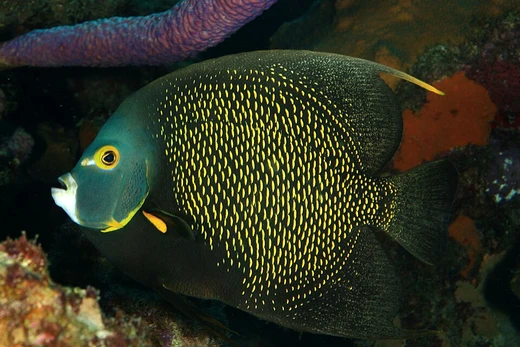
Cocos-Keeling angelfish
A shy, lemon-yellow angelfish with a blue stripe and purple eye ring.

The Cocos-Keeling angelfish (Centropyge colini), also called Colin's angelfish, is a small marine ray-finned fish in the Pomacanthidae family. It lives in the Indo-West Pacific region.
This fish is mostly lemon-yellow, with a broad blue stripe running from the nape along the back to the middle of the dorsal fin. A thin purplish ring circles each eye. The dorsal fin has 14 spines and 16–17 soft rays, while the anal fin has 3 spines and 17 soft rays. It reaches a maximum total length of 9 centimeters (3.5 inches).
The species has been recorded at scattered sites across the Indo-West Pacific, including the Spratly Islands, Palau, Papua New Guinea, Indonesia, the Marshall Islands, the Cocos Keeling Islands, Fiji, and Guam, with an unconfirmed report from Japan’s Ogasawara Islands.
It inhabits depths between 20 and 100 meters (66–328 feet), living in crevices and caves on deep reef drop-offs. The fish is shy and secretive, forming groups of one male with a harem of 2–6 females. If the male disappears, the most dominant female replaces him. Very little is known about its diet.
The species was first formally described in 1974 by William F. Smith-Vaniz and Ernest J. Randall, with the type locality given as Turks Reef in the Cocos-Keeling Islands. Some authorities place it in the subgenus Centropyge. Its specific name honors biologist Patrick L. Colin, who helped collect the type specimen.
The Cocos-Keeling angelfish rarely appears in the aquarium trade.
Quick Facts
- Taxon
- Centropyge colini
Facts from the source article.
Lore & Background
The Cocos-Keeling angelfish is mainly lemon-yellow in colour with a wide blue stripe from the nape along the back to the middle of the dorsal fin, and a thin purplish ring around the eye. Its dorsal fin contains 14 spines and 16-17 soft rays, while the anal fin has 3 spines and 17 soft rays. This species attains a maximum total length of 9 centimetres (3.5 in).
It has been recorded from a scattering of sites in the Indo-West Pacific, including the Spratly Islands, Palau, Papua New Guinea, Indonesia, Marshall Islands, Cocos Keeling Islands, Fiji and Guam, with an unconfirmed report from the Ogasawara Islands off Japan. It is found at depths between 20 and 100 metres (66 and 328 ft), living in crevices and caves in deep reef drop offs.
The species is shy and secretive, forming groups consisting of a male and a harem of 2-6 females. If the male disappears, the most dominant female replaces him. Very little is known about the diet of this species.
Reader's Guide
The Cocos-Keeling angelfish was first formally described in 1974 by William F. Smith-Vaniz and Ernest J. Randall, with the type locality given as Turks Reef in the Cocos-Keeling Islands. Some authorities place this species in the subgenus Centropyge. Its specific name honours the biologist Patrick L. Colin, who helped collect the type. The species rarely appears in the aquarium trade, which contributes to its limited recognition outside scientific circles. Its scattered distribution across the Indo-West Pacific, including locations such as Palau, Papua New Guinea, and Fiji, along with an unconfirmed report from the Ogasawara Islands, highlights the patchy knowledge of its range. The species' secretive habits and deep-water habitat make it difficult to study, and very little is known about its diet. Its social structure—a male with a harem of 2-6 females and the replacement of the male by the dominant female—is a notable aspect of its biology. The Cocos-Keeling angelfish remains a relatively obscure species, primarily of interest to marine biologists and dedicated aquarists.
Frequently Asked Questions
What is the Cocos-Keeling angelfish?
The Cocos-Keeling angelfish, also known as Colin's angelfish (Centropyge colini), is a small marine ray-finned fish in the Pomacanthidae family. It is native to the Indo-West Pacific region.
What does the Cocos-Keeling angelfish look like?
Its body is predominantly lemon-yellow, with a broad blue stripe stretching from the nape along the back to the middle of the dorsal fin. A thin purplish ring circles each eye, adding a subtle contrast to the overall coloration.
Where does the Cocos-Keeling angelfish live?
It is found at scattered sites across the Indo-West Pacific, typically at depths between 20 and 100 metres (about 66 to 328 feet). The species is not widespread, having been recorded only at a limited number of locations.
How big does the Cocos-Keeling angelfish get?
It is a compact angelfish, topping out at a maximum total length of 9 centimetres (roughly 3.5 inches). Its dorsal fin bears 14 spines and 16–17 soft rays, while the anal fin has 3 spines and 17 soft rays.
What makes the Cocos-Keeling angelfish stand out among other marine angelfish?
It is a notably shy, small-bodied species that pairs a bright lemon-yellow body with a bold blue dorsal stripe and a delicate purple eye ring. Like other Centropyge species, it stays compact and is restricted to scattered Indo-West Pacific reefs rather than being broadly distributed.
More in Marine Angelfish 1-24
Spotted an error? Know more?
Reader corrections go straight into our review queue. Suggest an edit · How this site is sourced