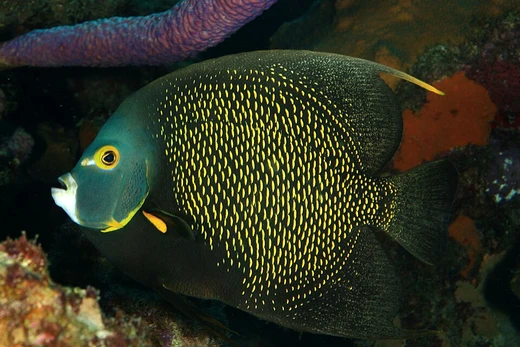
Resplendent pygmy angelfish
Endemic to Ascension Island, a rare pygmy angelfish.

The resplendent pygmy angelfish (Centropyge resplendens) is a small marine angelfish from the family Pomacanthidae. It lives only around Ascension Island in the South Atlantic Ocean. Its body is mostly deep blue, with a yellow patch on the snout, a yellow stripe along the back and dorsal fin, and a yellow tail fin. The dorsal fin has 14 spines and 16 rays, while the anal fin has 3 spines and 17 rays. This fish grows to a maximum length of 6 centimetres (2.4 inches).
It inhabits depths between 15 and 40 metres (49 to 131 feet), over rocky or rubble-covered seafloor. It eats algae and detritus. Like other fish in the genus *Centropyge*, it is a protogynous hermaphrodite: young fish start with no fixed sex, become female when mature, and if no male is present, the dominant female can change to male. This sex change can reverse over a few weeks.
The species was first described in 1975 by Hugh Roger Lubbock and Richard D. Sankey. Its scientific name *resplendens* means "resplendent," referring to its bright colours. Some experts place it in the subgenus *Xiphypops*.
The resplendent pygmy angelfish is rare in the aquarium trade, though it has been bred in captivity a few times.
Quick Facts
- Taxon
- Centropyge resplendens
Facts from the source article.
Lore & Background
The resplendent pygmy angelfish was first formally described in 1975 by Hugh Roger Lubbock and Richard D. Sankey. Its specific name resplendens means 'resplendent', a reference to the beauty of its colour. Some authorities place this species in the subgenus Xiphypops. The fish has a body largely deep blue, with a yellow patch over the snout and yellow along the back and dorsal fin to the yellow caudal fin. It occurs at depths between 15 and 40 metres over rock and rubble substrates, feeding on algae or detritus. Like other members of the genus Centropyge, it is a protogynous hermaphrodite: young fish are of indeterminate sex, become female at sexual maturity, and if no male is present the dominant female changes sex to become male. This sex change can be reversed, taking a few weeks.
Reader's Guide
The resplendent pygmy angelfish is significant as a species endemic to Ascension Island, a remote location in the South Atlantic Ocean. Its description in 1975 by Lubbock and Sankey added to the known diversity of the genus Centropyge. The fish is rare in the aquarium trade, though it has been successfully bred in captivity, albeit infrequently. Its protogynous hermaphroditism, with reversible sex change, is a notable biological trait shared with other members of its genus. The species' restricted range and specific habitat requirements over rock and rubble substrates at moderate depths highlight its ecological niche. The beauty of its coloration, referenced in its scientific name, contributes to its appeal, though its rarity limits widespread human interaction. The species is listed in the 2006 IUCN Red List of Threatened Species, indicating conservation attention.
Did You Know?
- The resplendent pygmy angelfish is endemic to Ascension Island in the South Atlantic Ocean.
- It attains a maximum total length of 6 centimetres (2.4 in).
- It is a protogynous hermaphrodite, and sex change can be reversed over a few weeks.
More in Marine Angelfish 1-24
Spotted an error? Know more?
Reader corrections go straight into our review queue. Suggest an edit · How this site is sourced