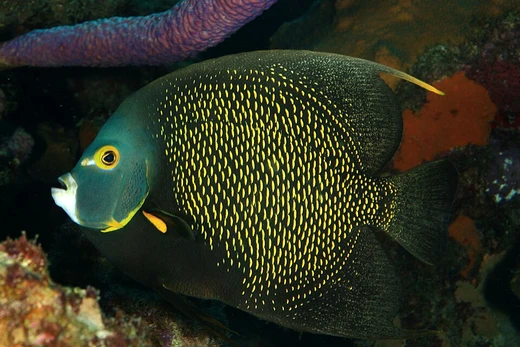
Orangeback angelfish
A marine angelfish found in the western Indian Ocean.

The orangeback angelfish (Centropyge acanthops) goes by several common names, including flameback angelfish, African pygmy angelfish, and in South Africa, the Jumping Bean or simply Bean. It belongs to the Pomacanthidae family of marine angelfish and is a ray-finned species found exclusively in the western Indian Ocean.
Its head, upper flanks, dorsal fin, and caudal fin are a golden yellow. The lower flanks and anal fin are black, covered in dense purple spots, and a blue ring encircles each eye. Adults reach a maximum total length of 8 centimeters (3.1 inches).
This angelfish ranges along the East African coast from Somalia south to East London in South Africa’s Eastern Cape Province. It also inhabits Madagascar, the Seychelles, Comoros, Chagos Islands, and the Mascarene Islands. In Asia, it has been recorded in the Gulf of Aden, the Arabian Sea off Yemen (including Socotra), Oman, and the Maldives, as well as the Australian territory of the Cocos (Keeling) Islands.
The species lives at depths between 1 and 70 meters (3.3 to 229.7 feet), typically near coral and often among coral rubble where it hides. It prefers areas with dense algal growth, grazing on algae and small invertebrates. Social by nature, it is usually seen in groups of up to ten individuals. Orangeback angelfish are protogynous hermaphrodites: the most dominant female in a group becomes male, and this change can reverse if dominance is lost. Spawning occurs at dusk, when the male bites the female’s abdomen to stimulate egg release; he fertilizes the eggs, which then drift away on the current.
The species was first formally described as *Holacanthus acanthops* in 1922 by English ichthyologist John Roxborough Norman, with Durban as the type locality. Some classifications place it in the subgenus *Xiphipops*. Its specific name, *acanthops*, combines the Greek *acanthus* (“spine”) and *ops* (“eye”), referring to the rearward-directed spine beneath the eye.
Common and popular in the aquarium trade, the orangeback angelfish has been successfully bred in captivity.
Quick Facts
- Taxon
- Centropyge acanthops
Facts from the source article.
Lore & Background
The orangeback angelfish was first formally described as Holacanthus acanthops in 1922 by the English ichthyologist John Roxborough Norman, with the type locality given as Durban. In some classifications it is placed in the subgenus Xiphipops. The specific name acanthops is a compound of acanthus meaning 'spine' and ops meaning 'eye', a reference to the rearward directed spine under the eye.
Its coloration includes a golden yellow head, upper flanks, dorsal fin, and caudal fin, while the lower flanks and anal fin are black with many dense purple spots. The eyes are ringed with blue. This species attains a maximum total length of 8 centimetres (3.1 in).
It is found at depths between 1 and 70 metres, usually near coral and frequently in areas of coral rubble where it likes to hide. It prefers areas with dense algal growth and grazes on algae and small invertebrates. It is a social species typically encountered in groups of up to 10 fishes. They are protogynous hermaphrodites in which the most dominant female in a group becomes male, a change that can be reversed if dominance is lost. Spawning occurs at dusk: the male bites the female on the abdomen to stimulate egg laying, fertilizes the eggs, and the eggs drift on the current.
Reader's Guide
The orangeback angelfish is common and popular in the aquarium trade, and it has been bred in captivity. Its distribution in the western Indian Ocean includes the East African coast from Somalia south to East London in the Eastern Cape Province, as well as Madagascar, Seychelles, Comoros, the Chagos Islands, the Mascarene Islands, the Gulf of Aden, the Arabian Sea off Yemen (including Socotra), Oman, the Maldives, and the Australian territory of the Cocos (Keeling) Islands. Its ability to change sex (protogynous hermaphroditism) and its social behavior in groups of up to 10 fishes are notable biological traits. The species is also known by multiple common names, including flameback angelfish, African pygmy angelfish, and in South Africa as the Jumping Bean or Bean.
Did You Know?
- It is a protogynous hermaphrodite: the most dominant female in a group becomes male, and this can be reversed if dominance is lost.
- The specific name acanthops means 'spine eye', referring to the rearward directed spine under the eye.
- It has been recorded from the Australian territory of the Cocos (Keeling) Islands.
More in Marine Angelfish 1-24
Spotted an error? Know more?
Reader corrections go straight into our review queue. Suggest an edit · How this site is sourced