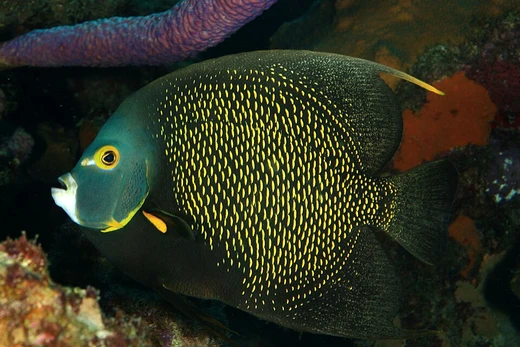
Japanese angelfish
A marine angelfish with orange body and purplish blue spots.

The Japanese angelfish (Centropyge interrupta), also called the Japanese pygmy angelfish, is a marine ray-finned fish in the family Pomacanthidae. It lives in the western Pacific Ocean.
This fish has an orange body covered with purple and blue spots. The spots grow larger toward the tail, and the lower rear part of the body gradually turns purple. The spots themselves shift from blue to purple near the tail. The tail is bright yellow. Juveniles have a black spot with a blue border on the rear part of the dorsal fin. The dorsal fin has 14 spines and 16 soft rays; the anal fin has 3 spines and 17 soft rays. The fish reaches a maximum total length of 15 centimeters.
Its range includes southern Japan from Tokyo to Shikoku, the Izu Islands, and the Ogasawara Islands. It also occurs around Midway Atoll, Kure Atoll, and south to Pearl and Hermes Atoll in United States waters.
The Japanese angelfish lives at depths of 15 to 60 meters, usually in pairs on rocky reefs with rich coral and algae growth. It eats algae, benthic invertebrates, and sponges. It is oviparous and monogamous. Females change sex to males at a total length of 12.7 centimeters, a process that takes 20 to 39 days.
The species was first formally described in 1918 by Japanese ichthyologist Shigeho Tanaka, with the type locality given as Tanabe in Wakayama Prefecture, Japan. The specific name *interrupta* means "interrupted," possibly referring to broken dusky bars on the head. Some authorities place it in the subgenus *Centropyge*.
Though uncommon in the aquarium trade, the Japanese angelfish does well in captivity and has been successfully bred and reared there. It can command high prices.
Quick Facts
- Taxon
- Centropyge interrupta
Facts from the source article.
Lore & Background
The Japanese angelfish has an orange body marked with purple and blue spots, with an orangey yellow body and purplish blue spots completed with a bright yellow tail. The spots are larger towards the tail, and the bottom part of the rear of the fish gradually becomes purple; the spots also turn from blue to purple towards the tail. Juveniles have a blue margined black ocellus on the posterior part of the dorsal fin. The dorsal fin contains 14 spines and 16 soft rays, while the anal fin has 3 spines and 17 soft rays. This species attains a maximum total length of 15 centimetres (5.9 in).
It is found in the western Pacific Ocean, occurring in southern Japan from Tokyo to Shikoku, as well as around the Izu Islands and the Ogasawara Islands south of Japan. It also occurs in United States waters around Midway Atoll and Kure Atoll, reaching south to Pearl and Hermes Atoll. The Japanese angelfish is found at depths between 15 and 60 metres (49 and 197 ft), typically encountered as pairs on rocky reefs where there are rich growths of coral and algae. Its diet consists of algae, benthic invertebrates and sponges. It is oviparous and monogamous; females change sex to males at a total length of 12.7 centimetres (5.0 in), a process that takes 20 to 39 days to complete.
The Japanese angelfish was first formally described in 1918 by the Japanese ichthyologist Shigeho Tanaka, with the type locality given as Tanabe in the Wakayama Prefecture of Japan. The specific name means 'interrupted' and was not explained but may refer to the broken dusky bars on the head. Within the genus Centropyge, this species is considered by some authorities to be in the subgenus Centropyge.
Reader's Guide
The Japanese angelfish is not common in the aquarium trade, although it does well in captivity and has been successfully bred and reared in captivity. It can command high prices within the trade. Its significance lies in its restricted distribution in the western Pacific Ocean, including waters around Japan and remote atolls such as Midway and Kure, and its distinctive coloration that changes with age and body region. The species is also notable for its monogamous pairing and protogynous sex change, with females transforming into males at a specific size over a period of 20 to 39 days. The description by Shigeho Tanaka in 1918 established its taxonomic identity, though the meaning of its specific name remains uncertain, possibly referring to broken bars on the head. Its successful captive breeding suggests potential for sustainable aquarium trade, though its high price reflects its relative rarity in the market.
More in Marine Angelfish 1-24
Spotted an error? Know more?
Reader corrections go straight into our review queue. Suggest an edit · How this site is sourced