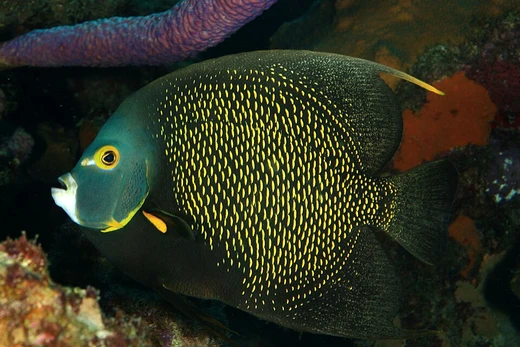
Golden angelfish
A shy, omnivorous reef fish with golden bars and a dark eye ring.

The golden angelfish (Centropyge aurantia) is a small, reef-dwelling marine fish from the family Pomacanthidae. It is also called the golden pygmy angelfish or velvet dwarf angel. Its body is reddish orange, covered with many thin, wavy golden vertical bars. The dorsal, anal, and tail fins have several dark bands near their edges, and a dark blue ring surrounds the eye. The dorsal fin has 14 spines and 16–17 soft rays, while the anal fin has 3 spines and 17–18 soft rays. This species reaches a maximum length of 10 centimeters (3.9 inches).
The golden angelfish lives in the western Pacific Ocean, from eastern Indonesia through Papua New Guinea and the Solomon Islands, east to Fiji and Samoa. It also occurs as far south as Australia, where it has been recorded at Carter Reef off Queensland. It prefers areas with coral reefs and rocky outcrops, often hiding in crevices surrounded by sponges. An omnivore, it eats algae, detritus, and invertebrates. This shy fish is rarely seen by divers and lives at depths of 3 to 20 meters (9.8 to 65.6 feet).
First formally described in 1974 by John E. Randall and Richard C. Wass, the type locality is Pago Pago Harbor, Tutuila, Aua Reef in American Samoa. Some authorities place it in the subgenus *Centropyge*. Its specific name *aurantia* means "orange," referring to its overall color. The golden angelfish is uncommon in the aquarium trade.
Quick Facts
- Taxon
- Centropyge aurantia
Facts from the source article.
Lore & Background
The golden angelfish was first formally described in 1974 by John E. Randall and Richard C Wass, with the type locality given as Pago Pago Harbor, Tutuila, Aua Reef in American Samoa. Some authorities place this species in the subgenus Centropyge. The specific name aurantia means 'orange', referring to the overall colour of this fish.
In appearance, the golden angelfish is an overall reddish orange marked with numerous vertical thin sinuous golden bars on its flanks. The dorsal, anal and caudal fins have a few dark submarginal bands, and the eye is encircled by a dark bluish ring. The dorsal fin contains 14 spines and 16–17 soft rays, while the anal fin has 3 spines and 17–18 soft rays.
This species is found in the western Pacific Ocean, ranging from eastern Indonesia through Papua New Guinea and the Solomon Islands east to Fiji and Samoa, and as far south as Australia where it has been recorded at Carter Reef off Queensland. It inhabits areas with many coral reefs and rocky outcrops, often hiding in crevices surrounded by sponges. It is an omnivore, feeding on algae, detritus and invertebrates. A shy species, it is only infrequently observed by divers, and occurs at depths of 3 to 20 metres.
Reader's Guide
The golden angelfish is a small marine angelfish of the family Pomacanthidae, first described in 1974 from American Samoa. Its distribution spans the western Pacific Ocean, from eastern Indonesia to Fiji and Samoa, including Australian waters at Carter Reef. The species is notable for its shy behavior and infrequent observation by divers, as it inhabits coral reefs and rocky outcrops, often hiding in crevices surrounded by sponges. It is an omnivore, consuming algae, detritus, and invertebrates. The golden angelfish attains a maximum total length of 10 centimetres and is rarely found in the aquarium trade. Its specific name aurantia means 'orange', reflecting its overall reddish orange coloration with thin sinuous golden bars. The fish has a dark bluish ring around the eye and dark submarginal bands on the dorsal, anal, and caudal fins. Some authorities place it in the subgenus Centropyge. The species is not widely known outside scientific and specialized aquarium circles, and its rarity in the trade underscores its limited interaction with humans.
Did You Know?
- It is found at depths of 3 to 20 metres (9.8 to 65.6 ft).
- The golden angelfish is rarely found in the aquarium trade.
More in Marine Angelfish 1-24
Spotted an error? Know more?
Reader corrections go straight into our review queue. Suggest an edit · How this site is sourced