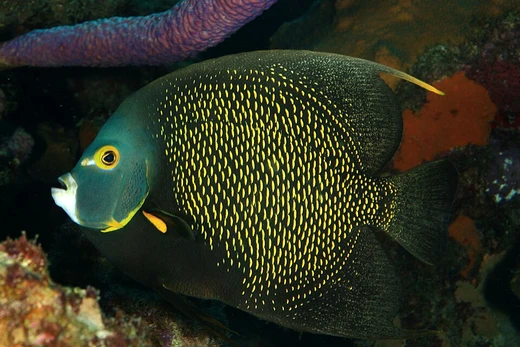
Flameback angelfish
A small marine angelfish with a blue body and golden-yellow back.

The flameback angelfish (Centropyge aurantonotus) is a species of marine ray-finned fish, a marine angelfish belonging to the family Pomacanthidae. It is also known as the flameback pygmy angelfish, Brazilian flameback angelfish, Caribbean flameback angelfish, or fireball angelfish. It is found in the western Atlantic Ocean and is popular in the aquarium trade.
Quick Facts
- Taxon
- Centropyge aurantonotus
Facts from the source article.
Lore & Background
The flameback angelfish has an oval, deep and laterally compressed body with a short, blunt snout and a small mouth. It has a long, robust spine at the angle of the preopercle with vertical margin serrated, and two large rear-pointing spines behind the bone below the eye. Its body is mainly blue, with the head and dorsal region bright golden yellow, and a blue ring around the eyes. The caudal and anal fins are dark blue with many black spots. It attains a maximum total length of 7.5 centimetres (3.0 in).
It is found in the tropical western Atlantic Ocean, from the Lesser Antilles and Curaçao along the northern coast of South America from Venezuela to southern Brazil, and has been recorded in the eastern Atlantic at São Tomé. It inhabits areas of reef and rock rubble at depths between 15 and 300 metres, and may be common around isolated patches of staghorn coral. It feeds on algae and sponges. Like other angelfish, it lays pelagic eggs and has pelagic larvae.
The species was first formally described in 1974 by Warren E. Burgess, with the type locality given as off Oistins in Barbados. In some classifications it is placed in the subgenus Xiphipops. Its specific name is a compound of aurantia meaning 'orange' and notus meaning 'back', referring to its golden-orange back.
Reader's Guide
The flameback angelfish is notable for its striking coloration—a mainly blue body with a bright golden-yellow head and dorsal region—and its relatively small size, reaching only 7.5 cm in total length. It is a marine angelfish of the family Pomacanthidae, found in the western Atlantic Ocean from the Lesser Antilles and Curaçao to southern Brazil, with an additional record in the eastern Atlantic at São Tomé. The species inhabits reef and rock rubble at depths of 15 to 300 metres, and is also common around patches of staghorn coral. Its diet consists of algae and sponges, and it reproduces via pelagic eggs and larvae. The flameback angelfish became popular in the aquarium trade, and during the 20th Century thousands were exported from Brazil. Its scientific name, Centropyge aurantonotus, was given by Warren E. Burgess in 1974, with the type locality off Oistins in Barbados. The specific name refers to its orange back. In some classifications it is placed in the subgenus Xiphipops.
Did You Know?
- It has a blue ring around its eyes and dark blue caudal and anal fins marked with many black spots.
- Thousands of flameback angelfish were exported from Brazil for the aquarium trade in the 20th Century.
More in Marine Angelfish 1-24
Spotted an error? Know more?
Reader corrections go straight into our review queue. Suggest an edit · How this site is sourced