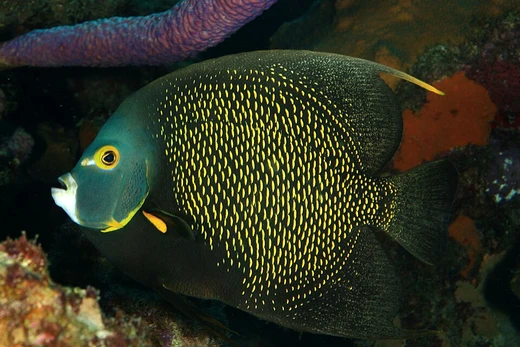
Flame angelfish
A bright orange-red marine angelfish from Pacific Ocean reefs.

The flame angelfish (Centropyge loricula) is a marine angelfish from the family Pomacanthidae, inhabiting tropical Pacific waters. It goes by other names such as flame angel, flaming angelfish, and Japanese pygmy angelfish. Its body is bright orange-red, marked with a vertical black spot and four or five bars on the sides, while the rear of the dorsal and anal fins display alternating short purple-blue and black bands. Fish from the Marquesas Islands lack these vertical black bars. Males tend to be larger and slightly more colorful than females. This species has a lifespan of 5–7 years or more.
The flame angelfish is found across various reefs in Oceania, most commonly around the Marshall, Line, and Cook Islands, and less frequently in the Hawaiian Islands. It typically inhabits the foreslopes of coral reefs and clear lagoons.
In the wild, its diet is varied, consisting of algae and crustaceans. While some individuals live long lives in reef aquariums, many die unexpectedly as they age. This may be because many Centropyge species feed mainly on plankton as juveniles and switch to an adult diet later. An underfed fish may need to “test” new foods. For this reason, flame angelfish are often added to well-established tanks and fed frozen mysis shrimp or meaty crustaceans like shrimp and clam.
In captivity, they eat brine shrimp, mysis shrimp, other meats, spirulina, seaweed sheets, and pellets, and they reportedly favor tuna and table shrimp. They are shy when first introduced to an aquarium, especially smaller specimens, but become confident within a week and graze on live rock during the day. They are generally considered reef safe, as they adapt quickly to a captive diet, which usually prevents them from eating soft or stony corals. Individuals that do pick at coral or clam mantles are often underfed.
Breeding in captivity has occurred, with successfully captive-bred specimens offered by Atoll Farm Aquaculture in Thailand. In the wild, flame angelfish are haremic and can be kept in pairs or trios in a very large aquarium, with only one male per tank. Males have more blue on the outer edges of the dorsal and anal fins and are larger. Spawning happens near the end of the day, releasing pelagic gametes into the water column. They are broadcast spawners, releasing eggs and sperm simultaneously at dusk as they rise to the top of the water.
Quick Facts
- Taxon
- Centropyge loricula
Facts from the source article.
Lore & Background
The flame angelfish's coloration is bright orange-red with a vertical elongated black spot and four or five bars on the sides, the posterior part of the dorsal, and anal fins, with alternating short purple-blue and black bands. Specimens from the Marquesas lack the vertical black bars. Males are generally larger and slightly more colored than females. In the wild, the flame angelfish has a varied diet consisting of algae and crustaceans. It is known to be shy upon introduction to an established aquarium, especially smaller specimens, but within a week it will gain confidence and is then constantly seen grazing around live rock during the day. The flame angelfish is often considered reef safe, though individual specimens that pick at coral or clam mantles are more often than not underfed or undernourished.
Reader's Guide
The flame angelfish is notable for its striking coloration and its presence in both wild reefs and home aquariums. In the wild, it is found on the foreslope of coral reefs and clear lagoons across Oceania, most commonly in the Marshall, Line, and Cook Islands, and less commonly in the Hawaiian Islands. Its life span is 5–7 years or more. In captivity, it feeds on a variety of food including brine shrimp, mysis shrimp, and other meat as well as spirulina, seaweed sheets, and pellets; from personal experience they favor tuna and table shrimp. The flame angelfish has been known to spawn in captivity, with successfully captive bred specimens offered by Atoll Farm Aquaculture in Thailand. It is haremic in the wild and can be kept in pairs or trios in an extra-large aquarium, with only one male. The fish spawn toward the end of the day, releasing pelagic gametes into the water column; collecting the eggs and raising the larvae is the biggest challenge. The flame angelfish are broadcast spawners, releasing eggs and sperm simultaneously at dusk, rising into the water column to release them at the top.
More in Marine Angelfish 1-24
Spotted an error? Know more?
Reader corrections go straight into our review queue. Suggest an edit · How this site is sourced