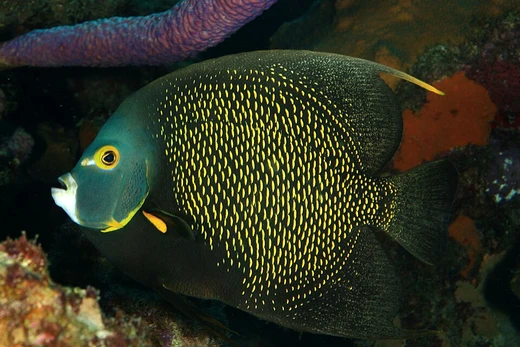
Chaetodontoplus ballinae
Endemic to eastern Australia, this angelfish has unique coloration within its genus.

Chaetodontoplus ballinae, the Ballina angelfish, is a marine angelfish from the family Pomacanthidae. It is found only in eastern Australia.
This fish has a pearly-white body marked by a black band that crosses the back and lower part of the dorsal fin. The front of this band extends down as a bar over the base of the pectoral fin. Its lips are black, and a dusky vertical bar runs through the eye. The anal fin, upper half of the dorsal fin, and pelvic fins are white. The eye, the first few spines of the dorsal fin, the caudal fin, and the pectoral fin are yellow. It grows to a maximum length of 20 centimeters.
The Ballina angelfish lives in the southwestern Pacific Ocean off eastern Australia. It has been recorded at widely separated sites, including Stradbroke Island in southern Queensland, and in northern New South Wales at Coffs Harbour, Ballina, Evans Head, North Solitary Island, and Seal Rocks. It also occurs around Lord Howe Island in the Tasman Sea.
It inhabits subtropical waters at depths between 15 and 120 meters, found on deep coastal offshore reefs and around sea mounts. It is relatively numerous near Balls Pyramid off Lord Howe Island, where it can be seen in deeper habitats with large boulders, rock piles, peaks, caves, and crevices. Balls Pyramid is almost the only place where this species has been photographed. Little is known about its biology, though it has been recorded in pairs or alone.
The species was first formally described in 1959 by Australian ichthyologist Gilbert Percy Whitley, with the type locality given as off Ballina Bar in New South Wales. Its specific name, *ballinae*, reflects this location. Its colour and patterning are unique within the genus *Chaetodontoplus*.
The IUCN classifies *Chaetodontoplus ballinae* as Least Concern. It does not appear in the aquarium trade because it has full legal protection in Australia. It is subject to some bycatch by fisheries.
Quick Facts
- Taxon
- Chaetodontoplus ballinae
Facts from the source article.
Lore & Background
Chaetodontoplus ballinae was first formally described in 1959 by Australian ichthyologist Gilbert Percy Whitley, with the type locality given as off Ballina Bar in New South Wales. The specific name ballinae reflects this locality. The species has a pearly-white body broken by a distinct black band across the back and lower part of the dorsal fin, with a bar reaching over the base of the pectoral fin. The lips are black, and there is a vertical dusky bar through the eye. The anal fin, upper half of the dorsal fin, and pelvic fins are white, while the eye, front few spines in the dorsal fin, caudal fin, and pectoral fin are yellow. Its colour and patterning are unique within the genus Chaetodontoplus.
Reader's Guide
Chaetodontoplus ballinae is endemic to the southwestern Pacific Ocean off the coasts of Eastern Australia, recorded from widely separated localities including Stradbroke Island in southern Queensland, Coffs Harbour, Ballina, Evans Head, North Solitary Island, and Seal Rocks in northern New South Wales, as well as around Lord Howe Island in the Tasman Sea. It is found in subtropical areas at depths between 15 and 120 meters, inhabiting deep coastal offshore reefs and sea mounts. The species is relatively numerous near Balls Pyramid off Lord Howe Island, where it can be observed in deeper habitats with large boulders, rock piles, peaks, caves, and crevices. Ball's Pyramid is almost the only place where the Ballina angelfish has been photographed. Little is known about its biology, though it has been recorded in pairs or as solitary fishes. It has been classified as Least Concern by the IUCN, does not appear in the aquarium trade due to full legal protection in Australia, and is subject to some bycatch by fisheries.
Did You Know?
- The Ballina angelfish reaches a maximum length of 20 centimeters.
- It is found at depths between 15 and 120 meters.
More in Marine Angelfish 1-24
Spotted an error? Know more?
Reader corrections go straight into our review queue. Suggest an edit · How this site is sourced