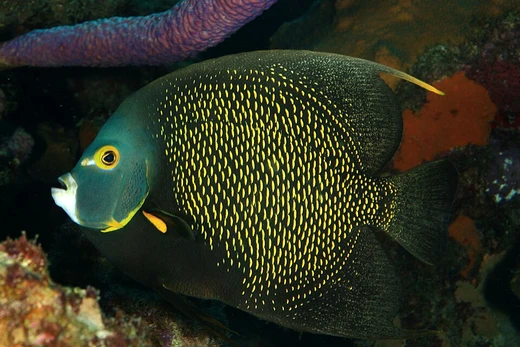
Centropyge vrolikii
A sex-changing marine angelfish from the Indo-Pacific.

The pearlscale angelfish, also called the half black angelfish, is a marine fish in the Pomacanthidae family. Its body is pale grey to brown, with whitish scale centers that turn black toward the tail. The gill opening and base of the pectoral fin are orange, and the tail fin, along with the rear parts of the dorsal and anal fins, have a blue edge. The dorsal fin has 14 spines and 15–16 soft rays, while the anal fin has 3 spines and 16–17 soft rays. It reaches a maximum total length of 12 centimeters.
This species lives in the Indo-Pacific, from Christmas Island east to Vanuatu and the Marshall Islands, north to Taiwan, and south to Lord Howe Island. Off Australia, it occurs near northwestern Western Australia, the northern Great Barrier Reef in Queensland, and as far south as the central coast of New South Wales.
Found at depths of 1 to 25 meters, it inhabits lagoons and seaward reefs, especially where coral is dense. It is common on rocky or rubble substrates with rich algae and sponge growth. Mostly herbivorous, it feeds on filamentous algae and also sponges. It can change sex from female to male: if a harem lacks a male, one female transforms. Juveniles of the mimic surgeonfish (Acanthurus pyroferus) imitate this angelfish.
Pieter Bleeker first described it as *Holocanthus vrolikii* in 1853, with the type locality being Ambon Island. The species name honors Dutch anatomist Willem Vrolik. Some authorities place it in the subgenus *Centropyge*. Where it overlaps with *C. eibli* and *C. flavissima*, it hybridizes with them.
Common in the aquarium trade, it does not tolerate ionic copper medications well. It is advised to use only ionic copper treatments or a gentler method like the Hybrid Tank Transfer approach.
Quick Facts
- Taxon
- Centropyge vrolikii
Facts from the source article.
Lore & Background
Centropyge vrolikii was first formally described in 1853 by the Dutch physician, herpetologist and ichthyologist Pieter Bleeker as Holocanthus vrolikii, with the type locality given as Ambon Island. The specific name honors the Dutch anatomist and pathologist Willem Vrolik. Some authorities place this species in the subgenus Centropyge, and where they are sympatric, it will hybridize with C. eibli and C. flavissima.
The species has a pale greyish to brownish body marked with whitish scale centers that darken to black towards the tail. The gill slit and base of the pectoral fin are orange, and the caudal fin along with the posterior part of the dorsal and anal fins have a blue margin. It attains a maximum total length of 12 centimeters. It is found at depths between 1 and 25 meters in lagoons and seaward reefs, most frequently in areas of dense coral growth, and is common where there is a rock or rubble substrate with rich algal and sponge growth. It is largely herbivorous, feeding on filamentous algae and also on sponges. This species is able to change sex from female to male: when there is no male in a harem, one of the females changes sex. Juveniles of the mimic surgeonfish (Acanthurus pyroferus) mimic this angelfish.
Reader's Guide
Centropyge vrolikii is common in the aquarium trade, but does not tolerate ionic copper medications very well. It is recommended to use ionic copper treatments only, or rather, a less harsh procedure such as the Hybrid Tank Transfer method. Its range extends from Christmas Island in the west to Vanuatu and the Marshall Islands in the east, north to Taiwan and south to Lord Howe Island. In continental Australia it also occurs off north-western Western Australia and on the northern parts of the Great Barrier Reef of Queensland, as far south as the central coast of New South Wales. The species' ability to hybridize with related species where their ranges overlap adds to its biological interest, and its mimicry relationship with the mimic surgeonfish highlights its ecological role in reef communities.
Did You Know?
- Centropyge vrolikii can change sex from female to male when no male is present in a harem.
- It hybridizes with Centropyge eibli and Centropyge flavissima where they are sympatric.
- The species was first described by Pieter Bleeker in 1853 from Ambon Island.
More in Marine Angelfish 1-24
Spotted an error? Know more?
Reader corrections go straight into our review queue. Suggest an edit · How this site is sourced